Leverage—the Real Power of Priestcraft

archimedes

by Michael Maciel

The world cannot be changed one person at a time. That would take far too long. No, we need leverage, the kind of leverage only God can provide.

Ask yourself, “What am I praying for? What, by my actions, my words, and my beliefs, am I asking God to do?” Do you have a vision for how the world should be, or are you in reaction mode? Have you succumbed to the notion that we are plunging into chaos, or will you switch on the engines and power away from the cataract?

You know, the Will of God can be summarized in this one, simple way:

God’s will is that you get your prayers answered.

That’s it. The whole purpose of this Earth Experience is to figure out what you want, what you will settle for, and what you can envision. That’s the entire curriculum. Will you rise to the challenge, or will cynicism and resignation take you (and the rest of us) down?

Make up your mind. Formulate how you would like the world to be. Write the script on your forehead, and stand in the Holy Place, that part of you that is in direct communion with God.

And then tell God exactly what you want.

Posted in Lessons | 5 Comments

Understanding the Priesthood

sunset

by Michael Maciel

In order to understand the Priesthood, we have to go back to basic Holy Order of MANS teachings about one’s personal atmosphere—that field of energy around each person’s body that is encoded with the thoughts, feelings, and experiences of an individual’s earthly existence. I have come to feel my own atmosphere as my “presence,” meaning, for lack of better words, the effect I have on the world around me in an energetic sense—not like a mechanical force field so much as a field with personality. Everyone has this, although they might not be aware of it in a way that lets them also see it in others.

Once you do, however, it becomes possible to offer it up as a vehicle for higher beings—those humans who have evolved beyond the need to be here on the earth plane—so that they can impart their spiritual energies and consciousness through your atmosphere/presence to those humans who are in need, whether those needs are physical or spiritual, which I have come more and more to see as the same.

Giving oneself up as a vehicle for a higher being is precisely what Jesus of Nazareth did, only the Being that used him was the Christ Being, or the Lord of the Sun. This idea might sound foreign to some readers, but it makes perfect sense to me, not because I learned it in the HOOM, but because everything I know as a human being on this planet tells me that the Sun is the source of all life, and not just as a blind force but as a living conscious presence, full of intelligence and personality.

When I was ordained a priest, it was through and by the authority of Jesus AS Christ (I like that better than simply “Jesus Christ,” because it better describes who and what he is). Jesus AS Christ conveys the reality of the greater being of The Christ working through the personality of the human person of Jesus. After being ordained, I began to become more and more aware of Jesus AS Christ showing up in my atmosphere/presence, especially while serving communion, which I have come to understand as the best way to grow and develop this relationship with this particular being.

The communion is an ancient ritual, preceding Jesus of Nazareth by hundreds if not thousands of years (no one really knows how long), which was appropriated by early Christians as a sacrament. It acts as a vehicle of sorts through which Jesus can “communicate” his life energy and presence to people on the Earth plane through the mediation of a priest. This energy isn’t “his” so much as it is the One for Whom he mediates, namely the Christ Being, the Lord of the Sun.

If the term “Lord of the Sun” bothers you, which it does most people, please bear in mind that we’re not talking so much about that massive star at the center of our solar system as we are the spiritual body of the Sun, the one that fills and permeates the entire system in which we live.  Every living thing bears its imprint—from the molecular level all the way to the level of consciousness. Science is discovering every day how and why this is true, although they use different names for it.

So, to understand the Priesthood is to understand the way the Christ Being, working through Jesus AS Christ, who in turn works through the atmosphere/presence of the priest (whether male or female, by the way) for the purpose of being a channel of grace to everyone living on the Earth plane.

This is the “function and purpose” of the Priesthood. One can aspire to it if one feels so called, but the actual hook-up, so to speak, has to come from above. It is not an earthly institution, although it is specifically designed to function in the Earth plane. It is an “initiation,” which means that your entire life will be different—forever. Once you have it, the presence of God becomes a part of your presence, so much so that people can sense that there is something different about you, even if you’re not wearing some kind of identifiable garment or insignia.

But just know that the motivation for becoming a priest must come from the heart—from the soul, actually—manifesting itself as an intense desire to serve all people everywhere, not just those of your own family or clan. It’s not like becoming a politician where you represent only certain interests over others. You become a universal servant in every sense of the word.

Posted in Lessons | 2 Comments

“Faith without works is dead”—what’s up with that?

by Michael Maciel
sorrowOne possible way to look at “Faith without works is dead”:
Believing a “truth” (or even knowing it) doesn’t do any good, unless we do something to move ourselves closer to realizing it.
For example, believing (or knowing) that “we are all one” doesn’t bring us the experience. The experience comes as a result of acting as if we are all one.
One way to do this is by exercising self-control in our private thoughts and feelings. Since we are all one, there is no such thing as “private”—what we speak in the closet will be shouted from the rooftops.
Another way is to examine our thoughts and feelings to determine whether they originated with us or came from someone else. If “we are all one” is true, then it would stand to reason that the line between our thoughts and feelings and the thoughts and feelings of others is, more often than not, blurred.
This is especially true (if the logic of this premise is correct) in our reactions to people and events. I would wager that most of our reactions come pre-packaged, that we step into them, and then experience the reaction as our own.
The pre-existence of these states of mind and feelings is both spiritual and physical—spiritual in that they are “in the air,” so to speak, and physical in that (through evolution) they are hardwired into our brain. The more people react in the same way to a given event, the more likely we are to have the same reaction. Mass-media is based on this principle. It teaches us by example how we should react to events, pubic figures, and commercial products.
Just something to think about.
Posted in Lessons | 2 Comments

The “I am God” Trap: Part 3


icarus

by Michael Maciel

Those who have never fallen are not afraid of heights. They have a kind of reckless courage when it comes to failure, not because they are brave, but because they have never failed. This is especially true in the world of spiritual development.

Amongst spiritual teachers, you will find many who have made terrible mistakes. They have hurt people and damaged the reputation of  their tradition. Those who have made such mistakes and have come back from them are usually the wiser for it. But those who have avoided mistakes because they haven’t had time yet to make them (or worse yet, those who simply deny that any mistakes were made) can be blissfully unaware of the Razor’s Edge they walk upon. As in politics and any other area of public life, the old adage holds true: the bigger they are, the harder they fall.

There are some spiritual teachers who believe that they are so special, so gifted and talented—so “enlightened”—that they can do no wrong. When they make a mistake, it’s the students’ fault, never their own. Their students were either too undeveloped to understand, or they had slipped over to the dark side, had become possessed by evil spirits, or were simply unwilling or too weak to complete their training. But never is it the teacher’s fault. Why? Because the teacher, in his own mind, is God.

This way of thinking is not restricted to the world of spiritual development. It shows up everywhere. If an organization or institution cleaves to a particular doctrine, that doctrine, for all intents and purposes, is God. Anyone who feels exceptionally aligned with that doctrine will naturally elevate themselves above everyone else in their group.

“God,” in this case, is the over-arching principle, regardless of what that is. For some, the over-arching principle is nationalism; for others, it’s family; still others place their religion above everything else, or science, or certain political ideologies. No matter what it is, all such “Gods” represent the highest reality to those who worship them, and whoever among them who feels that they have been to the mountaintop will see themselves as the embodiment of that God.

(I am intentionally capitalizing the word “God” here, because for the kind of person I’m talking about, these things are not “gods,” as in idols, but “God,” as in supreme being. As far as they are concerned, these are the highest principles to which anyone can aspire. Human beings tend to deify their highest conception of reality, regardless of how limited it is.)

What I’m talking about here is not a spiritual experience, but rather an elevation of the ego. It begins with a spiritual experience, but it ends with an inappropriate self-identification with the experience. The “self,” in this case, is nothing more than the ego.

None are more susceptible to this kind of self-deification than those who have highly developed intellects. When everyone around them appears less intelligent than they are, they quite naturally feel superior to them. In their own eyes, they are the light-givers, the saviors, the Good Shepherds. Everyone else is a sheep. Theologians are especially prone to this. Scientists, too.

For these people, “initiation” equates with deep insight into their particular intellectual milieu. Revelation is comprised of their “aha” moments. But in reality, initiation has nothing to do with intellectual insight. Initiation is experiential and can happen to anyone, regardless of how educated they are.

This cultural bias towards education-based knowledge is the primary driver of the worldwide discrimination against women. Why? Because women easily get bored with tables of endless facts, whereas men usually find them intriguing. The mistaken notion amongst men is that the more facts you have, the wiser you are. Women seem to instinctively know that this is not only wrong, it is dangerously wrong. Facts tend to empower the individual, whereas wisdom empowers the community. And women are hands-down more interested in the wellbeing of the community, not in the exaltation of an individual.

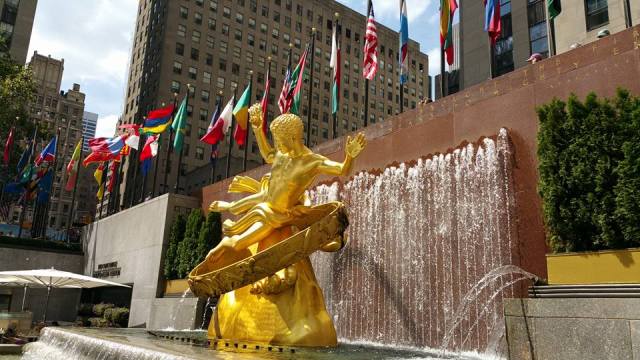
prometheus

A few months ago, I had lunch at the outdoor restaurant in Rockefeller Plaza in New York. Above the seating area is a large statue of Prometheus the Fire Thief. Prometheus stole fire from Olympus and gave it to humanity, similar to the way Adam stole the knowledge of good and evil from the forbidden tree in the Garden of Eden. Both stories depict the temptation of the intellect to make itself equal to God. They were written as a warning by spiritual teachers who lived in the ancient world, the ones who knew and understood human nature.

There is a saying amongst spiritual teachers: the ego is the first thing to be attracted to the spiritual path but the last thing to let go. While you yourself are probably not interested in wielding power over your fellow human beings, there are plenty of people for whom this is the primary reason for “finding God.” So when someone gets up on a soapbox and proclaims, “I am God,” consider the source. Is it God speaking through this person, or is it the person speaking through “God”?

Posted in Lessons | 3 Comments

Further notes on “The Razor’s Edge”

by Michael Maciel

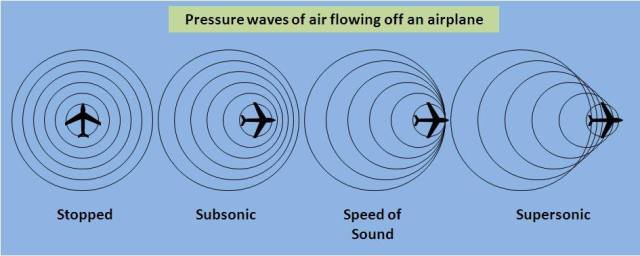
sound barrier

The principle of the Razor’s Edge is a simple one: breakthroughs require focused energy, which makes them inherently dangerous.

The first person to break the sound barrier, Chuck Yeager, feared for his life when his plane, the X1, started vibrating violently as it approached the maximum compression of the air in front of it. This is analogous to the maximum resistance to change that we experience just before we break through into “higher” states of awareness. This is what Jesus was talking about when he told his disciples that they must follow “unto death.” It’s the same kind of “death” as the egg experiences when the chick breaks it from within.

chicken

The mind is the most entropic component of a human being. It has to be in order to preserve continuity of awareness. Therefore, spiritual development is largely about hacking the mind, making it do what it doesn’t want to do, namely change. This is why candidates for mystery training are screened so rigorously—students have to be relatively stable before they can do the exercises safely.

The brain (which includes the entire nervous system) is the physical counterpart of the mind, so as the mind changes, so does the brain. When a teacher encounters a student who is erratic, either mentally, emotionally, or physically, he will automatically slow down the rate of change, meaning that he will give the student time to adjust to the changes that are taking place within him.

This is why Jesus said, “The secret of the kingdom of God has been given to you. But to those on the outside everything is said in parables, so that they may be ever seeing but never perceiving, and ever hearing but never understanding; otherwise they might turn and be forgiven!” “Forgiven,” in this sense, is to be released from the process of pressurization that is required for change. People “on the outside” are those who haven’t reached the point of maximum compression in their spiritual development; they haven’t come face-to-face with their “crisis,” or “cruces,” their “cross.” So to let them off the hook prematurely would not be in anyone’s best interest.

yeager

“Golgotha,” the site of the crucifixion, means “place of the skull.” Yeager reached his “golgotha” right before the X1 broke the sound barrier. It scared the shit out of him. He had never experienced anything like that before, even though he had been a test pilot for many years. The violent shaking made him think that his plane would disintegrate at any moment.

This is analogous to the way we sometimes feel like our life is falling apart as we approach a major shift in our spiritual awareness. People tend to find God at the end of their rope. And any significant breakthrough feels like “finding God,” because the change is so dramatic, and therefore “ultimate.”

If we resist the change, our head can feel like it’s going to explode, and many ill-prepared students experience this (metaphorically) and abort their spiritual quest, sometimes for the remainder of that lifetime—yet another reason for caution in vetting candidates for spiritual training.

This is why Jesus is portrayed as a passive victim in the story of the crucifixion. The lesson is one of non-resistance, not violent struggle. Spiritual students will often resist at different intervals in their training, but it’s the letting go that will slingshot them into some rather spectacular experiences—not insights, which are intellectual in nature, but real somatic and visionary experiences. In short, they get their minds blown. Insights come later.

These are just more things to consider while contemplating this idea of “I am God.” Spiritual realization is both an art and a science. We don’t “get there” by simply saying the words, just as a chick doesn’t hatch by simply visualizing itself on the outside of its shell. It takes work, and lots of it.

Posted in Lessons | 3 Comments

Beware the “I am God” Trap

by Michael Maciel
razors edge
This warning is for all of us. It is a general principle that governs everyone who sets foot on the spiritual path. In fact, the farther along on the Path one travels, the more important the warning becomes.
Throughout the ages, mystics and priests alike have referred to the spiritual path as the Razor’s Edge, a reference to the sharp ridge of a mountain that leads to its summit. One misstep in either direction can plummet you to your death.
It’s a metaphor for holding the tension of the opposites. On the one hand, we can say, “I am God,” and on the other, “I am human,” with all the frailties and sinfulness that implies—the sacred and profane wrapped up in one package.
No one likes to be condemned or to feel like there’s something wrong with them. The slightest accusation of that will make anyone defensive, because deep down we all know that we are God.
09 hermitBut here’s the truth, and it’s perhaps one of the greatest truths ever given in sacred scriptures throughout all lands and times. It’s a truth that everyone who has ever approached the summit of the mountain of spiritual attainment knows most intimately:
Freedom from condemnation comes through being utterly condemned.
Fundamentalists, the really thoughtful ones (and believe me, there are some) take great offense at the New Age statement, “We are all God.” They hold one side of the tension of the opposites. They know instinctively that unless both sides of that tension are held faithfully, the Razor’s Edge will take you down.
New Age fundamentalists (and believe me, there are some) are just as adamant in their faithfulness to the other side of the equation. They refuse to be called “sinners.” They refuse to be called anything but “Sons and Daughters of God.” They say, “I am perfect just as I am.”
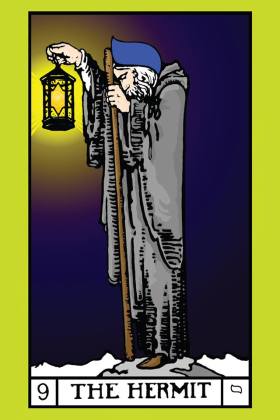
But those with mystical training see themselves as both. They know that either side of the equation, taken alone, invites disaster. Like the Hermit in the Tarot, they stand on the summit, but they keep their head bowed. It’s the LIGHT they hold that’s the holy thing, not themselves.
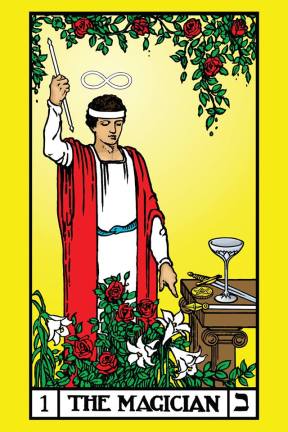
01 magicianAnd the Magician, though he stands proudly erect, knows from whence his power comes. It comes from above, not from himself. He holds the symbol of his power over his head, knowing himself to be the CHANNEL, not the source.
These two poles of the tension of the opposites stand like pillars at the entrance to the Holy Temple, the temple of initiation. Unless candidates can demonstrate that they can pass between them, without leaning on either one, they will not be allowed to enter.

“Being God” is tricky business. Lots of people have tried it and failed. They slip into megalomania and start proclaiming themselves avatars. They make people chant their names and throw flowers at their feet.

Ironically, being God has nothing to do with being yourself. This is the whole message of the Crucifixion: “He who loses his life will find it.” This doesn’t mean you have to die in order to know God. Neither does it mean that your ego has to die. It simply means that you have to be able to put your ego aside when the situation calls for it. You have to be able to create a space for others to shine, not just you.

Being yourself, trusting yourself, and overcoming the judgments of others is an essential part of the spiritual path, but it only frees us to set foot upon it. It isn’t the goal. The goal is the top of the hill, the crucifixion, where we let go of it all, where the ego says, “My God, my God, why hast thou forsaken me?”

pillars

The Middle Path

The name “Jesus Christ” is a mystical symbol—an equation: “Jesus” is our human identity; “Christ” is our divinity. “Jesus” is nailed to the Cross of Matter. It is “Christ” who rises from the sleep of death, infusing the body with life. This is the Word made flesh, the union of the opposites of Spirit and Matter.

The spiritual path is for rebels only. No one is celebrated for leaving the path of others. It is the flight of the alone to the alone. In the end, all of our rebelliousness comes to a laser point of intensity, that point where we finally rid ourselves of the tyranny of “me-ness.”

Therefore, it is never wise to proclaim, “I am God.” Never. We can know it, but we never proclaim it, because the second we do, we are at great risk. This is the “tricky” part I alluded to earlier. It is a warning to us all. And when I say “us,” I mean everyone who ever has or ever will set foot on the spiritual path.
“Don’t you believe that I am in the Father, and that the Father is in me? The words I say to you I do not speak on my own authority. Rather, it is the Father, living in me, who is doing his work.”
– John, 14:10
Posted in Lessons | 7 Comments

Notes on 666

horsemen

by Michael Maciel

Notes on 666:

6 is half of 12, which is the number for wholeness or the state of being complete.

When a number is tripled, as in 666, it indicates a kind of exponential power. In this case, it denotes a universal or general “principle.”

In 666, only the physical (instinctual/intellectual) mind is acknowledged. It means “worldly minded,” the mentality that denies the existence of the “unseen” and that rejects metaphysics and theism.

The Book of Revelation has been described as a roadmap for those who have accepted the teachings of Jesus Christ and are now endeavoring to incorporate them into their lives. It is a text for those who have stepped foot on the spiritual path, not those who are still in the process of deciding whether they should.

Consequently, those who have accepted the teachings are now in the throes of transformation, and this is where all hell breaks loose—Armageddon.

The “beast” is all of the worldly-mindedness in ourselves that must give way to spiritual-mindedness. And this can be a real struggle.

This is an inner “war,” not an outer one, although there’s nothing that says that civilizations can’t go through (or mirror) the process of transformation of an individual. This has happened many times throughout history every time a major shift in consciousness takes place.

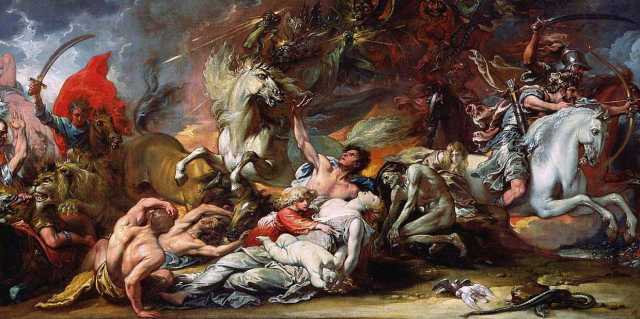
The Four Horsemen of the Apocalypse:

White horse: our spiritual nature
Red Horse: our emotional nature
Black Horse: our intellectual nature
Pale Horse: our physical nature

It doesn’t take much to see that these four elements of ourselves—in their un-transformed state—are our chief “adversaries.”

Posted in Lessons | 2 Comments

How to Worship a REAL God

worship-1

by Michael Maciel

We live in a great being. Should “great being” be capitalized? It should if we were to use it as God’s name. But as names go, it’s not a very good one. Too cold, too “scientific,” and too limiting. But nonetheless, “great being” is a good descriptor for what God is. And it gives us a way to make God real in our lives.

God is not the universe, although there is a certain majesty in that. The sheer infinity of it is awe-inspiring. And its complexity is marvelously intoxicating to ponder. But science has kind of ruined it as a literal God by the way it reduces it to vast, cold, empty space, filled with intermittent hot gasses, whirling nuclear furnaces, and enigmatic black holes. Black holes. Who could worship that?

But just as God is not the universe, neither is the universe “the universe.” Not really. Every year, we learn something new about it. It is never the same in our understanding or our imagination. Just when we think we know what it is, we’re told that there are multiple iterations of it – the multiverse. If, then, we say that God is the universe, we are left with the conclusion that there are multiple Gods. If one God is unfathomable, how much worse would multiple Gods be?

And yet, there is one thing that we know about the universe that makes it useful in the way we worship God: it’s alive! And not just alive in the same way that protoplasm is alive, but alive in the sense that we are alive. Just like us, the universe is intelligent and imaginative. Imaginative? Just look at the bizarre deep-sea creatures, the ones that look like ghosts and neon lights. If that’s not imaginative, I don’t know what is. Clearly, the universe is capable of imagining the unimaginable.

Is God a person, or is God a thing? This is the perennial question. Things are hard to worship, and persons are too…well, personal. We’re too used to thinking of other persons as being separate from us. And if they’re separate from us, it’s all too easy for them to be absent. Over-personifying a deity can be deeply problematic.

If we fixate on God as a person, it’s very hard to feel empowered. It tends to make us see our own personhood as somehow flawed and insufficient, which makes any kind of intimate relationship impossible. Unless, of course, you’re into being dominated and mistreated. Seeing God as an all-powerful person (with the emphasis on “all-powerful”) becomes the perfect recipe for feeling perpetually persecuted.

And God-as-person always seems to take on the look and feel of a parent. Not that there’s anything wrong with that. But who among us had perfect parents? Anyone? If we see God as a parent (whether father or mother), we wind up projecting all of our hurts and disappointments on Him or Her. It’s inevitable. Add to that the insidious terror of being abandoned, and you cannot avoid resenting God altogether.

One thing we can safely assume: nothing is as it appears to be. This doesn’t mean that the refrigerator is actually a cow or that physical substance is somehow unreal. No, what it means is that things are deeper than they appear. Everything in this world (ourselves included) is but the tip of the iceberg. Everything (ourselves included) seems to emanate from within itself, a kind of radiance that is alive, intelligent, and imbued with intention. Not intention as we normally understand it, but intention as in “purpose.” Everything fits. Everything, in the broadest sense, is in its native environment. Where else could it be?

When we contemplate this, it becomes clear that we too are in our native environment. We are in the universe, not merely on or of it. This is where we are. It is where we have our being. We become aware that this is our home. But not the “this” that is apparent, but rather the deeper “this,” the part of reality that extends far below the threshold of our conscious selves. It is from this deeper part of us that God emerges. It’s as though the universe is inverted. The entire thing is within us, right here inside our being. We don’t have to go anywhere to find it. We carry it around with us everywhere we go. It is existentially impossible to be separated from it.

Only when we drastically change our perspective, as I’m describing here, can we hope to enter into a real relationship with God. We cannot worship the infinite with a finite mind. Until we find the infinite within ourselves, we cannot worship God. The only thing we can do is worship an idea. And that’s no kind of worship at all.


Posted in Lessons | 4 Comments

Why Be Good?

Washing-machine

by Michael Maciel

Like a washing machine, our lives can be seriously out of balance as long as we’re just plodding along. But when our circumstances change, such as entering into a new relationship, a new job, or moving to a different city, our pace of life increases dramatically, and our imbalances become amplified. The washing machine starts walking across the floor, destroying everything in its path and eventually shakes itself apart.

There’s a saying that people tend to find God at the end of their rope. It’s in the face of utter failure that we discover who we really are. There’s no more solid a place to stand and find one’s footing than rock-bottom. But such events are usually the catalysts that bring us to the spiritual path. They should never happen as a result of having set foot upon it.

It is for this reason that spiritual schools have throughout history demanded strict moral development of their students, that they be able to demonstrate superior levels of self-control. Because once the energy of spiritual practice kicks in, it’s too late to make those in-depth adjustments, the imbalances that heretofore could be safely ignored. When the spin cycle begins, all hell will break loose, so it’s better to begin the process of spiritual acceleration with the most pressing adjustments already in place.

This is why obedience to the teacher is so important, why renunciation and strict adherence to the rules of your practice are so critical to your success. When your teacher tells you to do something that you don’t want to do, do it anyway. When you know you should be meditating, meditate, whether you feel like it or not. By working against your “natural” inclinations, you bring that which is out of balance into balance, and your further spiritual development is assured.

Posted in Lessons | 1 Comment

A Lotto Prayer

Lottery Balls

“And all things, whatsoever ye shall ask in prayer, believing, ye shall receive.” Matt. 21-22.

My friend Jeff wanted to win the lottery. It would be the answer to all of his prayers, he thought, and he daydreamed about it constantly. A solid middleclass blue-collar worker with two healthy children and a loving wife, he considered himself fortunate, but couldn’t help thinking how nice it would be to have a lot of money. He could see himself paying off the mortgage, maybe getting that fishing boat he’d been longing for, and, of course, a year off for travelling wouldn’t be bad either. Life would be so easy — no bills, no hassles, and no stress. What a dream! Who in their right mind wouldn’t want that?

Then he started thinking how having that much money would change the way others saw him and how his friends and relatives would want a handout. He would have to say no, of course, to most of them, and would probably alienate everyone. After all, most lottery winners take their cash in yearly stipends, not all at once. And with prices going up all the time, what seems like a fortune today could become merely a sufficient income tomorrow.

Costs have a way of escalating. Getting a nicer home would mean higher mortgage payments. A larger house would require more furniture, which needs more upkeep. Getting an extra car would mean getting more insurance. He would want to send his kids to college, and they would need cars too, along with a myriad of other things. There just wouldn’t be that much to go around. He would have to put his immediate family first. Everyone else would have to fend for themselves, just like he had been doing all along.

Jeff and his wife always put family first. Both their parents lived nearby, and they needed more and more help as they got older. He had two brothers; she had a brother and two sisters. None of them had gone to college, and all of them were in about the same boat financially as they were. If he helped his parents, would his wife think that he was being unfair to hers? The family politics were complicated enough without adding a pile of money to the equation. And even if he did have enough to meet everyone’s needs, did he really want to set himself up as godfather, making all the decisions about who got what? God Almighty! How could he possibly make everyone happy?

Friendships were important to Jeff, too. Most of his buddies had gone to high school with him, and some went all the way back to grade school. He had always felt awkward around rich people, because he had the bad habit of trying to impress them, thinking that they might give him money or at least some valuable advice. What would his life be like if he never knew what his friends’ motives were? Would he be loved only for his money? Would his friends be nervous around him, and would they continually be asking him for things? They were all great people, but they would have to be extraordinary not to start seeing him as either their personal banker or someone who was purposely denying them help when they needed it.

Jeff also believed that if he suddenly became wealthy he would have to associate with those whose incomes matched his own, and he didn’t particularly like those people. They seemed pretentious and shallow. And anyway, they would never accept him as an equal, no matter how much money he had. After all, they had gone to college, had professional careers, and came from wealthy families. He was unlike them in every way.

Obviously, Jeff had opinions about rich people. He had been schooled in the daytime soaps-the rich were self-indulgent and led reckless lives. Husbands and wives always cheated on each other. Divorces were frequent and often violent. Their kids were cynical and usually wound up on drugs, became pregnant, or both. For Jeff, being wealthy meant that you were decadent, narcissistic, and bored. And you could never trust anyone, not even your spouse.

Life for the rich, he believed, was all about “getting yours”. How could anyone who lived like that ever enjoy the simple things in life, the things that really matter? If he was rich, would he become obsessed with getting more and more money, the way he thought wealthy people were? Would his kids become spoiled and get into trouble? Would he become suspicious of his wife? These scenarios were frightening. No amount of money was worth losing love and happiness over!

Were any of Jeff’s opinions about rich people true? He knew they probably weren’t. But deep down, he felt that if he suddenly came into a lot of money that he would lose his place in the world. The newly rich usually make fools of themselves, he thought, through conspicuous consumption. And though people envy them, no one really likes them. No, there was just too much about being rich that he either didn’t trust or didn’t understand. He realized that he had it pretty good right where he was and decided that being wealthy wasn’t for him.

All of this didn’t stop Jeff from daydreaming about winning the lottery, but now he knew it was just an idle fantasy and not what he truly desired. Life might not be bed of roses, but he had his family and his friends. This was the kind of wealth he could accept wholeheartedly. His life was a perfect demonstration of what he was actually praying for. Top on his list was a loving family and lots of friends with whom he could relax and be himself. This is exactly what he had. He was in complete control. Having money, in his mind, would jeopardize everything.


The Lesson

Once we learn that prayer works, we feel that we must immediately set about getting our prayers answered. There is a feeling that we should ask for the things that everyone else on our block is asking for, such as health, wealth, and happy children. What we don’t realize is that there has never been a time in our life when we haven’t been praying, that the patterns of acceptance woven into the fabric of our day to day living are indeed our prayers. Our actions mirror the conditions that we will accept and the conditions that we will not accept. The truth of this is reflected in the saying, “You are always exactly where you need to be.” Merely changing our actions, besides bringing us face to face with our resistance, will not by themselves effect any lasting change. We have to look closely at our “bottom line”, those deeply held, sometimes subconscious beliefs that motivate us to do the things that we do.

Are all rich people obsessed with money? No. In fact, the opposite is usually true — it’s when we’re broke that we become obsessed with money! As Mark Twain said, “Money isn’t everything, as long as you have enough of it.” The lack of money breaks up more marriages than being wealthy does. But these were Jeff’s beliefs about what it means to be rich. Our beliefs about money are powerful regulators of how much of it we allow to come into our lives.

Possessions work the same way. We are successful when we own what we have, not just on paper, but in our heart and mind as well. Pursuing things we don’t really want, simply because we think we should, is the same as going into debt, only spiritually. And regardless of how much of the material things of life we possess, we can only have as much as we are comfortable having. As long as our possessions do not interfere with the things that we really value, such as love, family, and friendship, we can have as much or as little as we want.

The fact is, we always have exactly as much as we are willing to accept. Sometimes we think we want much more than we actually do. When we think about it, really think about it, we find out that money and possessions might not be the things that we are actually praying for.


Putting the Principle into Practice:

Here is an exercise that I know you will find helpful. It’s called “Fasting from Acquisitiveness”. It is the deliberate reversal of the desire to acquire more money and possessions.

Here’s how it works: each morning when you wake up, say to yourself, “I have enough”. Briefly review the things that you have, your money, your possessions, and your relationships. Create the feeling (pretend) that all of these things are more than sufficient to fulfill your desires. Allow your heart, if only for a moment, to feel satisfied. Then forget about the exercise and start your day.

At night, as you’re falling asleep, say to the Infinite, “Thank you.” Again, mentally encompass all that you have – “select all” like the computer menu says – and create the deepest feelings of gratitude that you can muster. Allow your heart to touch, if only for a moment, the hem of the garment of perfect gratitude. Then drift off to sleep.

Do this morning and night for twenty-one days. This will effectively establish the pattern of perfect fulfillment. After all, if there’s no pattern for perfect fulfillment within you, how will you ever experience it?

The feelings of gratitude and satisfaction are independent from the circumstances of your life. In other words, you can feel grateful without having to feel grateful for a particular thing. You are simply allowing your heart to have the feeling without attaching the feeling to an external object. Likewise, the act of saying “I have enough” allows the mind to accept this new idea.

Remember that our mental environment is saturated with the message, “You need more!” This keeps the race going — both the rat race and the human race. We counterbalance this extreme position with another extreme position — “I need more” with “I have enough”.

Our inner pendulum of desire is constantly swinging between the extremes of frustration and satiation. Only when the pendulum comes to a standstill do we find the Stillpoint of Buddhism, the “I shall not want” of the 23rd Psalm, and the Peace of Jesus Christ.

“When the mind is quiet and the heart is still, the doors of perception are cleansed, and we see the universe as it is – infinite.” (William Blake)

Posted in Lessons | 1 Comment