Humility – Getting Real

Through the Green Fuse

Unless humility can be explained in terms of power, force, and energy, it can be of little use to us in our quest for Self-realization. We have to find out what it is, actually. If it motivates a movement of the Spirit, we need to know how. Spirit is real – it has energy, it is capable of producing effects in our lives, it heals people. It is not a theological concept, though many have tried to make it that. We need more. If Spirit is real, we need to know how it works, and humility is the key.

If you can sense the power of God, if you have a sense of life as energy in action and not just a set of circumstances, if you’ve had the experience of seeing the world pregnant with possibility, bursting from within with the urge to demonstrate itself in outward manifestation, if you know it as the “force that through the green fuse drives the flower,” then you know that Spirit is real. It is not just energy, it is also intelligence, it is sentient, and it pours itself into the world in a way that can only be called love. Whether we are conscious of it or not, Spirit is always working, always expressing. It does so because it has to; moving into form is its very nature. Once we know this about it, our most natural reaction is to want it to move towards us. Once we know that God is real and not just a concept, once we know God and not just believe in God, we want the experience, and we want as much of it as we can get. And when we have it, we want to share it, because sharing it increases its power. The more power it has, the more we can experience it, so we share it as much as we possibly can.

As a word, “humility” has lost nearly all of its meaning, because it does not address the aliveness of God. If we saw God as the source of Life, we would rush toward God with eagerness. But the word “humility,” the way it is used today, would have us crawl toward God in shame in a kind of reverse egotism that would deny the flow that is God’s will to bestow upon us. The Spirit cleans everything it touches, so why feel shame? Shame and humility are antithetical to each other. Shame is a clever dodge of the ego to keep the ego in play. In order to be truly humble, shame has to go.

Humility is the expectation of a movement of the Spirit. It doesn’t try to force that movement; it knows the movement will happen. It knows the same way a catcher knows that the ball is going to land in his glove. He doesn’t even have to think it, because he IS it. The way you can tell if a person is truly humble is by the way he expects God to act. Certainty is the hallmark of humility.

Posted in Lessons | 2 Comments

The Five Vows – Humility

It would not be wise to assume to know what humility is. It would not be, well…humble. The state of not knowing is powerful. More rightly said, the state of not knowing is a source of power. But unless humility is recognized as a source of power and not valuable in and of itself, say as a “virtue,” which makes no sense at all, because why would not knowing be virtuous, unless it led to something empowering?

For example, the scientist who admits to herself that she’s not seeing the whole picture is in a much more powerful position than she who thinks she knows what she’s looking at. (All the best scientists are humble.) In this case, the power lies in being open to something new, no matter how much it might fly in the face of what is already known. The same applies to our spiritual searching – for are we not scientists also, seeking to know what’s real?

It’s one thing to say, “I don’t know.” It’s quite another to put yourself into a state of not knowing so that the real can show up. To say, “I don’t know” only amounts to a negative, self-limiting prayer when it fails to take that stance as a means of “pulling” the truth out of the Cosmic Mind. What good would it do to be humble if it only kept you ignorant?

Saying “I don’t know” may be appropriate for a novice, because it puts one in a receptive frame of mind. It makes you teachable. But the mature Christian mystic seeks his or her wisdom from within. Here is where humility becomes a tool, not as a means to boost one’s ego, but to raise one’s consciousness to a higher level. “Nature abhors a vacuum.” Not knowing turns the mind into a vacuum, a vacuum which must be filled.

“Not this, not that,” says the Buddhist practitioner. When the mind jumps in with an “answer,” the wise meditator says, “Not this, not that.” The mind then says, “Well, how about this?” to which the wise meditator says, “Not that either.” Eventually, the field of mind is cleared, and the truth comes bursting in.

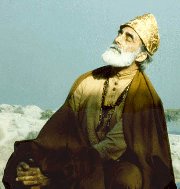
Murshid Samuel Lewis and Father Paul Blighton

Murshid Samuel Lewis and Father Paul Blighton

When a person of high consciousness, one who also has the authority to administer vows, gets in touch with the reality of humility and then escorts another into that same state of consciousness – one who has stated his or her intention to experience it – then the Holy Spirit moves, and the vow is placed on that person’s soul, not as a burden, but as a blessing, a pattern of power that will aid and assist that person in their journey toward God-realization.

God’s consciousness flows into the world like water into a garden. The energy of Spirit is raw, undifferentiated, it cares not who is just or unjust, but rather gives to all alike. It nurtures souls according to their need, bringing to fruition their deepest, most fervent desires. To be humble is to get out of the way of the process and let it work. God knows what to do. And people who have attained to the consciousness of humility live in a state of constant wonder and amazement at the miracles taking place all around them.

Exercise: Pick any ordinary object, say an apple. Look at it for a full minute, then ask your mind, “Is this an apple?” The mind will say, “What, are you kidding? Of course it’s an apple!” But being rule-bound as all minds are, it has to take your question seriously. So it digs deeper. It throws out all of the assumptions and categories into which apples have been placed and seeks a wider and deeper context in which to interpret the object called “apple.” All of a sudden, the apple no longer looks like “just an apple.”

If you do this exercise right, you will be amazed at what you haven’t been seeing. The mind likes to think in words. When you challenge those words, it forces the mind to reconsider, to re-examine the thing it has been taking for granted. After using this technique on common, ordinary objects for awhile, you might want to turn it on “yourself.” Look in the mirror and ask, “Am I a human being?” This will open some doors, believe me. Depending on your stamina, you will see things about being that may surprise you. And if you’re humble, you won’t take it personally.

__________________________________________________

Note to subscribers to The Mystical Christ:

New articles automatically show up in your inbox in a ready-to-read format, but going to the website is a much richer reading experience. Just click on the underlined text, and you will be switched over to the site itself.

If you are on Facebook, please “share” The Mystical Christ so that your friends will have the opportunity to check it out. If you like it, odds are they will too.

Thank you for being a subscriber!

Posted in Lessons | 2 Comments

Vows – Why Take Them?

There is power in taking a vow. It may not seem like it, given that so many vow rituals are treated as though they don’t really matter, just a formality, or something nice to do. Or they might be thought of as simply a promise one makes to God, as though the person taking the vow is the giver and God the receiver. This would be like trying to stuff electricity into a wall socket – clearly a misunderstanding of the principles involved.

Another common misperception of vows is that they derive their power from consensus; by stating your intention in front of witnesses, it somehow strengthens your resolve. But this too misses the reality – the power to perform does not come from them, nor does it come from your desire to live up to your word. Power is there, but it doesn’t come from you, and it doesn’t come from another person, although it can come through another person, as long as that person is of high consciousness and knows how to get out of the way and let grace do its work.

So, what is a vow? Let’s start by saying that it is more of a verb than a noun – a vow is an action, not a thing. Yes, there are different names ascribed to vows, but the action in all of them is the same. If we can understand the action, we can understand what the action does.

It is important to get what “action” is. It is perhaps the most important distinction to make when it comes to understanding God and Spirit. Action is power manifesting as energy moving from a source to a receiver. The application of energy upon a receiver is called “force.” So, you have three elements: power, energy, force. Force, semantically speaking, is neutral – a rolling ball striking a wall exerts a force upon the wall; it is not “forcing” the wall to do something the wall doesn’t want to do. Some words, like “negative,” have taken on a negative connotation, which unfortunately obscures their scientific meaning. Force, in the context in which we are speaking, means “energy applied,” nothing more.

Along with the word “action,” there is another word crucial to understanding vows. Unfortunately, I don’t know what that word is ; ) Some might call it “reality,” but that word, like “love,” has many different meanings. When someone says, “I love you,” it has a different meaning from when they say, “I luv you.” You get what I mean. When something is “real,” we mean that it is a part of God, some aspect of the Divine that is all-pervasive, all-inclusive, and eternal. “Reality,” for the sake of this discussion, does not mean my reality or your reality. It means that which is real to God.

Things that are real to God appear archetypal to us – over-arching, abstract, non-specific – like love. The word “love” is a general term to us, but for God it is highly specific. Love is either present, or it is not. Love is a part of God’s being; it is interwoven into the fabric of reality. It is not a concept. So, if we know this about love, and we have actually experienced it, we can enter into the reality of love as though we were entering an energy field – an energy field that is alive and sentient (like you). Being a part of God, when we experience the reality of love, we are experiencing the reality of God.

Noor Inayat Khan

Remember the three-part principle of power, energy, and force? Well, if a person has gotten in touch with the reality of love, then that person becomes a channel of love for other people. Through the connection we all have with each other, the real displaces the unreal, the energy moves from an area of higher concentration to an area of lower concentration. And if a person is receptive to this flow of energy, a force will be applied. In other words, a transformation will take place.

Pir Vilayat Khan

Pir Vilayat Khan

Transformation is key to taking vows. Otherwise, why take them? But like the words “love” and “reality,” transformation has been transformed into something different from its spiritual meaning. “Transformed” is usually thought of as changing into something new, whereas in its spiritual context it means changing back to the way God originally conceived you. It is a kind of washing clean the encrusted self in order to reveal that which was there all the time, only hidden. It is a return to one’s own Divine Nature.

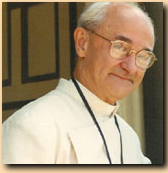
Father Paul Blighton

Father Paul Blighton

So, here are the keywords: vows, action, reality, sentient energy field, transformation, restoration (return). When a person of high consciousness acts as a channel for God to immerse a willing person in the real energy of God’s own being, the person receiving the blessing is cleansed of the false energy patterns created by years of illusionary thinking and behaving. A vow is a blessing. It is a movement of divine energy that bestows grace upon the receiver, enabling him or her to overcome the inertia of the sensory world, and enlivening the divine spark within.

In subsequent articles, we will discuss the different kinds of vows (using the word as a noun again) and further misconceptions, such as vowing yourself to an organization or to another person, which is something we should never attempt to do.

Posted in Lessons | 1 Comment

Bible Interpretation

by Michael Maciel

Visit my new YouTube channel, The Mystical Christ with Michael Maciel

The mythologist, Joseph Campbell, after studying the religions of the world and their folklore, discovered that only one story was being told—The Hero’s Journey. Basically it is this: a young seeker of truth leaves the safety of the known and ventures into the unknown, against the warnings of his elders and sometimes in transgression of the law. Through numerous acts of heroic self-sacrifice, he obtains certain knowledge and experiences and brings them back for the benefit and development of his people. More often than not, the hero is born of a virgin, killed by the authorities, and rises from the dead. His dead body becomes food for the salvation of his people, and his blood, let into the earth, vivifies all of nature. Incidences of this story are almost too numerous to count, and most of them occur before the time of Jesus.

Hero's Journey

George Lucas was inspired by Joseph Campbell’s The Hero With a Thousand Faces when he wrote Star Wars

This approach is called the mythic interpretation of the Bible. Along with the historical approach, which takes everything in the Bible literally, it constitutes one of the two most popular methods for interpreting Holy Scripture. But, there is a third way. According to Annie Besant in her Esoteric Christianity, there is the mystical approach. In the mystical approach to Bible Interpretation, Jesus’ life is not merely a parallel to other world saviors and avatars, it describes the path that every human being must take in his or her spiritual evolution. In this form of interpretation, Jesus is you. Every step along the way is symbolic of what we must go through to escape sense-bound consciousness and realize the Christ within us.

Annie Besant

Annie Besant, author of Esoteric Christianity

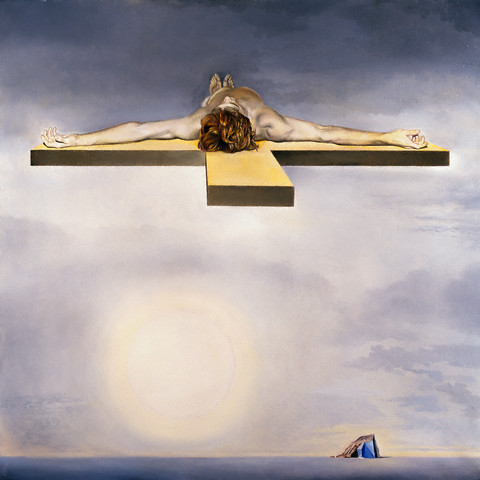
In the mystical interpretation of the Bible in its cosmic dimension, Christ crucified on the cross is “Diety becoming enveloped in matter, the becoming incarnate of the Logos, the clothing of God in ‘flesh'” (Besant). In the dimension of human evolution, Jesus is the prepared candidate for spiritual initiation having gone through the baptism, the temptations, and the purification through trials so as to be a fitting vessel for God-consciousness. Jesus becomes the everyman and Mary the everywoman. The biblical accounts of the events of their lives, the characters they encounter, and the trials they must endure are the same events we must all experience, in fact do experience, whenever we set our foot on the spiritual path. And as we experience the “incarnation” in our own flesh, we recapitulate the cosmic drama of God taking on the “flesh” of matter.

Salvador Dali "Crucifixion - Christ of Gala"

Salvador Dali “Crucifixion – Christ of Gala”

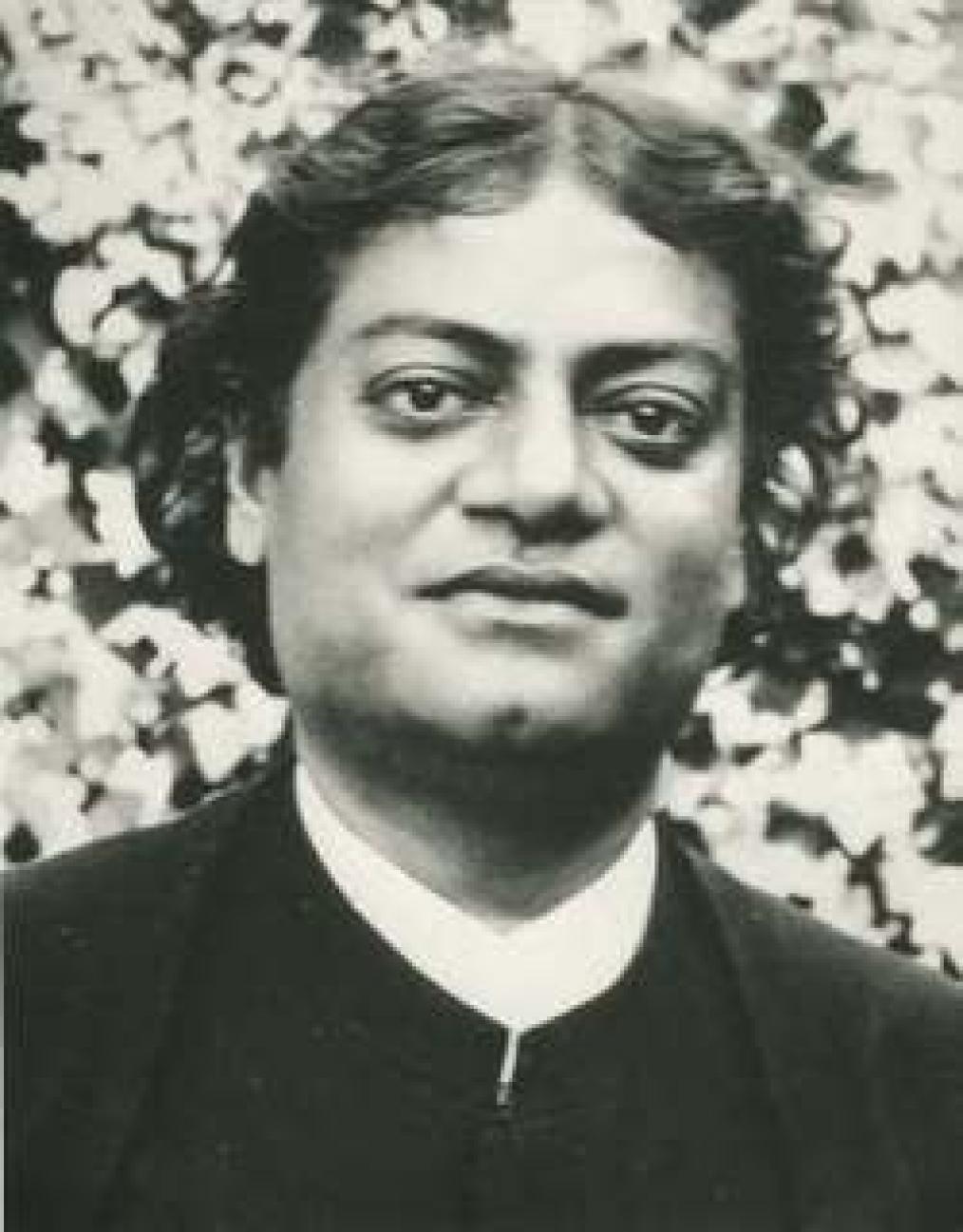
Considered thus, the body of Jesus nailed to the cross becomes Spirit affixed to matter. No one on the spiritual path feels at home on the earth; all have the distinct feeling of being a “stranger in a strange land.” This is the basis for Buddha saying, “All life is suffering”—the limitations of matter are painful to Spirit. The crown of thorns placed in mockery on Jesus’ head at his trial represents the “turning about of the Shakti,” where the outward pointing nimbus of an earthly crown is turned inward, signifying rulership over oneself rather than a king’s rulership over his subjects, thus symbolizing control of one’s own thoughts—one of several prerequisites for spiritual initiation. The great Hindu sage, Swami Vivekananda, said, “He who conquers self conquers all,” and Jesus said, “Be of good cheer, I have overcome the world”—John 16:33. The goal of the spiritual path is the transformation of consciousness from mundane to divine—the raising of the dead.

Swami Vivekananda

Swami Vivekananda

When we see that the Story of Jesus is the story of us on the spiritual path, and we learn to read the events of his life as the stages of development towards spiritual initiation, then we can read the Bible as it was intended to be read. The authors of the New Testament were Initiates of high caliber; they knew the steps along the Way, and they used the events of the life of their Teacher to illustrate the roadmap that we all use in our quest toward God-realization.

Visit my new YouTube channel, The Mystical Christ with Michael Maciel

Posted in Lessons | 4 Comments

The Wild and Wonderful World of Spiritual Exercises

Consciousness in the brain

If you are new to the idea, concentration exercises are the necessary prerequisites to a successful meditation practice. In fact, if you are having difficulty meditating, it could be that you are missing some of this foundational work. While you might think that you do plenty of concentrating at your job and probably don’t need to do more of it in your spare time, just remember that even strenuous physical labor is no substitute for a good cardio-vascular program. Musicians, writers, ball-players, dancers – all benefit from their specific exercise routines. They are essential to mastering your discipline.

Concentration exercises are not really “spiritual” exercises. They are essential, but any process that requires your undivided attention for at least fifteen minutes is an exercise in concentration and will give you the benefits of a focused awareness. Playing chess, composing music, jumping rope, playing tennis, giving a speech – these are all legitimate ways to improve your ability to meditate, because a mind that can concentrate is a powerful instrument, regardless of what it is engaged in.

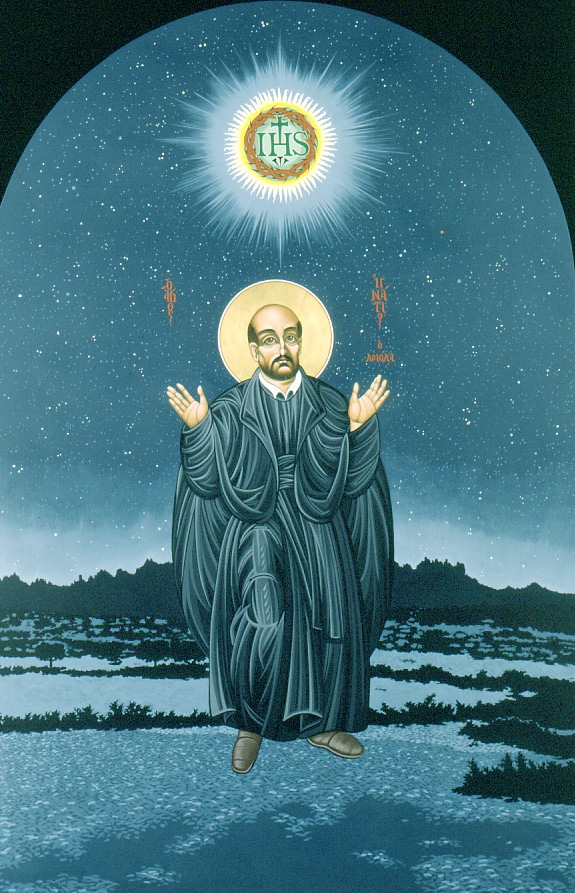
Ignatius of Loyola

The Orange Concentration Exercise is perhaps better than most exercises in that it incorporates universal symbols while at the same time utilizing the mind’s native functions of inductive and deductive reasoning. Check out the Orange Exercise in Exercises.

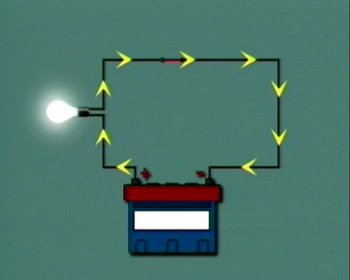
Spiritual exercises are different from concentration exercises in that they generate a movement of Spirit. In order to do a spiritual exercise, you have to have first acquired concentration skills; the orange and candle exercises are very useful for this. But spiritual exercises are designed to bring you into the experience of the movement of the Spirit. The word “Spirit” means “God in action.” God is a sentient, living force that continually moves through Its creation. It is That without which nothing could exist. Just as an electronic circuit without electrical energy moving through it is as inert as a pile of wire, so is a mind without Spirit. God’s intelligence is everywhere, but in order to manifest life, It has to be focused. Otherwise, It exists only in potential. This is the function of mind. And a well-tuned mind is powerful indeed.

Here is a little-known spiritual exercise that demonstrates the movement of Spirit in a way that is not only practical but fun. It begins with a need. Think of a lost object that you wish to find, one that you know is within your vicinity but hidden. It should be an object you know the feel of, one you know well. Realize that this object, like all objects, makes a “sound.” All physical substances vibrate, and whether their vibrations can be detected by our eardrums is irrelevant, because our ears do not hear anything anyway; it is the auditory centers in the brain that “hear.” So by listening for something that is impossible to hear with your ears, you are instead listening with your brain. I used to work in a large shop filled with equipment and cabinets full of tools. Misplacing tools was a daily occurrence. I would use this technique all the time, and it never failed to work. I would fix the image of the tool I was looking for in my mind’s eye and isolate its “frequency.” Once firmly established in my consciousness, I would then walk right to its location.

Metal tools, such as wrenches and pliers, are particularly easy to find because they are metallic, and metal vibrates easily. It “rings” with the slightest disturbance, even the disturbance of mental attention. But you can use this technique to locate almost anything, even a location across town. Every location has its signature sound, its “character.” If you know what that is, you can tune into it, and your mind becomes a homing pigeon. But to do this, you have to be able to concentrate; you have to be able to filter out all unrelated thoughts and impressions. How do you know when you have this ability? It’s when someone speaks to you and you do not hear them, or when you look up and realize that an hour has gone by in what felt like ten minutes.

Try this out. Learn to detect energy as it moves through your consciousness. Become sensitive to its tracks the way a hunter tracks an animal. It is the movement of energy that makes this a spiritual activity and not merely a psychic one. Psychic activity works through mental impressions; spiritual activity is alive. “I am come that they might have life, and that they might have it more abundantly.” Jn 10:10

Posted in Lessons | 2 Comments

Spiritual Independence

by Michael Maciel

None of us can legitimately claim to be spiritually independent if we are consciously or unconsciously living in an illusion. It does no good to pursue enlightenment if it does not bring about real improvement in our lives in realistic ways. In terms of integrity, it would be better to be an activist—either political, social, or environmental—than it would to sit all day in meditation and behave as though we were separate from the rest of the world, believing that our actions have no real effect.

Here are a couple of principles to keep in mind. One is that at some point in your spiritual work, you will experience what some people call the Dark Night of the Soul. This is where you meet the maximum amount of resistance to change, where the ego makes its last stand, and where you’ll be most tempted to give up and go back to being “normal” life. In this sense, you could say that being on the spiritual path doesn’t look like it improves anything in your life. Instead, it makes it a lot worse!

But we know that it gets better for those who persist. Nothing of value ever comes cheap. So, by saying that your spiritual work must make real improvements in your life in order to be worthwhile, it should be clear that we’re not talking about personal levels of comfort but rather improvements that make a real difference in the human experience as a whole. And any reasonably intelligent person alive today knows that unless improvements are made soon, the future of this planet and all the life upon it is going to be very dark indeed. What each of us does spiritually must address this, or we might as well live as though there will be no tomorrow, because there won’t be.

The second principle is that the power to bring about change never comes by fighting against anything—it comes by fighting for something. There is more power in a positive vision than there is in being right about what’s wrong. Critics abound, but visionaries are rare.

That being said, the true visionary is not naive; he or she knows what the problems are. But instead of railing against them, they identify the solution and then go to work to bring it about. Instead of attacking greed, they live according to the principle of generosity. Instead of bemoaning pollution, they strive to keep their thinking clear. Instead of criticizing corrupt politicians, they seek to give more than what they are getting in return—in their job, in their social interactions, and in their relationship with the planet. This is working for change.

Okay…there’s a third principle. Consciousness. Always strive to see into the heart of the matter, no matter what it is that you are dealing with. Do you see problems in the world? What are their causes? When you think you know the answer, ask yourself if you are merely repeating someone else’s opinion or if you are truly seeing the truth. Chances are, you are letting someone else do your thinking for you.

The problems facing the world are extremely complex—from an intellectual standpoint. But they are very simple when seen through the eyes of Spirit. This is the kind of seeing we must all strive to attain. And when we attain it, we will never again blindly believe whatever someone else thinks we should do. Our perception of what the world needs has to come through our own spiritual understanding, and our response to it must be authentically our own.

We cannot depend on our senses to tell us what the facts are. We have to look within. Once we get the clear picture, then we can bring our vision out into the world and put it into action. Sigmund Freud believed that people make their decisions based on emotions, not facts. The entire culture bought into his vision hook, line, and sinker. And it has very nearly brought the world to irredeemable disaster. If we do not learn how to find the truth within ourselves—and soon—the world will come to an ugly end. At this point, it will take a miracle, but hey…we can do that.

Posted in Lessons | 2 Comments

Horse Latitudes

from Fraser's Folio .com

Rudolf Steiner said that during the Winter months spiritual energy flows into the earth, and in the Summer the direction reverses itself, much like breathing in and breathing out. In fact, everything in nature exhibits this kind of ebb and flow. The solar system itself is cyclic, even in its form, pulsating in rhythmic vibrations from the very large to the very small. It is logical to assume that our lives would do the same, and when we observe our experience, we find this to be true.

Each day has its introspective period, usually in the early dawn just before daybreak. This is the perfect time for prayer and meditation. Likewise with the year – the Winter Solstice calls us inward so that we can experience the higher vibrations of the spiritual plane and receive the influx of its energies. This schedule does not prevent us from going within at other times of the year; it simply gives us the benefit of a cosmic boost to our efforts. It is a propitious time to make significant progress in developing our consciousness of the higher worlds.

Our lives have other cycles, patterns of activity both inner and outer. Sometimes, we feel like our train is pulling up to the station beckoning us to get on board, and other times we feel like it has left us standing on the platform. We feel as though we have missed an opportunity, that we are left with nothing, that all is lost. The important thing to remember is that opportunity, as in all aspects of life, is cyclical. It may only knock once, but ironically, it does so over and over again. Just so in our spiritual life. When it feels like nothing is happening, when we are stuck in the doldrums, the Horse Latitudes, the tendency is to feel that all is lost, that all of our efforts have been for naught. We feel like we have failed, that we are not worthy to tread the spiritual path, and we meekly turn back to the world seeking old patterns we know all too well. This is the tendency, but wisdom dictates patience.

As the physical sun rises higher in the sky, our spiritual light seems to slip below the horizon. We continue our spiritual work, our prayer and meditation, but we know not to expect inner fireworks. And this is okay. The full light of day calls us into outer activity, to take care of business so that when days grow shorter and the spiritual sun begins its ascendency, we will be prepared to take full advantage of the opportunities for spiritual growth. But for now, perhaps the best thing to do is to get outdoors and enjoy the beauty of God’s Creation and not get too hung up on whether we are advancing spiritually to the satisfaction of our ego’s demands for perfection.

Here’s hoping you have a great weekend. Enjoy!

Posted in Lessons | 2 Comments

Blessing

http://www.dreamspell.net/LKS/art/dynamics/Blessing.htm

from Dreamspell.net

It is important to remember that a blessing is a real action, not a symbolic act. By real action, I mean one where energy flows and produces an effect. Blessings behave according to certain laws, laws that are similar to the laws of electricity. There must be a source of power, a conduit through which the power moves, and something that will receive the power and use it in a manifest way.

Electricity comes from a generator and travels through a wire to a transformer, which converts it into a usable quantity. From there it travels to a motor or some other appliance, which converts it into some form of force, whether motive, heat, or light. In order for electricity to flow, all of these elements must be present. Likewise, in order for a blessing to be real, these same elements must be present, although in their equivalent spiritual form.

When we administer a blessing, we must be connected to a source of spiritual power, preferably God. I say “preferably” because even though there is only one power in the universe, it can take many forms and occur at different levels, and not all forms are appropriate. For instance, when electricity moves through a copper wire, it produces a magnetic field, but when it moves through the element of a light bulb, or through certain gasses, it produces light. Magnetism and light are two different forms of manifestation, and they produce different effects. Spiritually, when power moves through our body, it produces a type of magnetic field, which can affect the magnetic field around someone else’s body, or around those bodies within our body called “organs,” which have magnetic fields of their own. When Spirit moves through patterns of thought, it produces light of various wavelengths, each having their own unique characteristics.

Spirit is power, and like electricity, it does not exist unless it is in action, except as a potential. In religious terms, Spirit in its potential form is the “Father;” the pattern or “circuit” through which it moves is called the “Son;” the energy produced by connecting the source or potential to the “world” through the pattern or circuit is called the “Holy Spirit.” For instance, the form of energy we call “life force” is the result of the knowing of God moving through the perfect pattern of intelligence we call the “mind of God,” connected with the physical substance we call “organic matter.” In scientific terms, Father, Son, and Holy Spirit are stated as “cause, medium, and effect.”
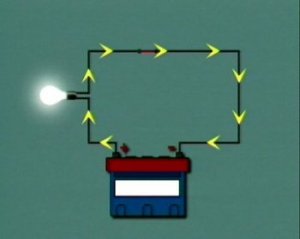
The reason why electricity and Spirit behave similarly is because both are manifestations of the One Power we call “God.” Electricity is a denser form of Spirit; it is Spirit as it manifests in matter. When considering electricity in this way, we have to be careful to avoid certain assumptions. Because electricity is so common in our lives, we think that we know what it is. The truth is that no one, not even the best theoretical physicists know what electricity is. They know what it does – they can detect it, measure it, and use it – but they do not know what it actually is. And because scientists do not like to use the word “mystery,” they avoid the question altogether, preferring instead to focus on the practical applications of electricity, not its inherent nature. This they send down the hall to the philosophy department, for which they have little concern.

Thought is the medium of Spirit. Patterns or “bodies” of thought seem to take on a life of their own, even those based upon false premises. As long as enough people think those thoughts, the pattern will exist, and it will exert some amount of “force” on the actions of those who engage with it. The so-called “mass-mind” is this kind of pattern. Therefore, it is possible for the energy within it to act as a “source” of power that when tapped into can produce tangible manifestations of energy. These are short-lived, however, because they require constant maintenance or “spin” in order to stay energized. But while they are energized, the power within them can be “bestowed” in a kind of blessing similar to those originating in Spirit. The mass-mind has its own priesthood to whom those who participate in that mass-mind look to for favors, and the blessings they bestow can feel real indeed. But the energy of those blessings are more akin to static electricity – a quick discharge producing a jolt but nothing that will live on its own.

There are many different kinds of mass-minds, each having their own built-up charge. Within each of these mass-minds are accepted patterns through which that charge can be dispensed to produce certain effects. And there are the participants who willingly provide their minds and bodies as “motors” to keep the whole thing animated. For instance, schools are mass-minds. They have a complex body of thought organized into logical patterns that are continually kept afloat through dialog and ritual. Similar to a living organism, they give birth to (matriculate) offspring in the form of graduates, who then act as missionaries, spreading the faith wherever they go. They do this with authority, because the aura or charisma of the energy of the mass-mind for which they are emissaries is tangible. When they endorse someone who is outside of their energy field, the differential creates quite a “pop,” a kind of blessing that lends reality to the body of thought they represent.

Some mass-minds are based on outright superstitions, depending on the vast unknowns of the subconscious mind for their aura of authority. They use patterns of thought more like suggestions, encouraging their participants to fill in the blanks with their own dark fears so as to lend to the illusion of a living organism. The motivation for keeping such a mass-mind alive can be not so much for power as for identity. In a universe that is perhaps more vast than comfort allows, a walled encampment can provide a kind of security otherwise not found. But, having its basis in fear, power then becomes the dominant theme, power to defend against the darkness of the unknown. The self-generated energy produced by spin (interpretation) can be inflicted upon others as a kind of curse, which the recipient drives home with his or her own power of belief. Thus we have “black magic” and its social equivalents, such as advertising and nationalistic fervor.

Until we experience blessing as a real action and not merely a symbolic act, we will be unaware of how the Spirit, and it counterfeits, move in our life. Part of being alive in God is knowing how God works – how power, force, and energy operate and how results are obtained. The effects we feel are quite real, but they have different points of origin that, when understood, give us a greater capacity for action and the power to discern those things that are truly alive.


Posted in Lessons | 3 Comments

Grace—what does it really mean?

Few words have been subjected to as much theological wrangling as the word “grace.” And all of the attempts to analyze and define it have done nothing to bring anyone closer to the experience.

It reminds me of a Saturday Night Live episode years ago where Dan Aykroyd parodied the then late-night talk show host, Tom Snyder. Playing Snyder, Aykroyd interviews the famous Blues singer, Ray Charles. He asks him in the overly earnest, pseudo-intellectual style that Snyder was known for, “Just what are the Blues, and who gets them?”

Indeed. Dan Aykroyd

We all have someone for whom we hold the highest esteem, someone whom we respect more than anyone else in the world. Imagine standing next to that person, feeling his or her full attention on you and expressing toward you an absolute affectionate regard. This person embodies your highest ideals, so their unqualified approval gives you an overwhelming feeling of affirmation. Your highest hopes become immediate possibilities; you feel as though you could accomplish anything. It is as though the entire universe is for you.

We have all had some version of this experience, whether a first-grade teacher, a grandparent, or maybe even Dan Aykroyd. Who knows? The point is, what did it feel like? What did it feel like to bask in his or her glow? And perhaps more importantly, what were the conditions that made the experience possible? Knowing the conditions will make the experience of grace available to you wherever and whenever you need it.

Of course, no one can create grace, just as no one can create electricity. But if we understand how electricity works, we can access it and benefit from its characteristics.

Placing your favorite person high above you, as in the examples above, creates a kind of potential energy. They are in a “high” place, and you are in a “low” place—the energy is going to flow towards you. This is why it is so important to hold God in your consciousness as an all-loving, benevolent being. If you see Him or Her as a punishing dictator probing you for every little (or big) thing you have ever done wrong, grace will be hard to find.

This kind of god is strictly the creation of theologians and has no resemblance to God at all. There is nothing so bad in your resume that will cause God to withhold love. Nothing. The only person who is withholding love is you, which only makes you want to hide. God’s only desire is to retrieve us from the mess we have created for ourselves. That’s it. Punishment, revenge, and hatred do not exist in the mind of God. These are things we have made up, and we have projected them onto God. Smite


What about karma? Don’t we have to “pay” for our wrongdoings? Unfortunately, the Law of Karma, as it is understood by Eastern mystics, has been corrupted by our notions of a wrathful god. More often than not, karma is a thinly veiled euphemism for revenge. “What goes around comes around,” means God is gonna get you for what you did to ME.

In actuality, karma is part of the Creator’s great love for us, in that it’s a teaching tool designed for our good. If our mistakes had no repercussions, we would never learn from them. The purpose is learning, not punishment. This is a profoundly different understanding of this universal law.

Connected

Connected

As in the example of your favorite person showering you with benevolence, you have to be in their presence in order to have that experience. To feel divine grace, you have to be in the presence of God. But usually, when you need it most, God’s presence can seem remote. This is where faith comes in (another grossly misunderstood word)—you have to know that God is there, and you have to know that there is not one shred of vindictiveness in God at all.

Faith is knowing, and like grace it comes from God. If God feels remote, imagine calling God on the phone. It would be kinda like calling Dan Aykroyd. You wouldn’t have to actually be in his presence to feel his love. All you need is the connection. Once that’s established, the power will flow. It has to.

Posted in Lessons | 3 Comments

Christian Mysticism and the New Economy

Someone said recently that if you’re not angry about what’s going on, you aren’t paying attention. There is no question that the world is changing, that the division between the wealthy and the poor is growing wider and deeper every year. People everywhere are working harder and for longer hours. The American Dream – you have to be asleep to believe it, as George Carlin said, but more and more Americans are waking up. And they are not happy. So, how are you as a Christian mystic choosing to respond to this “new economy?”

Obscene greed

There are two choices, in Christian mystical terms: 1) weeping and gnashing of teeth, or 2) standing in the Holy Place. Either you are going to rail against the injustice of it all, as so many throughout history have done, drive yourself into an anguished and cynical madness at the cost of your very soul, or…you are going to focus your spiritual energies on the things that really matter. What are those things? Your ability to love in the face of hatred, to be at peace with yourself while in the midst of war, to find it in yourself to forgive the most heinous acts of cruelty and depravity, and to hold yourself apart from the madness even while you engage with it, both in others and in yourself – these are the important things. Others may control your body, but no one can control your spirit, unless you hand it over to them.

Road rage

What will you do? Every time you walk out of your front door, every time you turn on the news, every time you surf the web – you will either react, as most people do, or you will act. Action, in Christian mystical terms, means knowing the truth. Action, in Christian mystical terms, means keeping your thoughts under your control, not surrendering them to every sound bite you hear or ad that you see. Action, in Christian mystical terms, means not judging – above all, not judging – your fellow human beings while they are being human. Your job as a Christian mystic is to be more than human, to forgive in the face of abuse, to forgive when others rage at you, to forgive even when they throw you out of your home. And what is forgiveness? It is letting go of your expectations and accepting things, and people, as they are, not as you would like them to be.

Lily Tomlin said, “Forgiveness is giving up all hope for a better past.” Focusing on what happened is far more empowering than asking what’s wrong. What’s wrong is that your expectations were violated; what happened was that someone was caught being human. Shame is a violation of expectation – either yours or someone else’s. Freedom from expectation is peace.

Equanimity in the midst of injustice

Activism is only powerful when it comes out of what you want, not what you don’t want. The mystical experience fills us with vitality and enthusiasm. How is it, then, that we react to the negatives of the world? Logically, we have to say that whenever we are in a state of reaction, we have moved out of the mystical experience. Mystical experience and reaction cancel each other out. They are inversely proportional to each other.

Posted in Lessons | 1 Comment