Intuition vs. Subliminal Messages

Let’s see if we can make the distinction between knowledge that is derived strictly from within ourselves and knowledge that is arrived at by the finer aspects of our physical senses.
Just as slipping the image of a Coke bottle into a film strip as a single frame will be invisible to the conscious mind but picked up subliminally by the subconscious, so do other signals, such as body language, micro-facial expressions, and nuances of color affect us and give us “feelings” or hunches about our environment. I might like one person when I first meet him, but not another. If you ask me why, I might not be able to tell you, only that I trust the one and not the other. I am picking up on subliminal signals that my conscious mind cannot adequately interpret, but which my subconscious can read like a book. Depending on how closely I pay attention to my “feelings”, my subconscious impressions can be very helpful.

Now, conventional psychology and western science in general claim that intuition, as a tool for determining what’s going on in our world, is entirely dependent upon input from the physical senses—not a pipeline to the mind of God. Mystics, on the other hand, claim just the opposite. So, let’s use the power of paradox to see if we can resolve the two claims. In order to apply the principle of paradox, we have to take each claim as an absolute truth, not as a relative truth, but an absolute one. In other words, the physical senses ARE the only means for acquiring knowledge, and the intuition IS universal in scope. Now these two claims are clearly contradictory. To the rational mind, they both can’t be true. But by using the principle of paradox, we can find a place where they are. To do this, we have to ask what third “fact” needs to be present to reconcile the two claims. This is kind of like the algebra rule that says if a = c, and b = c, then a and b must equal each other. Don’t worry—that’s about the extent of my knowledge of algebra, so we’re both safe. So, we’re looking for what else has to be true in order for both claims to be true.

For instance, we know that the eyeball doesn’t see anything—it only conveys information to the visual cortex of the brain. It is there that “vision” takes place. But we also know that we can “see” with our eyes closed, with our imagination. Science says that what we see with our imagination is not real, but this is actually a superstition on their part, because there is no hard evidence to prove that it’s not, at least not in every case. With them, you see, nothing is real unless it has been proven so. This is like saying that you are guilty until proven innocent, but that’s another story. All we need is one instance of “in”-sight that turns out to be true, one that is off the charts, statistically speaking, and that cannot be shown to have been derived subliminally, and science’s claim evaporates. Of course, we know of countless examples of this kind of knowing.

So, in order for the physical senses, which we know are located in the brain and not in the organs of perception, to be the only means of acquiring knowledge, AND for knowledge to be inherently unlimited in scope (everything is known), then all knowledge must reside in the brain. This is not as difficult as it might seem, no more than understanding how all radio stations can exist inside a radio. Science hotly denies this as a possibility, but again this is a superstition on their part, because there is no actual proof to the contrary. Huston Smith expresses this idea beautifully in his Forgotten Truth:

“Mechanists consider mind to be a part of the body, but this is a mistake. The brain is a part of the body, but mind and brain are not identical. The brain breathes mind like the lungs breathe air.”
All of this is a roundabout way of demonstrating how each of us has access to all knowledge. It also demonstrates that the brain is a very important mechanism and that whatever happens to it has a direct effect on that access. Therefore, learning and mental development are an important part of spiritual training – not learning more facts, necessarily, but by learning how to be receptive to new knowledge.

Things get a little bit esoteric at this point, both in a scientific sense and in terms of mysticism. According to the Heisenberg Uncertainty Principle, the very act of observation affects the outcome of an experiment, and as mystics we know that we are co-creators with God. These two concepts sound suspiciously the same to me. Normally, the theological concept of the act of creation gets shot down, because science says that something cannot be created from nothing. But this is an overly literal interpretation that confuses objects with principles. An analogy might be the way we can create an eddy in a stream of water by sticking our hand in it. The eddy is real, but it is not an object in the normal sense. Sticking our hand in the water is analogous to the Heisenberg Uncertainly Principle, because every time we look at something, we disturb it by interjecting ourselves into its “process”.

While the brain is important, it is only important here, in the physical part of the spiritual spectrum. But then, this is not exactly correct, because the brain is to mind as the eyeball is to the brain. Or, put another way, light is to seeing as seeing is to the one who is looking. In other words, mind is every bit as much a “mechanism” as the brain is, only it resides on a higher band of the spiritual spectrum. On that level, what we call “our mind” might be just as solid an object as the brain is here in the physical. It doesn’t have to be shaped like a brain, because on its own level, “shape” has an entirely different meaning. This is not that hard to understand. While the words I’m typing on my computer look like they have the same shape as the words in a book, their actual shape is no shape at all, but rather strings of electrical impulses within the CPU of my computer. But they have shape nonetheless, only of a different order. For our senses to “see” that shape, our brains would have to be configured differently. Do you see?
The boundaries of the physical and spiritual worlds begin to overlap when we look at consciousness in this way. By understanding how consciousness works, we can better understand the nature of reality, because one is analogous to the other. In the movie Solaris, the main character asks his ghostly wife, “Am I dead or alive?” to which she replies, “We’re in a place where we don’t have to think like that anymore.”

Which mechanism is more real, the mechanism of the brain or the mechanism of the mind? Which has influence over the other? Is that influence a one-way street, or does it exercise authority in both directions? Is the mind/brain relationship a kind of feedback loop, a system that “learns” like a computer learns? If it is, then this gives us an insight into the nature of the soul and what makes us an individual person. It also helps us to differentiate between the soul and the mind, instead of letting the two definitions collapse into each other. Just as we can say that we are not the physical body, we can also say that we are not the mind. Understanding this has an enormous effect in how we live our everyday lives.

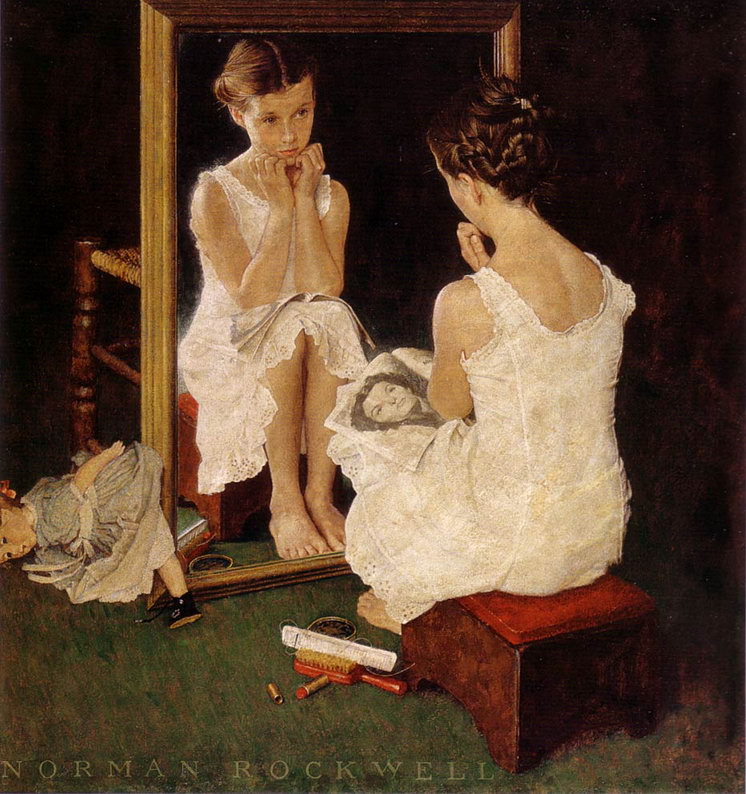
Many of the world’s problems, both personally and collectively, stem from the belief that we are the thoughts we think. This is the basis of ego. If we can experience the mind and its processes more like the way we experience our stomach or our lungs, the closer we can come to recognizing our true identity—the Self—that part of us that was made in the image and likeness of God. But as long as we confuse our “self” with what we see in the mirror, or if we confuse the “body” of thought that parades itself daily in front of the mirror of our awareness, then we will suffer. We will not understand the true cause and effect relationship between these different parts of ourselves, nor will we understand how personal experience shapes who we are.
Posted in Lessons | Leave a comment

The Sacred Marriage

Forget all of the myths, they were meant to hide the real meaning.

Bring your inner state out into the world. Be outwardly what you are inwardly.

From The Gospel of Thomas:

Jesus said, "If you bring forth what is within you, what you
bring forth will save you. If you do not bring forth what is
within you, what you do not bring forth will destroy you."

Inner does not mean what you feel. Feelings have nothing to do with high spiritual consciousness. Whatever feelings you might have will be the result of having had the experience, with the exception of joy. High spiritual consciousness is Peace.

You can be a warrior in the midst of battle and still be at peace.

Therefore, bringing the inner into the outer is to express the Peace of your inner being.

How do you DO this?

By laying your hands on another person and administering a blessing. By getting out of the way and letting Spirit move through you, you are letting the innermost part of you out into the world.

***Acting from within, you wed your inner being (God) to your outer personality.***

Once you have mastered or even achieved a level of proficiency at living from an inner state, the Sacred Marriage begins. As in all initiations, it is a beginning. It doesn’t come all at once. That would be too disorienting.

Posted in Lessons | 1 Comment

A Piece of Chalk by G.K. Chesterton in 1905

I offer this as a supplemental to my article Positive Prayer – MM

______________________________________________________________

I remember one splendid morning, all blue and silver, in the summer holidays when I reluctantly tore myself away from the task of doing nothing in particular, and put on a hat of some sort and picked up a walking-stick, and put six very bright-colored chalks in my pocket. I then went into the kitchen (which, along with the rest of the house, belonged to a very square and sensible old woman in a Sussex village), and asked the owner and occupant of the kitchen if she had any brown paper. She had a great deal; in fact, she had too much; and she mistook the purpose and the rationale of the existence of brown paper. She seemed to have an idea that if a person wanted brown paper he must be wanting to tie up parcels; which was the last thing I wanted to do; indeed, it is a thing which I have found to be beyond my mental capacity. Hence she dwelt very much on the varying qualities of toughness and endurance in the material. I explained to her that I only wanted to draw pictures on it, and that I did not want them to endure in the least; and that from my point of view, therefore, it was a question, not of tough consistency, but of responsive surface, a thing comparatively irrelevant in a parcel. When she understood that I wanted to draw she offered to overwhelm me with note-paper.

I then tried to explain the rather delicate logical shade, that I not only liked brown paper, but liked the quality of brownness in paper, just as I like the quality of brownness in October woods, or in beer. Brown paper represents the primal twilight of the first toil of creation, and with a bright-colored chalk or two you can pick out points of fire in it, sparks of gold, and blood-red, and sea-green, like the first fierce stars that sprang out of divine darkness. All this I said (in an off-hand way) to the old woman; and I put the brown paper in my pocket along with the chalks, and possibly other things. I suppose every one must have reflected how primeval and how poetical are the things that one carries in one’s pocket; the pocket-knife, for instance, the type of all human tools, the infant of the sword. Once I planned to write a book of poems entirely about things in my pockets. But I found it would be too long; and the age of the great epics is past.

With my stick and my knife, my chalks and my brown paper, I went out on to the great downs. . . .

I crossed one swell of living turf after another, looking for a place to sit down and draw. Do not, for heaven’s sake, imagine I was going to sketch from Nature. I was going to draw devils and seraphim, and blind old gods that men worshipped before the dawn of right, and saints in robes of angry crimson, and seas of strange green, and all the sacred or monstrous symbols that look so well in bright colors on brown paper. They are much better worth drawing than Nature; also they are much easier to draw. When a cow came slouching by in the field next to me, a mere artist might have drawn it; but I always get wrong in the hind legs of quadrupeds. So I drew the soul of a cow; which I saw there plainly walking before me in the sunlight; and the soul was all purple and silver, and had seven horns and the mystery that belongs to all beasts. But though I could not with a crayon get the best out of the landscape, it does not follow that the landscape was not getting the best out of me. And this, I think, is the mistake that people make about the old poets who lived before Wordsworth, and were supposed not to care very much about Nature because they did not describe it much.

They preferred writing about great men to writing about great hills; but they sat on the great hills to write it. The gave out much less about Nature, but they drank in, perhaps, much more. They painted the white robes of their holy virgins with the blinding snow, at which they had stared all day. . . The greenness of a thousand green leaves clustered into the live green figure of Robin Hood. The blueness of a score of forgotten skies became the blue robes of the Virgin. The inspiration went in like sunbeams and came out like Apollo.

But as I sat scrawling these silly figures on the brown paper, it began to dawn on me, to my great disgust, that I had left one chalk, and that a most exquisite and essential chalk, behind. I searched all my pockets, but I could not find any white chalk. Now, those who are acquainted with all the philosophy (nay, religion) which is typified in the art of drawing on brown paper, know that white is positive and essential. I cannot avoid remarking here upon a moral significance. One of the wise and awful truths which this brown-paper art reveals, is this, that white is a color. It is not a mere absence of color; it is a shining and affirmative thing, as fierce as red, as definite as black. When, so to speak, your pencil grows red-hot, it draws roses; when it grows white-hot, it draws stars. And one of the two or three defiant verities of the best religious morality, of real Christianity, for example, is exactly this same thing; the chief assertion of religious morality is that white is a color. Virtue is not the absence of vices or the avoidance of moral dangers; virtue is a vivid and separate thing, like pain or a particular smell. Mercy does not mean not being cruel, or sparing people revenge or punishment; it means a plain and positive thing like the sun, which one has either seen or not seen.

Chastity does not mean abstention from sexual wrong; it means something flaming, like Joan of Arc. In a word, God paints in many colors; but he never paints so gorgeously, I had almost said so gaudily, as when He paints in white. In a sense our age has realized this fact, and expressed it in our sullen costume. For if it were really true that white was a blank and colorless thing, negative and non-committal, then white would be used instead of black and grey for the funereal dress of this pessimistic period. Which is not the case.

Meanwhile I could not find my chalk.

I sat on the hill in a sort of despair. There was no town near at which it was even remotely probable there would be such a thing as an artist’s colorman. And yet, without any white, my absurd little pictures would be as pointless as the world would be if there were no good people in it. I stared stupidly round, racking my brain for expedients. Then I suddenly stood up and roared with laughter, again and again, so that the cows stared at me and called a committee. Imagine a man in the Sahara regretting that he had no sand for his hour-glass. Imagine a gentleman in mid-ocean wishing that he had brought some salt water with him for his chemical experiments. I was sitting on an immense warehouse of white chalk. The landscape was made entirely of white chalk. White chalk was piled more miles until it met the sky. I stooped and broke a piece of the rock I sat on: it did not mark so well as the shop chalks do, but it gave the effect. And I stood there in a trance of pleasure, realizing that this Southern England is not only a grand peninsula, and a tradition and a civilization; it is something even more admirable. It is a piece of chalk. G. K. Chesterton (1874-1936)

Posted in Lessons | 1 Comment

Where Is Within – becoming the source

Hindus make pilgrimages to the headwaters of the sacred Ganges River. Sacred rivers symbolize the flow of divine life into the world, so going to the source, for a Hindu, is like returning to God. Of course, they don’t really believe that God lives in the mountains where the river begins – they don’t literalize their symbols as we tend to do in the West. The outer action of walking to the headwaters is a ritual, a living meditation on the inward journey toward the Source of All. When one reaches the source of the river, she can then turn around and look downstream, as though she herself were the source of it. This is a way to “lose” oneself – by becoming one with It. The only thing that the one who does this will be aware of is the endless flow of the eternal Life of God. Jesus said of such a one that “out of his belly shall flow rivers of living waters”.

What does this tell us about our relationship to the flow of the eternal Life of God when we are in this state of consciousness? It tells us that we are not the flow itself, neither are we “in the flow”, but that we are the source of the flow. This is what it is to be alive. This is what it means to be spiritually endogenous, to unfold from within the infinite part of ourselves. This is being at one with Being, where the Infinite says through us, “I am that I am”.

When awareness is turned back upon itself, it comes face to face with Being, which is the source of awareness. Therefore, Being is “within” awareness. Coming to this realization is called “standing in the holy place”, the immovable spot, the axis mundi of Buddhism. Isn’t this what we’re really seeking when we “go within”?

Posted in Lessons | 1 Comment

Positive Prayer

We are used to thinking of the words “positive” and “negative” as referring to “good” and “bad.” For a scientist or electrical engineer, this would seem humorous – good protons vs. bad electrons. Ha! But if we consider ourselves to be spiritual scientists, we have to learn to use these words in a scientific context.

When we give energy, we are acting positively. When we receive energy, we are acting negatively. Giving = positive; receiving = negative. Going out – coming in. There is a saying: “Be positive to people and negative to God. In terms of energy, you can see how this would work. It would not mean that you would be cheerful with people and angry with God. That’s thinking in the wrong context again. When you are negative to God, you are receptive to God; when you are positive to people, you are a source of power for them. Being negative to God empowers you; being positive to people empowers them.

The default setting for prayer seems to be the “Lord, give me…” setting. The very word “pray” is synonymous with “ask.” But there is another mode of prayer. It is the “Let this be done” prayer. And this is what we call “positive prayer.”

Now, it takes a certain amount of confidence to say, “Let this be done.” Usually, we skirt this by saying, “I accept this,” which is perfectly all right. But there is a difference. Even though all of the energy we could ever give must first come from God, there is a certain power that comes when we take complete responsibility for what we ask. When we are aligned within ourselves – our heart, our mind, and our will – and we issue forth a command to the world and the natural forces that inform it, all of nature will respond to us. It has to. This is what the Bible means when it says that God gave us dominion over the world. It doesn’t mean that animals and the environment are inferior to us; it means that we are in a position of control, the same as the captain of a ship. Within the format of natural law, we can change things, for good or for ill.

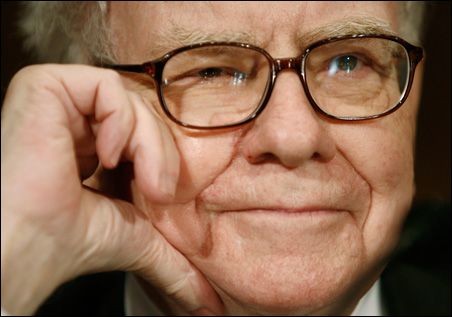
Warren Buffett

If this concept makes you uncomfortable, consider first that this is how it works anyway. Everyone who has ever made their mark in the world did so by putting themselves on the line and acting positively, energetically speaking, and consistently until the effects they were looking for manifested in their lives. Because what we’re talking about is not magic; it is natural and divine law.

Examine your thinking. Do you observe what’s going on around you and then formulate your thoughts through a process of analysis and comparison, or do you let others tell you what to think? Do you make up your own mind, or do you “go with the flow?” Energetically speaking, a positive thinker is one who makes up his or her own mind, based on their own rational consideration and intuitive judgement. Positive thinking does not mean that the sun is shining every day. When we take the emotion out of thinking, and by that I mean looking at it neutrally, then we can see how anyone, no matter how they are feeling or what their disposition is toward the world can be a positive thinker.

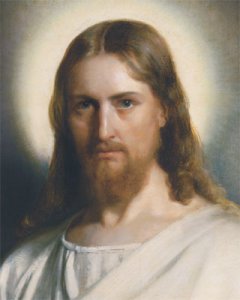
Carl Bloch's "Jesus the Christ"

Positive thinking and positive prayer are powerful. They are pattern-makers. And patterns, when applied definitely and consistently will draw to themselves all the forces of the universe, which will bring them to their logical outcome. This is how it has always worked. When our thoughts and our speech, our desire and our actions, our imagination and our will are in alignment, and they are energized by the Holy Spirit, nothing can prevent the object of our intention from bursting into creation!

So let it be done.

Posted in Lessons | 6 Comments

Prayer – the art of creating a vacuum

Our mental state can most often be described as a swirl. Our thoughts are largely determined by what we see and what we hear. And since our senses are always flitting about, so are our thoughts. But when we focus our attention on a single idea, we start to gather power, and that power forms an image in the Mind of God.

Learning to control our thoughts does not mean suppressing them. It means choosing what we are going to think about and keeping our attention on that and that alone. Having a quiet mind does not mean having a blank mind. A quiet mind is an observant mind. You cannot receive an accurate impression while conducting a running commentary.

The power of a quiet mind has many benefits. It reduces stress, makes us peaceful, and generally improves the quality of life and our ability to pay attention to those around us. But when that quiet mind “situates” itself in an idea, its power is magnified exponentially.

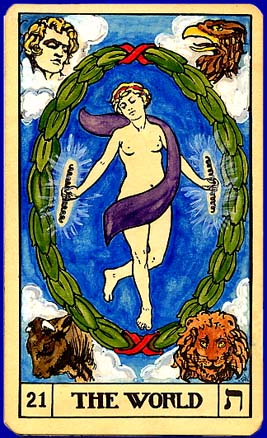
An idea is not simply a string of related thoughts but rather an image containing all of its component parts within itself. It’s like an icon or a Tarot Key. Everything essential to the idea is present in one image. When that image is fully realized in our mind, and we stand in the middle of it as though it were an extension of ourselves, the image has enormous drawing power.

Priming the pump

Strictly speaking, power is only a potential. A car battery has power. But unless you connect the two poles of it to an electrical circuit, no energy will flow. It is not enough for us to embody an idea; we have to breathe life into it. And the way we do this is by turning the image into an animation. In order for an image to have creative power in the Mind of God, it must have action. Is it money you need? See yourself paying your bills. (Remember, it is in giving that we receive.) Sufis say, “Ask for what you need, and then pay for it.”

Picture yourself holding a wad of $100 bills. Peel them off one at a time and lay them on top of a spot representing the account that has to be paid. Do this over and over until all fear is gone. Pay the entire amount, not just the monthly payment. Doing this sets up a flow of energy in the Mind of God, and where there is a need, God provides the means to fulfill that need.

Remember that God doesn’t care what the need is or who is making the request. “Rain falls on the just and the unjust alike.” It doesn’t matter one iota whether you deserve it or whether you’ve been good. This is an impersonal principle. An electrician doesn’t have to “deserve” a proper flow of electricity; he just has to know how to connect the wires.

This doesn’t make prayer sound very romantic, but it does make it practical. After all, is your goal to make yourself feel good, or is it to get results?

Posted in Lessons | 1 Comment

The Divine Feminine – Woman Clothed with the Sun

painting by John Collier

The tendency on the spiritual path is to personify divine principles, and to a certain extent that’s okay. But the discipline is to never forget who the person is and which principle is being represented. In the case of Mary, the mother of Jesus, this is especially true because, well, she’s the mother of Jesus, you know? And if you’ve already personified the Christ in the person of Jesus of Nazareth, then Jesus is God, which makes Mary the Mother of God. And I am quite sure that there is no one in the universe who would object to that appellation more than Mary herself.

The reason divine principles are personified in the first place is that in order for a teaching to persist over time, it must be turned into a myth. This doesn’t make it a lie, which is the way most people interpret the word “myth.” Instead, it turns it into an immortal story. And because divine principles don’t change over time, all of the world’s great myths closely resemble each other. It does not mean, as some mythologists think, that one story gets emulated over and over, thus building up a mystique around it. The stories are similar because the principles they describe are eternal.

Some believe that the Feminine Principle has to do with the mystery of childbirth, which it does, but to say that that’s the only thing it does misses the boat entirely. Childbirth, while miraculous, is still of the body. Even if you raise it to the mental level and call it the creative principle, it’s still only a mental phenomenon. No, the real meaning of the Feminine Principle has to be ontological in scope. It has to be about being itself. This is the realm of the divine – not body, not mind.

For this reason, the Feminine Principle cannot be about Mary alone, nor can it be about the female gender alone. Gender is body. And it doesn’t help us very much either to try to expand it into a cosmic perspective and say that it is about polarity, though it is about that, too. But to think that Mary represents the negative charge of an electron would be reductionist in the extreme.

There is a reason that people are used as icons, that God is pictured as a person, that animals and other living things are used to describe divine principles. And it has to do with the very nature of the universe itself, namely that it is alive and not merely an aggregation of rocks and ice pushed and pulled by nuclear reaction and gravitational force.

When we talk about the Feminine Principle, we are talking about consciousness. And even deeper than that, we are talking about Being and the way Being expresses itself outwardly into manifestation – the act of creation.

The act of creation requires four things:

  • an idea of the thing you want to create – a plan
  • the will to put your plan into action
  • the daring to commit the action, sometimes in the face of seemingly insurmountable resistance
  • and the ability to let go of your action so that your plan can manifest (on the seventh day, God rested)

The Feminine Principle is the spiritual universe’s response to these four elements of the act of creation. “Let it be done……….unto me!” That which is put into motion by mind must have an energy that receives the action and brings it into manifested form.

Now, this all sounds so cosmological, so metaphysical – even occult. And it would be all that if the universe were not conscious and alive. Rocks, trees, plants, and animals are not enough to contain this Life. We are not talking about nature worship. What we normally perceive as “nature” is but the effect of a larger Life, our own physical body being no exception. It is the Solar System itself that constitutes the vehicle of this larger Life – a living cell in the greater body of the Cosmos. We have to understand the body in which we live before we can understand the greater body.

The Feminine Principle is so vast and so powerful that the mind cannot comprehend it. Consider the analogy of sperm and egg. The tiny sperm cell carries the initiative, the spark; the brooding ovum carries the power to act on that initiative. The sperm cell carries the plan, which is procreation. It is the extension of will. And it is committed to the action. But once it has achieved its goal, it disappears. And all of the latent potential of the ovum is unleashed in mathematical precision to the fulfillment of the Divine Will.

The universe functions through adaptation. It takes the infinite number of available possibilities and decides which of them will be acted upon. The ancient symbol for decision is the sword. (Note that the word “decide” has the same root as the word “homicide.”) The ovum culls the herd of sperm cells, choosing only one. The rest die.

The Divine Feminine yearns to fulfill the Divine Will. Without the Divine Feminine’s yearning (and capability) there could be no Divine Will. Neither could exist without the other. A plan means nothing without the ability (and the mater-ial) with which to carry it out.

The vast productive power of the Divine Feminine belies its seemingly passive nature. Just as the ovum controls which sperm will be allowed to start the process of reproduction, so does the Divine Feminine adjudicate the endless ramifications of the mind. If the mind were the final arbiter of what would be created, this universe would be chaotic and unsustainable. It would implode under its own weight. Thus the Divine Feminine is the Preserver of the Cosmos.

The Divine Feminine manifests itself in both men and women. It is not exclusive to the female gender. In fact, it has nothing to do with gender at all. Women manifest outwardly as feminine, but inwardly, which is to say spiritually, they are fiercely masculine. This is why they are the chief proponents of the world’s spiritual movements. Men, on the other hand, are spiritually feminine, which means that they are willing to receive instruction. But those who have achieved the balance of male and female within themselves are capable of being both proponents and adherents. They can both give and receive. They have the ability to create within themselves. This is the Sacred Marriage spoken of by the ancients. It is the inner meaning of the Virgin Birth. Mary was one who had attained the Sacred Marriage, and was thus able to give birth to the Sun.

Posted in Lessons | 11 Comments

Faith Is a Dirty Word

borrowed from Common Ground

borrowed from Common Ground

You can’t even bring up the word Faith without appearing to oppose logic. And the society we live in worships logic. Being a person of faith means that you believe in the illogical, the irrational, the mysterious, the flighty – the make-believe. If something is not touchable, seeable, and provable, you are not allowed to talk about it, not in intelligent company. The only approach to matters of faith, most people believe, is through speculation and/or wishful thinking. Faith is therefore useless, unless you’re dying, and then only as an opiate to soften the blow.

But in reality, what does all this mean? Whence the malice toward faith? Skipping over the part, for now, where millions of people use it as an excuse to slaughter each other, what do the rationalists really have against it? Oh, and we have to mention the other part about keeping the masses huddled in fear, the fear of going to hell if they disagree with the Holy Fathers, the mullahs, or whoever else claims to have a direct line to God. And this is where it really began (and where it continues today) – the turf war between rationalists and intuitives – the battle between those who think that truth is a done deal and those who want to explore the options.

What you are allowed to think

Nothing is more reprehensible than a dictator father-type who wants to run your life. Since conserving the status quo is his chief preoccupation, the dictator father-type sees intellectual curiosity or independent soul-searching as a direct threat to his authority. He may not even know the truth himself. He only needs to convince others that he does. And when someone else stands up and claims to have had a vision, the hammer comes down hard, because the “vision” has already been had – why do we need another one? In fact, “vision” has been replaced with a book – it has been written. The cruel irony is that the book can be a textbook as easily as holy scripture. There are dictator father-types everywhere. Anyone can wear a white robe: popes, gurus, mullahs, doctors, scientists, university professors. It is easy to see that authority is less about knowing the truth than it is about being right.

Truth vs. fact 

For the gnostic, truth is a beacon; for the realist, truth is a prop. The realist says, “This is all there is.” The gnostic says, “This is only the appearance of things.” The one affirms the ego; the other acknowledges something greater than itself.

Gnosis uses inner knowing and the mystical experience. Gnosis begins with truth, not the known truth but the unknown truth. Gnosis has had a face-to-face experience of God and yet cannot describe what it has seen. Life then becomes a search for that experience and the hope for its return. Gnosis has “felt the naked body of its dreams” but cannot as yet realize its discovery.

The mystical experience is the substance and the evidence of our knowing. For the mystical experience is not so much in knowing as it is in being known. This is what we sense, this is what we have felt, this is what draws us.

Faith is real. It is based upon inner experience. How can we say that spiritual experience is subjective when so many have had the same one? The mind is as powerful a scientific instrument as any in the laboratory, even more so. We have to trust it, and at the same time admit that it is only a tool, not the author. We did not invent the truth. We can only open up to it. Therefor, it is not for anyone to say, “Lo, here is God. For all have known God, from the least to the greatest.”

We can own our knowing without imposing it on others.

Posted in Lessons | 2 Comments

The Mystery of 3

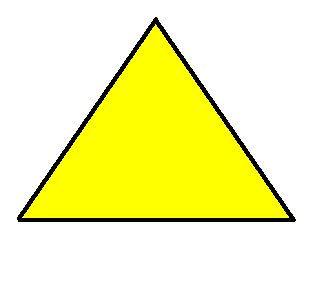
3, a powerful number, right? The Holy Trinity of numbers. The triumvirate – the word “triumph” begins with 3. I’m writing it as a noun instead of as a modifier (as in three somethings), but as a word, you can never fully isolate it as either. It is always 3 and three. There is something in its nature that causes change, like fire.

I used to think that the Trinity, in terms of physics, meant that every vibration was bordered by that which is above it in frequency and that which is below, the same way that green is bordered by blue and yellow. No matter where you are on the spectrum of life, there are those above you and those below you, those from whom you receive and those to whom you give. Jacob’s Ladder. But as a simple theory of placement, or as a sequence of events, as in cause/medium/effect, as that master of the Law, Earnest Holmes, puts it, leaves 3 lacking in some vital quality. What is that quality?

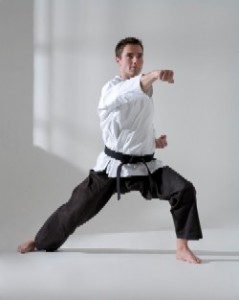
I have seen demonstrations of power wherein there is a dynamic interplay of two opposing forces. They are all around us, actually. Electricity is a good example – positive and negative. That’s a relatively easy one to grasp, in a superficial, chalkboard kind of way – a plus and a minus separated by empty space. You know intuitively that there exists a tension of opposites that somehow produces energy, although no one really knows how it’s done, not even physicists. Perhaps the most visceral demonstration I have seen is on the sparring floor of a martial arts studio. In some mysterious way, a punch is more powerful if the forward motion of the hand that punches is counteracted by the opposite movement of the other hand. The right hand thrusts forward, and the left hand retracts. Perhaps this is why balance is so important.

Another example I can think of is the human lung. Here there are two things, opposite in type as well as direction, like the punch. On the one hand, the blood coursing through the lungs takes on oxygen, the most urgent requirement of life, while at the same time giving up carbon dioxide, the exhaust, so to speak, of the body. One flows in, and the other flows out. But the two actions, though seemingly separate in the inhale and exhale, actually take place together at the level of the red blood cell. Oxygen and CO2 pass each other like ships in the night, or like delivery boys in a revolving door. Again there is balance, but it is a dynamic balance. And it is that word “dynamic” that seems the all-important factor whenever we speak of Life.

Sushumna, Ida, Pingala

So, rather than a noun or a modifier, 3 is the name we give to that one essential activity that is always burning at the center of the very large and the very small, the above and the below, the macrocosm and the microcosm – Life. And, of course, we are not talking of life as it is usually meant, namely as a set of circumstances (I think we are well past that now) but life as an energy. But to be rigorous in our use of the term “energy,” we must include the other two members of the Triumvirate, power and force. Because, as every student at Stanford knows, energy is power in action, and force is energy applied. You can’t have one without the other two. Every equation must be balanced.

Isis, Horus, Osiris

That trite saying, God is a verb, tries to get at this, the idea that Spirit is alive and not just a thing. And saying that God is consciousness or Nature are further attempts at describing the indescribable. But perhaps the reason why the concept is so hard to grasp is due more to the level we approach it on and not the fault of the concept itself. Maybe it requires a different kind of thinking. Science is only now beginning to discover that the fundamental laws that govern the universe have been described for millennia in the sacred scriptures of the world. Well…maybe they haven’t discovered that yet, but they are bound to eventually. The new way of thinking that I’m talking about is going to have to be a synthesis of the two, a balance. Two things interacting within a third.

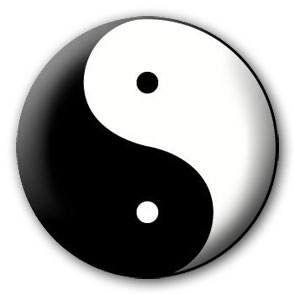
Everywhere in nature we see the forces of expansion and contraction, attraction and repulsion, adhesion and cohesion. Esoterically, they are known as Sun and Moon, Yin and Yang, Rod and Staff. One force innervates, the other provides a restrictive or defining form. Jupiter and Saturn. Male and Female. Chokma and Binah. Pingala and Ida. One speeds up, the other slows down. The object is to find these forces within ourselves, to experience them and use them, consciously. This is why we contemplate the nature of things, the super-nature of things. We must move beyond appearances and and into the world of abstract thought. Unless we do, the underlying principles of Cosmos will be hidden to us, and we will be stuck in the world of effect. “But be of good cheer,” as Jesus said, “for I have overcome the world.” So must we.

Related Articles:

Cycles and Symbols

Prayer 1

The Union of Opposites

Posted in Lessons | 1 Comment

What You Should Know About Advertising

Can marketers really get inside a consumer’s head to influence the choice they will make? For market researcher, Clotaire Rapaille, the answer is yes. He believes all purchasing decisions really lie beyond conscious thinking and emotion and reside at a primal core in human beings. As chairman of Archetype Discoveries Worldwide, he helps Fortune 500 companies discover the unconscious associations for their products — the simple “code” — that will help them sell to consumers: “When you learn a word, whatever it is, ‘coffee,’ ‘love,’ ‘mother,’ there is always a first time. There’s a first time to learn everything. The first time you understand, you imprint the meaning of this word; you create a mental connection that you’re going to keep using the rest of your life. … So actually every word has a mental highway. I call that a code, an unconscious code in the brain.” This interview was conducted on December 15, 2003.    – Frontline interview

Posted in Lessons | 1 Comment