Posted in Lessons | 1 Comment

Turn the Other Cheek—what’s up with that?

aliForgiveness seems difficult because often it is confused with condoning the action that has harmed us. Or, we think that we are obliged to love the perpetrator as though “love” meant affectionate regard. These misunderstandings make forgiveness nearly impossible, if not downright repugnant. To forgive in these contexts would open us to charges of weakness and moral cowardice. So to appear strong, we cultivate hatred and thus lose our humanity.

The problem with condoning a harmful action or feeling affection for the perpetrator is that both of these postures are emotionally reactive. Siding with the wrongdoer is borne of fear—if I act like I’m one of them, maybe they will leave me alone. Or, if I pretend to like them, maybe they will like me back and stop hurting me. Both of these strategies give power away to the aggressor and can only perpetuate the problem. Therefore, they have nothing whatsoever to do with forgiveness.

Confident good looking young woman smilingThe concept of forgiveness can also be misconstrued to mean excusing the malicious acts of another person, to simply overlook them as though they did not matter—to “rise above” them. But just as anger cannot be ignored or suppressed, neither can the negative traits of another be swept aside as though they did not exist. Instead, they can be allowed to be what they are. Instead of resisting what you do not like in the other person, give it space—allow it to be what it is. Give, as in give way. Do not resist—do not try to superimpose your sense of right and wrong onto the other person. If you do, you will always be disappointed, and eventually your disappointment will turn into indignation.

Indignation blinds us to what is and makes us ineffective. In the movie, The Godfather, Michael Corleone says, “Never hate your enemy—it affects your judgment. ”We are offended by those things that reveal our own weaknesses. Real strength is never—can never be—offended. So look for the lesson. Your adversary is your teacher.

This is the opposite of pressurizing or trying to contain what other people are putting out. Not pressurizing them is the same as not judging them. Judgment is trying to force other people to be as you would have them be. No one responds well to that. Do you?

sun diskForgiveness acknowledges that there is more to the other person than you are seeing and is therefore an aspect of humility. Carelessness, malice, greed, ignorance—these are all symptoms of deeper problems. We cannot ignore them, but we can look past them to see what is really there. The ego is always in competition with other egos. When we look for the divinity in the other person, we are bypassing his or her ego, and our indignation begins to fall away.

What can you accurately say about a violent person? What is the “what is” of him? Violence is the outgrowth of anger. Anger is the outgrowth of the sense of having been wronged. The sense of having been wronged is the outgrowth of the violation of a preconceived idea of how things should be. You might call this the wounded wounder—it is a human tendency to act out the abuses suffered earlier in life. This doesn’t excuse bad behavior, but it does give us a way to understand it, and by understanding it we can deal with it more effectively.

By understanding bad behavior, we demonstrate humility by putting our energy into effective action rather than letting it inflame our already indignant ego.
pennHere is another way to understand a violent person. Take, for example, the pathological killer. When people are split within themselves, they tend to see their separated part as the enemy. But in their insanity, they are unable to understand that their tormentor is a part of themselves, so they project it outward onto other people. By killing the other, they mistakenly believe that they are killing the part of themselves that is causing them pain. This is obviously insane, but such is the belief of a fragmented personality.

This is why in hostage situations, hostages are encouraged to talk to their abductors, to try to get them to see that they are real people rather than faceless, nameless “things” to be abused. The more real the other person becomes in the mind of the perpetrator, the harder it is to project his inner demons upon them.

Again, this is not an excuse for deranged behavior, but rather a way to understand and thereby be more effective in one’s response to a dangerous situation.

Jesus said not to fear those who can kill your body but to be [damned afraid] of those who can cast your soul into hell. No one can cast our soul into hell, but they can induce us to do that to ourselves. And that is the danger Jesus warns us about. When we regard an insane person as an “evil” person, we start to hate him. Hatred is the “fire of hell.” Hatred corrupts the hater, making him identical, spiritually speaking, to the object of his hatred.

Mastering forgiveness does not mean there won’t be a fight—in only enables you to keep a clear head. So, never go into a fight blindfolded. The violent person believes that there is something wrong with the world and is attempting to fix it. If you know that, you are in a much better position to deal with him effectively.

According to George Lamsa, expert in Aramaic and Middle Eastern idioms, the saying, “Turn the other cheek,” means do not start a fight—do not react. Reaction is powerless, because you are letting the other person state the terms of engagement. It is better to walk away and wait for the opportunity to begin a new round, one that will allow you to take the high ground.

samuraiHistorically, the fiercest warriors have been the Samurai—the armies of the warlords of feudal Japan. The mythologist, Joseph Campbell, tells the story of one Samurai sent to assassinate the rival warlord of his master. He takes the warlord by surprise, and just as he is about to cut off his head, the desperate warlord spits in his face. The Samurai warrior immediately sheaths his sword and walks away, leaving the warlord unharmed. Why? Because it is against the Samurai code of honor to kill in anger.

Forgiveness abates anger. And while anger can induce us to act, to pry us out of a rut, it must be quickly sublimated into willpower, or it will work against us and lead us into bigger problems.

Action is powerful when it operates at the level of cause. But re-action only gives power away. Reaction makes us want to hurt the other person back, instead of focusing our attention on taking an appropriate response. Turning the other cheek does not mean letting the other person continue to hurt you. What would be the purpose of that?

gandhi

Posted in Lessons | 2 Comments

First the test, then the lesson

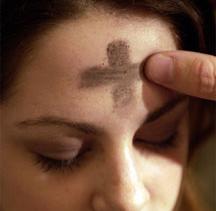
easter_cross2Now that Lent is over, I thought it would be a good time to review what it is about in terms of the Western Esoteric Tradition:

From the sacrificial fires

From the sacrificial fires

The reason that Lent is the designated season for sacrifice is that it is that time of year when the Sun is ascending once more from the grave of the Winter Solstice. In astrological terms, this is called “applying.” It is a condition where the energies are on the rise, compressing, as it were, the same as the energies of the Moon intensify with the approach of the full Moon.

There is that saying, “Beginnings are powerful things.” When an energy is applying, that is the best time to take advantage of it, to use it for a higher purpose. Nature uses this energy for procreation, and people who are more driven by their instincts than they are by their mind also use it in this way. Think: Spring Break.

The Equinoxes have a kind of “square” aspect, the halfway point between the longest and shortest days of the year, the peak times of light and shadow. In astrology, squares provide the extra energy needed for change the same way that a weighted flywheel helps to sustain momentum.

water-pressure-experiment

Turn this image upside-down, think of the Kundalini, and you get sublimation.

The challenge of Lent is to sublimate sexual energy by elevating one’s thoughts to loftier ideals. It’s not that there is anything wrong with sex, it’s just that this is a great time to use that energy for spiritual transformation rather than letting it reinforce what’s already going on. It’s an opportunity.

There are some who use sexual energies for “spiritual” purposes, but this is an entirely different path. Those who practice it are convinced of its power, but they are using different forces and are in touch with other beings than those who seek the Solar Initiations. The Solar Path works with the Angelic Hosts and the White Brotherhood, whereas the other path works with Earth energies, Earth spirits, and the magnetic forces of the Moon.

We also use these lunar forces, but since these forces are in such abundance here in this earthly experience, we emphasize the Solar aspect in order to offset the lunar dynamo. Being the immediate influence, the Moon and its forces tend to keep us involved in Nature. But by “lifting our eyes to heaven,” which is to say looking to the greater cosmological sphere, we are better able to rise above the Moon’s influences, not to abandon or negate them, but to be the master of their forces so that we can use them for greater purposes and not be used by them.

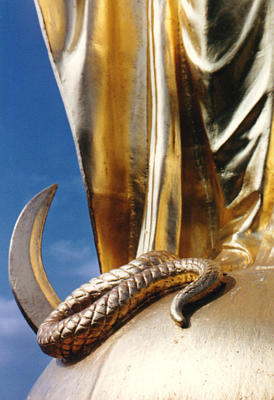
serptailThis “overcoming/mastering” is symbolized by the depictions of Mary with the Moon (and the Serpent, symbolizing the cyclical/lunar forces and the domain of Time) usually under her left foot, indicating that it is the subconscious mind that benefits by our looking past it to the superconscious mind, the same way we look past the Moon to the Sun.

The object of looking past the subconscious mind to the superconscious mind is not to eliminate the subconscious but to purify it of negative thought patterns, meaning those patterns that are self-reinforcing and lacking the capacity for self-transcendence. The subconscious mind was never intended to sit in the driver’s seat, so to speak, but to act as a “base” or operating system (in computer lingo). It serves as a memory or record system, and it is the “substance” from which thought patterns are formed.

To look to the subconscious mind for guidance is to mistake the system for the intelligence for which the system was created. We always look past the immediate structure (in mind) to that which lies just beyond it. In folklore, this is understood as “favoring the grandparent,” and in some religions it manifests as ancestor worship. It is also what is meant by “seeking a higher power,” which in societal terms is interpreted as “the Rule of Law,” where plaintiffs can appeal their cases to a higher court.

So, Lent is designed to give us a rudimentary pattern by which we can delay gratification of our bodily impulses and rise past the natural to the supernatural. It’s all one Nature, of course, but Nature is layered in a distinct hierarchy of organization and potency of cosmic powers. This knowledge helps us to keep moving forward in our spiritual evolution.

Earth life is inherently dangerous in many, many ways, and it is a well-known fact that people who can keep their wits in times of stress are those who have the best chance to survive and thrive. Fear, anger, lust, avarice—all of the “deadly sins”—tend to undo us when the chips are down. Lent is the ideal time of year to rechannel these potent tendencies, keeping our spiritual development on an upward trajectory, and ensuring the survival of the race.

rooseveltquote

Posted in Lessons | 3 Comments

Death and Rebirth…hooray!!!

Earth.sunriseI liked Geography 101 so much that I took it twice. One thing I learned was that soil—the basis of all life—is the product of the [mystical] life and death of the Sun, the alternating seasons brought on by the axial tilt of the Earth—summer solstice to winter solstice.

Notice how I bracketed the word “mystical”? That’s because they sure as hell didn’t teach it that way in Geography 101! (The eye [I] sees what it brings to the seeing.)

It turns out that soil depends on layering—weathered rock particles overlain with autumn leaves and churned by spring’s flurry of insect life. Cycles create layering. And layering is everywhere. You can find it in tree rings, in vegetables and fruit, and in the eyeballs you’re using to read this page. All forms of life, and the systems that support life, have this laminar quality. Life depends on layering.

Why is this [mystically] important? Because it’s the death and rebirth cycle that makes all life possible. It’s the build-up/tear-down process that lays the foundation and the circuitry for the energetic impulse we call Life.

Oh, did you think “life” is a set of circumstances? As in “life is complicated”? No, no, no. That’s not Life; that’s your story about Life; it’s what you do with Life. No, Life is a Force. Life is………….(wait for it)…………alive! 

ouroborosAnd, incidentally, this is why scientists have such a hard time figuring out what Life is. They don’t want to admit that it is alive, that it is intelligent, and (God forbid) that it is sentient. They would have us believe, rather superstitiously I might add, that life is a blind force, like the electricity coming out of a wall socket. They would have us believe that consciousness is a product of the brain, which is like saying that people are the product of houses. Someone saw a person come out of a house and deduced that the house created the person. Now, that’s superstition!

Back to layering. As I look out at the tall grasses growing in my backyard, which I’m doing right now, I can see that they are trying for something. They have a yearning that is undeniable, a will that will split rocks. They will not stop, even if I cut them down. And like the Terminator they say, “I’ll be back.”

Flowers straining to find the Sun is not just heliotropism. If you want to understand Nature, you only have to understand one thing: the relationship between the Sun and the flowers is symbiotic. Get this, and you get it all.

Scientists think that all you get from the Sun is heat and light. They are very mechanistic in their thinking on this subject. But when we look at Nature, we see that it is crammed full of intelligence. It is so intelligent that it cannot be reproduced artificially—more complex than a network of supercomputers.

Just what kind of eggs are we looking for, anyway?

Just what kind of eggs are we looking for, anyway?

So why is it that scientists think that life evolves from the simple to the complex, that life came from a chance encounter between a lightning strike and a mud puddle? Does it not make more sense that the intelligence we see here below is a reflection of that which is above? The Cosmos is not linear—what happens on one side of spectrums happens on both sides—simultaneously.

The Solar System is a cell, and the Sun is its nucleus. Everything in the body of the Solar System is an elaboration—an exploration—of the intelligence inherent in the spiritual body of the Sun. One scientist put it brilliantly: “The universe is made of information.”

Okay, now we’re really gonna get back to layering: it takes 100 years to create one inch of soil. Soil is created by the action of weather on rocks, combined with decaying plant life and millions of microorganisms. It’s the weathering part that’s important because it’s the freeze/thaw cycle that busts up the rocks. Meltwater seeps into the cracks and then freezes, forcing the rocks to break into smaller and smaller pieces. This is the basic stuff of soil.

It is also the basic stuff of human life. Civilizations have their own freeze/thaw cycles. Our personal lives are the same—circumstances change, and it is out of that change that new life is made possible. Death and Rebirth. Death and Resurrection. Change and Renewal.

Out of many mistakes, one breakthrough. Out of the detritus of our lives we find the material to build a new one. And in the Process, we grow. We Learn. We Evolve.

Welcome to Easter!

resurrection

Posted in Lessons | 4 Comments

Sacrifice?

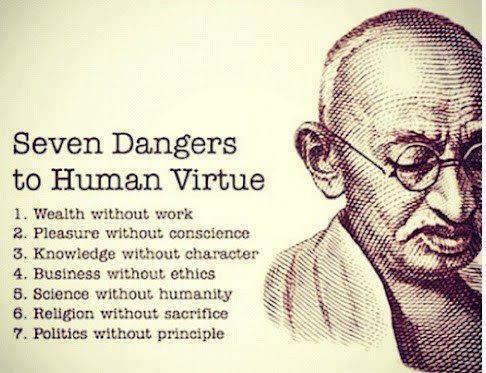
ghandhiAwhile back, this poster appeared on Facebook, and some questioned the “religion without sacrifice” phrase.

The word “sacrifice” has come under scrutiny in the past few decades, due to the way it is treated in A Course of Miracles. But today this poster appeared again in my timeline in close proximity to another poster that read, “If you want to change, you have to be willing to be uncomfortable.”

I think that this sentence is a good restatement of Gandhi’s “religion without sacrifice” being a danger to human virtue. It fits with my understanding of the Hero’s Journey, the path of initiation, in that once the first threshold is passed, the tests and trials begin.

Once a person realizes that there is more to life than what meets the eye (and the other senses) that initial experience is followed by a cellular reaction as the body tries to adjust to the new reality.

That reaction can be painful.

This is why the aphorism “let go and let God” figures so prominently in the spiritual discourse. Non-attachment goes hand in hand with the willingness to “suffer for the kingdom of God’s sake.”

Christ on the cross is a visual icon of Buddha’s declaration, “All life is suffering.” In this, Christianity and Buddhism have essentially the same message:

Change does not come easily—there is always a price.

Today, being Good Friday, is a good day to reflect on this—this season of the Spring Equinox—when the juice is ramped up and all the circuit breakers of our being start to heat up. Current + Resistance = Heat.

Resist not.

Posted in Lessons | 3 Comments

An Easy(?) Way to Learn the Bible

fire

I am not a Bible scholar. I don’t have a Bible quote for every occasion. In fact, the quotes I have memorized could all fit on the back of a business card. And I like it that way. Why? Because every time someone throws a Bible quote at me, it feels like a brick. Not in terms of its impact (I’m pretty immune to them now) but in the sense that a brick is an undifferentiated mass. If you break a brick in half, there is no insight hidden inside of it. It’s just more brick. And Bible quotes, especially when hurled, don’t illuminate the actual teachings—they just turn them into bricks.

While I can’t quote the Bible verbatim, I do feel like I get the gist of what it has to say. And if I had to choose whether to get the gist or be able to recite numerous passages by heart, well…I’d choose gist every time. Because it’s one thing to know what a book says, and another to understand what it says. Understanding trumps knowing any day of the week.

There is a simple way to learn the Bible, not just what it says, but what it means. But first, let’s be clear about meaning: you cannot know what a thing means until you know what it means to you. This might sound obvious, but it really isn’t. Not when it comes to learning the Bible. So many people have interpreted Scripture that the interpretations have taken over. And most Bible study programs start with the interpretations. Why is this bad? Because it denies you the opportunity to form your own opinion, to make your own associations, to relate what the Bible says to what you already know about life. In other words, you have to start from where you are, not from someone else’s point of view. 

For example, if you take the saying, “Turn the other cheek,” what in your life can you relate that to? What experience have you had where this teaching of Jesus could apply? There is probably an incident bubbling to the surface right now, right? How did you handle the situation? Did you react, or did you consider your options? Does the incident linger as a moment of cowardice or a moment of shame? Can you take Jesus’ saying and sit with it—let it sink in? How does it apply to what happened to you?

You see, this is what it takes to study the Bible. You have to think about it. And not in intellectual terms, necessarily, but in terms of your gut.

Thinking is not easy. It’s far easier to just memorize. And not just thinking about something, but to reflect on it. How does it apply in my life? This is a form of meditation, sitting with an idea as though it were a living presence, like another person sitting in the room with you. Very few words, but lots of sensing, lots of being with. What does it say to you, what does it evoke?

What other sayings can you think of? How about, “I and my Father are one.”? Is there a place in you that can say this as Jesus said it, with knowing and legitimacy? Does it only apply to Jesus, as the Bible scholars would have you believe? Was this an historical statement, or was it a universal truth? If you sit with these words as I have described, and take them just as they are without interpretation, what happens? What inner reality do they evoke? Can you enter into the reality of what the words say?

If you do this, you will see that the teachings of the Bible perform a kind of alchemical function—they are designed not to inform but to transform. The teachings of the Bible are the Bread of Life, not a philosophy. You don’t need to get it with your head. But once you get it in your gut, your head will catch up.

Posted in Lessons | 5 Comments

What Is Spiritual Initiation?

There are boundaries in our consciousness, common to all of us, meaning that every person without exception has these boundaries, and every person at some point in their spiritual evolution will encounter them. They are simple, easy to discern, like the place where land meets ocean or mountaintop reaches sky. They are not peculiar to the individual; they do not appear one way to one person and another way to someone else. They are the same for everyone.

Initiation is the crossing of these boundaries, and every person who makes the passage makes it in the same way, though each may have slightly different reactions or form different concepts about it.

Every person who has ever lived was born from a woman’s body. No one is an exception to this simple fact. The transition from life in utero to life outside of the mother could be said to be a boundary, common to all, in our earthly life experience—part of the mother, apart from the mother. Once apart, one cannot enter into the womb again. Once breached, the womb is closed forever.

But what is a spiritual boundary? What could be so simple, so primary, like the act of being born, that could be the common destiny of every living soul? Here is the first boundary, one that perhaps you remember. There comes a point in everyone’s journey where the world of the senses begins to seem inadequate, where the question looms in consciousness, “There must be more to this life than what I can see, hear, taste, touch, and smell.” Familiar things begin to look false somehow, as though the seeable world were a painted backdrop.

More and more, the “real” world feels like it is somewhere else, somewhere behind the world that appears. And the feeling will not go away. The search begins for a way out, a way out of this false world of the senses into the real world that lies beyond it. What is that world? No one can tell you. In fact, they warn you not to look for it, lest you lose your mind and become incapacitated in the world they call real. But the more they warn you, the more you want to find what lies beyond it.

That which you know is there but cannot yet see becomes the “pearl of great price,” that for which you are willing to forsake everything of value in this world—wealth, health, happiness—in order to find. It will not let you rest. It makes hollow everything that before seemed worthwhile. No amount of the riches of this world can fill the vastness of the world you sense just beyond your reach. Your life becomes a quest, a mission to find what you cannot name, what you cannot envision, what you cannot justify or explain. You only know that you must find it. You must escape from a world that increasingly feels like a prison, even at the risk of your life.

This state of determination, this willingness to risk everything known for that which is unknown, is the threshold of the first initiation. The door of the threshold is narrow, so narrow that no attachment can squeeze through, no cherished possession, no well thought out philosophy, no deeply held belief, for these are all products of the senses. It is the “eye of the needle,” the “straight gate,” the “Mount of Olives.” Once crossed, the threshold cannot be uncrossed. Once you are born into the new world, you cannot retreat into the old, lest like an old wineskin taking on new wine, your mind bursts. You cannot enter again into your mother’s womb. By stepping across the threshold, you die to the life you have known and enter into the life you are to become, a life that was prepared for you from the beginning.

This, then, is the prelude to spiritual initiation. And by describing it, I hope I have helped you to see that it is the one road, the one path to the one truth, that this world of the senses, this world of body and intellect, is a world of shadows, and that passing from it into the unknown world beyond is the one act common to every person throughout all time in his or her journey to realizing the luminous world of Being.

see

Posted in Lessons | 4 Comments

Zombies—what’s up with that?

zombies

Why the infatuation with zombies?

When the first Terminator movie came out, I was struck by the phrase, “It will not stop!” It made me think that the machine inside the flesh, the unstoppable forces of nature, scare us as much if not more than any external threat. After all, life chews us up in the end, does it not?

And all through our earthly experience, do we not struggle against those same forces, the ones that when left unchecked tend to tear us and those closest to us apart?

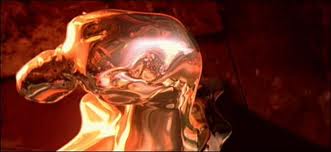
T 1000

Liquid metal—Mercury

Of course, this is how it all appears to our fragile sense of self, until we stop seeing the life force as a threat and make our peace with it. Just like the fierce demons that guard the gates of Hindu temples and the gargoyles on the tops of cathedrals—God appears demonic to the unprepared. Or the unclean.

These movies mirror our separation from life, our tendency to ignore the core energies of our being, and the fight to the death that such ignorance entails. Yes, we have seen the zombies, and they are us. But only because of the way we have cast them, not for who they really are.

T2In Terminator 2, the nature machine is reprogrammed to be the savior and is able to learn how to be more human. In the end, he/it sacrifices himself so that the boy and mother can live. The instrument of his sacrificial act is the cauldron of fire. Purification through sacrifice motivated by love.

Through his service to the child—the nascent Christ within us all—raw e-motion is sublimated into love. The reptilian rises from its own ashes and learns to fly.

The foe, as always, is the mind—the cold, bloodless intellect that will slice and dice hopeful youth.

From the Gospel of Thomas, verse 70: “If you bring forth what is within you, what you bring forth will save you. If you do not bring forth what is within you, what you do not bring forth will destroy you.”

Zombies, terminators—we’ve got to get on the right side of life. As the terminator said to Sarah Connor in T2, “Come with me if you want to live.”

Posted in Lessons | 6 Comments

Death (and resurrection) By Meditation

Listen...

Listen…

The principle of meditation is really quite  simple—quiet you mind.

So, let’s take this principle to its extreme limits, as if these three words—quiet your mind—were the only available instructions on how to meditate.

We are going to assume that everything you need in order to reach Self-realization (which is after all the purpose of meditation) you already possess. There is no knowledge, no technique, no posture, no training. There is only you.

When you realize that 99.999% of the contents of your mind are sensory-dependent, it becomes immediately obvious what you have to do. Turn off your senses, deny your thoughts, and die. Not literally, of course, but in the sense that Saint Paul meant when he said, “I die daily.” He could just as easily said, “I meditate daily.” You leave this world and grope your way, perhaps blindly, into the next.

Bonnie FooteI’m not saying that this is the only way to meditate, but I am saying that unless you start here, all you will ever be able to do is to explore the mind and the products thereof. No liberation, no enlightenment, no Self-realization. You have to “die.” And out of that death, you will rise. Sound familiar?

Let’s call it the “Easter Principle.” That takes it off the calendar and into reality. This presupposes that you understand that things like Easter, Christmas, Hanukkah, and every other high holy day are more than historical events that we celebrate once a year. To think that—and that only—is to miss the point.

lunar-rocket-launch-458479-oEaster comes in Spring. We know that. But what is Spring? It is “that time of year” when Life Rises. If you’ve ever been on a farm during Spring, you know what I mean. Life starts busting out all over! So, what is “Spring” in the way we’re talking about? If it’s not a “time of the year,” what is it?

The day of equinox has a kind of square aspect to it, which means that some kind of energy is being laid on hot and heavy. Energy for a purpose. Energy that’s going to change things. It’s the same kind of energy that we experience any time we get close to the God Being within. As in meditation. Get close to That, and all hell’s gonna break loose. Literally. The kundalini is going to jump, and it’s going to jump UP. And every little chakra that lies in its path is going to be visited. To the kundalini, those chakras look like doors, and it’s going to knock on each and every one of them.

Unless, of course, one of the doors opens.

imagesI mean, what would you do? It’s nighttime, you’ve been stuck indoors for such a long time, and finally this jolt of energy comes over you and you bust out. You don’t know where the energy came from—you don’t need to know. All you know is that it’s time to MOVE.

The first door you come to (actually, it’s the second, but who’s counting) looks quite interesting. You look in the window and THERE’S A PARTY GOING ON IN THERE! What luck, right? And convenient. Who in their right mind would pass that up? But, all of a sudden, a big hand comes down out of nowhere and blocks the door. You try to get around it but it’s no use. You can’t get in. You feel despised, rejected. Oh, the suffering. There’s nothing to do but move on.

tight-spotDoor after door, the same big hand blocks your way. It feels like lifetimes! But you keep moving UP, and the higher you get the tighter the squeeze, until finally you come to the Last Door. Actually, it looks more like a skylight. And around the edges of it you can see this brilliant light trying to get through. What is that? By now, you are so determined to get somewhere that you throw yourself against this final door and…it opens! 

None of this could have happened if one of the lower doors had opened, if that big hand hadn’t blocked your way. You would have taken up residence there for who knows how long. Maybe lifetimes. But you didn’t, you couldn’t, so you made it out—into the light.

Somewhere in our strivings to realize the Self, we muster enough will power to resist the temptation to stop moving UP. It’s that will power that keeps us from taking the first easy exit. Meditation is the daily reenactment of this inner journey. Only, in meditation, we consciously choose to ignore every little interesting thing that arises in the mind. More than just say it, we powerfully assert, “Not this, not that.” We close each door ourselves. And not just the big doors, but all the little ones too—the ones that show up as ideas, as body sensations, as memories, as people. We shut the door on those as well.

Each denial is a denial of self. Not the big-S Self, but the little self, the one that’s made up of all your likes and dislikes, your fears and your desires, your rights and your wrongs, your ups and your downs. All of it. It’s like dying. But, you persist, even unto death. It feels like someone stealing the shirt off your back, and in response you give them your jacket also. It’s like your boss making you work overtime without pay, and so you work even longer than he asks. It doesn’t matter, because you’re dead anyway. You’ve died to all that. You have no more resistance left in you.

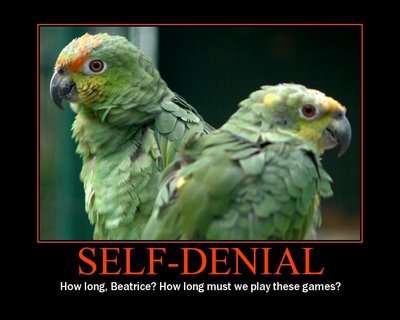
Lent is “that time of year” when we close some doors. We say no to our barnyard instincts and hold out for something better. WAY better. After all, if not now, when?

self-denial

Posted in Lessons | 7 Comments

Blessing—The Breath of Life

girlThe question “who am I” is, in a spiritual sense, meaningless. It is far better to ask “what” am I. For until we know our place in creation, how can we know anything about ourselves?

The “what” of who we are has to do with function. What do we actually do; what is our purpose in God’s creation? The “who” of who we are has only to do with our reflection—who am I to you; who am I to me? How do you see me; how do I see myself? These questions are clearly egotistical. They are concerned with identity, not function.

Let’s establish one solid foothold in this otherwise speculative venture—identity is eternally wedded to function. Unless we know what it is we do, we cannot know who we are.

Why were we made? Whether you believe in God does not matter, not where this question is concerned. We might as well ask for what purpose did we evolve? Why did the  universe come up with such a thing as “human being”? If you believe in the interconnectedness of all life, you must eventually ask,”What is my connection?”

Intelligence

netHere’s another foothold, though maybe not as solid as the previous one. We are mental beings. We have our connection to each other (and to all of life) through mind. What we think matters, not only to ourselves but to everyone else as well. In order to conceive of this as real, we have to understand that mind is a medium. It is something in which we live, move, and have our being. Our activity in this medium sends out waves of information in all directions—not in a homogenous way, the way light spreads out from a light bulb, but through the connections we have formed with the people and things around us. Connection, proximity, sequence—add energy to this formula and you get intelligence.

Often a correlation is made between the number of connections between the neurons in the human brain and the number of stars in the universe. The numbers are staggering, so large that they are impossible to conceive. The human brain is the most complex structure in the known universe. But, the intelligence of the brain lies in the connections between the neurons, not in the neurons themselves. The neurons are mere switches; it’s the patterns of energy that the switches create, the interchange and frequency 0f the impulses that pass through those switches that creates intelligence, not the little globs of nerve tissue that comprise the brain.

If we are like the neurons in the brain or the stars in the universe, then what we are lies not in our identity but in our connections. The amount of intelligence we have is in direct proportion to the number of those connections, their proximity to each other, and how well the energy of life moves through them. This is the difference between identity and function. Looked at from a physical perspective, all brains are roughly the same, but the connections formed between the neurons have an infinite capacity for variation.

Breath

Most of this happens without our conscious involvement. If we want to move energy in the medium of mind, we do it with our breath. Breathing is the interface between mind and body. We can, through conscious, deliberate breathing affect those with whom we are connected. We can do this because we are connected through mind. Mind is the medium of exchange. To think about another person is one thing, but to breathe life into them changes both of you.

If in the process of thinking of another person we encounter resistance, this is important. It shows us where the blocks are. Breathe into those points of resistance. Acknowledge the connection, not the problem. Let Good Will be the vector—always Good Will. Know the result you want, and the means will take care of themselves.

Inhalation and exhalation

Remember, when God breathed the breath of life into Adam, He did it on the exhale. If God had looked upon His new creation and inhaled, it would have sucked the life right out of it. Why is this important? Think of who you might be envying. Think of who, when you look at them or think about them do you want what they have. Do you want their attention? Do you want their life energy? Don’t be a spiritual vampire. When you do this work, breathe life into people, don’t suck it out of them. There’s a reason why envy is called a deadly sin. Be a source of light, not a black hole.

Whenever we place another person on a pedestal, or we place them above us for any reason, such as greater wealth, good looks, or social status, we are essentially drawing our life from them. Remember that life comes through giving, not taking. It’s alright to admire someone for their accomplishments or their personal qualities, but don’t look to them as a source for your life. That’s idolatry. And, whenever we look down on another person with disgust, or if we simply think ourselves better than they are, this is ill will. If we do this, we set ourselves up to be on the receiving end from someone else. Why? Because we’re acting as the source of life for that person, which is something we can never be. If we believe that we can deny life to another person, we believe that someone else is capable of denying life to us.

handsLife is possible through connection, not from any thing. The life energy is universal and moves freely wherever there is a connection. Be the connection, not the source. By breathing into an object or person held in mind, we provide direction to the life energy that is all around us. The more we do this, the more spiritually free we become. We find out that it is truly more blessed to give than to receive. Everything we need comes to us by virtue of what we give.

Posted in Lessons | 3 Comments