Divine Guidance – Knowledge vs. Knowing

You have probably been told not to be attached to the outcome when making choices in your life. Easier said than done. But decision making, as in boxing, requires balance – we should neither balk and stumble backward nor lunge forward, lest in our eagerness to be right we fall flat on our face. And if we try to force our way in instead of waiting for an opening, life will clobber us but good! Balance means keeping your weight over your feet, to let your body find its place in the world, flowing into it as water flows into the ocean.

Balance of being means relinquishing the frenzied desire to be right. It is letting the truth come to you. When the waters of the mind are still, they become clear. Rather than seeking knowledge, we seek clarity, for knowledge is constantly changing, but clarity is eternally the same. Knowledge, because it is endless, presents us with a dizzying array of endless choices, but clarity makes the path set before us obvious. Knowledge is mental; clarity is intuitive.

We tend to seek divine guidance in the form of answers, as though right action will come through the acquisition of knowledge. Therefore, we endlessly search for facts, as though they will lead us to better choices, when in reality facts more often lead us away from truth and into confusion. Truth is not the aggregation of facts; it does not come through knowledge. Truth comes by knowing, and that is one of the most difficult things for the mind to comprehend.

Somehow, we have come to believe that “to know” means to know something – knowing without an object of knowing seems…well, counterintuitive. This is ironical, maybe even paradoxical. It is ironical in the sense that we have conflated the verb and the noun as if they mean the same thing – to know and knowledge –when they do not.

Knowing is akin to confidence, which is as important in one’s spiritual life as it is in the world. Confidence creates a locus for being – it establishes a stillpoint, an eye (I) of calm in the midst of the swirl of “facts”. And because the word confidence is normally used to describe a mind in possession of truth, we find it difficult to have confidence unless it is based upon what we “see.” Confidence without knowledge seems disingenuous, even fraudulent, as in “con (confidence) men.” Success, whether spiritual or material, depends upon acquiring inside information, according to this model. But confidence in the spiritual sense is tapping into the knowing of God, to what actually is, which can most rightly be described as Being itself. To come in touch with that Being and the influx of confidence it provides, even in the face of a complete lack of evidence, is what religionists call “faith,” though that word too has been conflated with the word “belief.” Faith is deeper than mere belief. Belief is dependent upon knowledge; faith is dependent upon knowing.
Divine guidance comes to us when we are in a clear state of mind. It does not have to come in the form of an “answer,” which is mental; it is most powerful when it comes as a “knowing,” a deep confidence in the presence and power of God acting in and through our lives. Since most of our problems come as a result of our thinking, of being in our head and not in our heart, it stands to reason that our problems will disappear when we get inwardly quiet, when we stop the chatter and the arguing, and find the stillpoint of our Being.


“Be still and know that I am God.”


Posted in Lessons | 2 Comments

Entering the Fascinating World of Self-observation

Athanor

The Alchemist's Furnace

There is a Buddhist saying that the way you do anything is the way you do everything, as though the weave of a cloth tells more than its print. It is the way our soul is threaded together that concerns us as mystics, its structure, not what we know or the things we possess. And while we did not create our soul, we are responsible for its content. What we do is not as important as what we do automatically. “Habit becomes character” (Ovid).

Self-observation begins with  retrospection, the nightly practice of reflecting upon our actions of the day. As an impartial judge weighs the evidence of a case and rules on its merits, we look at what we did, what we said or thought, and evaluate it in the light of an awakened conscience. Then we resolve to get it right the next time. In so doing, we change the patterns of our behavior, the deep ones, and gradually our nature changes. In the fires of Athanor, the alchemist’s furnace, opacity and density give way to light and airy transparency, and the Light of Christ shines through. Lead becomes gold, and the dead are raised to life. This is the work of the mystic and the enlightened Christian.

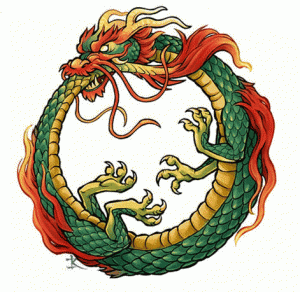
In a competitive world, compassion is weakness. But the emergence of compassion is the hallmark of an evolving soul. Souls do not compete, but instincts and intellects do. We strive to be more than instinctual/intellectual beings – the children of this world. Instead, we desire to connect, to become part of the whole, not so much for what that has to offer but for what we might contribute. For it is in giving that we live. We become the Worm Ouroboros in reverse – our body is born out of our mouth, not eaten by it. We find our life by speaking it forth into the world, to spend our energies relentlessly in giving life to the good, not by resisting the evil.

The Bible says that sparing the rod will spoil the child (Proverbs 13:24), but the enlightened Christian knows that it is our inner children that need discipline and that the “rod” is the Word of Power, the channeled Voice of God. “He conquers who conquers himself” – the battlefield is not out there. Holy War, as the good Muslim knows, is an inner affair, not a political ideology. The highest form of government is self-government, and one can only win at that game by carefully observing one’s own reactions and by redirecting the energy of those reactions down the streets of compassion.

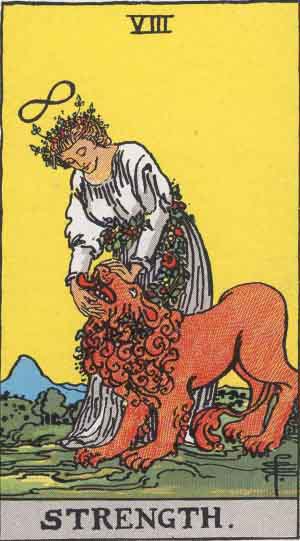
Tarot Strength Card

Self-restraint Through Love

Our inner reactions are the “members of our own household” that will defeat us (Matthew 10:36). These are the “father and mother, wife and children, brothers and sisters” we must hate, not the flesh and blood we share our life with. Being a good shepherd means guiding our own instincts (and thoughts) to green pastures and away from wolves. Good Christians know this.

In your patience possess ye your souls (Luke 21:19).


Posted in Lessons | Leave a comment

New Spiritual Exercises

spiritual exercisesNew spiritual exercises have been added to the Exercises page:

Exalted Imagery Meditations and Climbing the Wall.

Give them a try and, if you like, add comments and share them on Facebook.Spiritual Exercises

Posted in Lessons | Leave a comment

Enlightened Christians and Their Mission, Part 2 – What Is Enlightenment?

Thomas JeffersonThe word enlightenment has a different meaning for Westerners than it does for those who are familiar with Eastern Philosophy. In the West, enlightenment means the ascendancy of reason; in the East it means piercing the veil of illusion. The one has to do with overcoming dogma and superstition, the other with…well, overcoming dogma and superstition. Both eschew hearsay knowledge in favor of direct experience. And this is what it means to be an enlightened Christian.

Some say that mystics are born and not made. If that is so, then everyone is a mystic, at least in potential, because everyone has at least some inkling that there is more to reality than meets the eye. The world reported to us by our senses, which is to say our brain, seems in our more lucid moments to be projected onto the screen of our awareness in a way that begs the question, what else is there? And if we press the question, it leads us to ask further, what is the source of that light? The answer, of course, cannot be conceptualized; it can only be experienced. Any attempt to rationalize it only leads to dogma, and often the attempt to acquire the experience, to make it happen,  devolves into superstitious thinking and magical formulae. 

This is where the word mission can get distorted.

There is a mystic saying, “You teach more by what you do than by what you say, but you teach most by what you are.” The mission of the enlightened Christian follows this aphorism closely: enlightenment is a state of being. In a way, it supercedes experience or, perhaps more rightly said, creates it. For, what we experience is a direct result of what we are being. It hardly depends on what we know or understand intellectually, although sometimes we need the concept to lead us into the experience. But ultimately what occurs in our lives comes out of what we are – the quality, not the quantity.

St Gemma Galgani -The extraordinary "Gem of Christ"The word quality is also problematic, because it can so easily invite egotism. This is where a scientific mindset comes in handy – quality, in the scientific sense, means substance – what is the nature of the vibration you are putting out? Far from being moralistic, or judgmental, the quality of the energy we transmit into the world either adds to or subtracts from the veil of illusion that makes all of the error in the world possible. Ignorance is the cause of suffering, according to Buddha. And for both scientists and mystics, ignorance is the source of error.

For now we see through a glass, darkly; but then face to face: now I know in part; but then shall I know even as also I am known.                                                            –   1 Corinthians 13

To adulterate means to dilute. As enlightened Christians, what is the substance, the quality of the energy we are transmitting into the world? Is it sometimes this, sometimes that? If the mass mind were a swimming pool, well…I think you know where I’m going with that! How clear is the water immediately surrounding us? Are we a source of new water or something else? It does not matter what clothes we wear, what profession we follow, what our politics are, or our religious beliefs. What we are talking about here goes way beyond any of those. What does matter is whether God is present, that we know even as we are known.

This is the only thing that will transform the world.


Posted in Lessons | 1 Comment

Enlightened Christians and their Mission

As enlightened Christians, we know we have a soul. We know that we are citizens of heaven sojourning in a physical world. We are spiritual beings, not instinctual bio-machines. Our thoughts may be shaped by neural nets, but the will to think does not originate in the brain. It comes from a higher neural net, one that is invisible to the microscope but visible to the soul. To believe this is to be a person of faith; to know it is to be enlightened. To live it is to be Christian; to BE it is to be an enlightened Christian.

Enlightenment is an inside job. It’s not that you can will yourself into enlightenment, but you can will yourself to stand in the light, to stand without wavering, without running away, without seeking release from the intensity of the influx of grace that will awaken your moral conscience.

Those two words – moral and conscience – are not popular. And for good reason. Moral implies an external body of law, doing what others superior to you say you should do. It bridles against your intuition that no human being is superior to any other, that all are created equal in the eyes of God. It implies that you are born sinful and must have morality imposed upon you from without, a denial that you are in fact a moral being and were created that way. Even if you believe that you are fallen, you had to have fallen from a place higher than where you are now – your place of origin, your true nature. So to reject the term moral because others have used it to make you believe that there is something intrinsically wrong with you is a mistake.

The word conscience is guilty by its association with the word moral. If your idea of morality is corrupted by the notion that it is something you have to acquire instead of something that you are, then conscience becomes an imposition and not something you already have. No one says that you must acquire a soul – the hubris of moralists has not risen (or fallen) to that level – and conscience is an aspect of soul. So it is not forced upon you from without but is a thing to be realized from within. We have a conscience. We just need to own it.

Having a strong sense of right and wrong does not entitle us to condemn others when they fail to live up to our standards. In fact, a well-developed conscience knows that condemnation is immoral. But to shy away from conscience out of the fear of condemning others is moral confusion – knowing what’s right and condemning others for not doing it are two different things. As the sayings go: you can hate the sin without hating the sinner; you can disagree with what someone says and still defend to the death their right to say it.

Enlightened Christians know they have a soul and they are protective of it. To defend one’s soul is more important than defending one’s body, because the soul is the one thing you take with you when you leave this world and the one thing that stays with you forever. The body is subject to time; the soul is eternal. Outside the context of soul, the body is meaningless. It has purpose, but no meaning. Matter is devoid of meaning, but it has relentless purpose. Part of its purpose is to continually recycle itself, including your body – Ouroboros.

The word defend is another word that has been corrupted by confusion, because it implies the use of force against other persons, which is immoral. This notion violates the mystical ideal of defenselessness and the political ideal of non-violent resistance. It conjures up visions of Christian soldiers marching off to defend the faith by slaughtering heathens, including their women and children. There is also the word defensive, which implies weakness. But there is nothing weak about having strong boundaries.

To defend the soul is to protect its integrity and not let the misguided opinions of others lead us to deny its existence. If we do, we deny our conscience, and then anything goes. What we let go to becomes us, so we must be careful about what we accept. Part of our mission as enlightened Christians is to protect the integrity of our soul.

Note: these ideas are a work in progress. I welcome your response and feedback.

Posted in Lessons | 6 Comments

Constructing a Life

Our creations tend to take on a life of their own, so beginnings are most important. One thing is certain: if our primary concern is success or security in the world, we will experience the ups and downs of the world. But if we seek a higher consciousness, a greater ability to respond to the promptings of Spirit, and a greater capacity for caring, then this is how we must build our lives.

The natural force of entropy will try to convince us that it is too late to start over, but our soul tells us that every moment is an opportunity to begin again. In fact, growth and perfection can occur in no other way. Evolution is indeed a spiral, but progression up the spiral is as fast as we let go of our apparent position on it. Each time we begin again, we move up a rung, regardless of whether the supposed requirements of the current cycle have been met. For it is a lie constantly whispered in our ear that tells us that we must slog through the seemingly endless process of soul-perfection, when if fact what we really need to learn is to let go.

There is nothing written that says enlightenment has to take a long time. The author of that lie has a vested interest in getting us to believe that it does. So we shed our old skins as soon as we become aware of them—when the concrete hardens, we strip away the forms. We must trust in the foundation we have and build upon it and not get stuck in the belief that we have to go back to square one. Why hang onto yesterday?

The Sun again is in its yearly cycle of rebirth. Soon it will purge itself of everything that has not worked. Can we do the same? Easter is approaching. Will we be distracted by the cares of the world, or will we be vigilant to the needs of our soul? Prayer and meditation take no time at all when they are integrated into our daily life. No one ever complains about having to eat; why then should we look upon raising our consciousness as a chore?

People say that if you want to hear God laugh, tell him your plans. But God never laughs at the aspirations of soul. Façades and edifices of self-importance will be torn down faster than a Hollywood set, but if our architectural drawings envision spires of spiritual yearning, the angels themselves will pound the nails.

_______________________________________________________________

You never know who you might reach by liking The Mystical Christ on Facebook. Christian mysticism needs all the exposure it can get. Please pass the Word.


Posted in Lessons | 5 Comments

Guideposts for the New Year

Learning how to access our own wisdom is more important than learning someone else’s techniques and practices. Wouldn’t it make sense that everything we need in order to grow spiritually is already right at our fingertips? Here are eight spiritual tools that you were born with:

  1. Fill your body with light. Every cell in your body is filled with light and energy. When we allow ourselves to experience this directly, it enlivens our entire system. It also tunes us in to the divine intelligence that created us and reboots the original programming that It gave us in the beginning. This light energy in our bodies, and the intelligence inherent within it, is the interface between us and God. When we put our attention on it, it grows stronger, and so does the interface. Our intuition gets better, events occur with greater synchronicity, and our thoughts manifest much more quickly. This is not a patented technique. We were all born with it.
  2. Sit up straight and stand erect. This is a yoga exercise you can do all day long. In Buddhism, there is a concept called axis mundi. It means “center of the world.” It’s where Buddha sat when he came into enlightenment, and it’s represented in Christianity by Christ on the cross. It is the lifting up of the serpent by Moses in the wilderness, and it is the Central Mountain of the World of the Ogallala Sioux. When the ancient philosophers insisted that the Earth was the center of the universe, they were talking about axis mundi (philosophy and science had not yet separated). By sitting up straight and standing erect, we are telling the universe, with our bodies and our intention, that we are one with axis mundi.
  3. Breathe. This is the first and last thing we do on Earth, and it is the most important tool in our spiritual tool bag. I saw a bumper sticker once that said, “Stop Holding Your Breath.” My reaction was, “Who, me?” It’s fear (apprehension and stress) that makes us hold our breath. And if Saint Paul was right, when he said that perfect love casts out all fear, then breath and love are directly related. The formula is simple: when we breathe properly, our heart chakra opens.
  4. Be grateful. As Unity writer Jim Rosemergy says, don’t be grateful for what you are experiencing, be grateful regardless of what you’re experiencing. Gratitude is the reset button of spiritual energy work. No matter what is happening or how you are feeling, gratitude restores the flow of grace. Gratitude is the one virtue within everyone’s immediate grasp. Why is gratitude so important? Because it dissolves resistance. And resistance, according to Ohm’s Law, stops the flow of energy.
  5. Relax. When I was a teenager, I was into alpine ski racing. You wouldn’t believe how slippery snow can be when it turns into ice, especially when you’re skittering across a steep slope of it at sixty mph. Next to strong leg muscles, controlled relaxation is the most important acquired skill. If your upper body gets tense, it becomes impossible to maintain balance and control, regardless of how strong you are. Similarly, when you’re walking on icy pavement, relax your shoulders and let them drop. This lowers your center of gravity and keeps your weight over your feet, making you less likely to fall. Spiritually, it works the same way: When we try to carry the weight of the world on our shoulders, we tense up. Rapid changes can throw us. Also, the smooth muscles in our bodies, like the ones in our stomach and small intestine, react to stress in a way that we cannot immediately control. They have a mind of their own, and like a tortoise with its head pulled back into its shell, they will not relax until the coast is clear. Just telling yourself to relax is not enough. The body has to be trained over time to relax, through practice and repetition.
  6. Pay attention to attention. If you’ve ever flown an airplane or sat next to a pilot in the cockpit, you know that the instruments inside the airplane are just as important as what’s going on outside. We have instruments, too, and they are always reporting valuable information to us. But, if our attention is always on the externals of our life, those inner reports will go unnoticed. We will be flying blind, in the dark. Remember, in life there is more to the unseen than there is to the seen. Learn how to read the unseen. Pay attention to your instruments!
  7. Find a way to serve others. In water pumps, there is a component called a check valve. It’s a spring-loaded valve that lets the water flow in only one direction. We all need an activity in our lives that employs the spiritual equivalent of a check valve. This means giving one hundred percent without getting something back. The keywords here are giving and one hundred percent. Giving means giving something of value, such as your time or your money. Compliments, promises, and pats on the back don’t count. One hundred percent means that you can’t give to some and not to others. No room for prejudice and bias here. Like the rain that falleth on the just and the unjust alike, you have to give freely, without thought of return. Serving and gratitude go hand in hand. Whereas gratitude dissolves resistance, self-forgetting service brings that resistance right up to the surface and into the light where you can do something about it. So simple, so fast, and so elegant.
  8. Change the past. Everyone has a story to tell, and the stories are usually loaded with drama. So and so did this; so and so did that. And now I’m a mess because of it. But these are just stories. The actual events are like the lines of the drawings in a child’s coloring book; we’re the ones who add the color, and sometimes it gets very messy. Unfortunately, the drama is too deeply imbedded for us to do much about it. It’s like a bad program in a computer—only a skilled technician should attempt to change it. God is that technician. Ask God to change the story. The events will stay the same, but the story you tell yourself about them work for you instead of against you. 

We do not need exotic and complicated spiritual practices to cultivate our spiritual energies. Everything we need is already within us. By simplifying our approach and our understanding of spiritual principles, we can achieve greater health, a higher consciousness, and a clearer conscience. The oracles of Delphi had it right: “WoMan, know thyself.” After all, what good is a spiritual practice if you can’t live it every day?

Posted in Lessons | Leave a comment

Why Mary?

In an age where knowledge is evaluated in terms of its usefulness in everyday life, it is tempting to approach spiritual teachings as a way to improve our life in the world. This would be fine but for the fact that life in the world is all about getting, about advancing oneself, about gaining competitive advantage for the sake of survival and setting oneself apart as important or superior. While obtaining knowledge for these purposes is appropriate to life in the world, it is highly inappropriate and even harmful to healthy soul-development. The only appropriate approach to spiritual knowledge is the path of service – the betterment of the world and the the full expression of the highest human potential.

Unless this orientation is present in the fiber of our soul, the power made available through awakening to higher spiritual truths serves only to strengthen our sense of self-importance, separating us from the realization of oneness with life and deadening our capacity for compassion. It would be better to stay away from spiritual teachings altogether than to use them as a means to increase our competitive advantage over others.

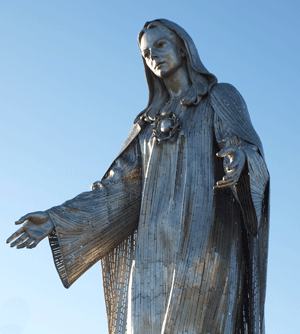
It is for this reason that Mary stands prominently at the entrance to the path of the Western Esoteric Tradition. She typifies the proper orientation of heart, mind, and will of the spiritual aspirant on the road to Self-realization. The themes of her life – humility, service, obedience, purity – serve as the eye of the needle through which the spiritual aspirant must pass before the Higher Intelligence will grant illumination of the secrets of life and entrance into the heavenly realms. For it would be the antithesis of compassion to allow one whose primary goal is self-aggrandizement to participate in the powerful teachings and practices of the Sacred Way. To do so would be to condemn that person to a fruitless, downward spiraling path into greater and greater egotism, leading him or her farther and farther away from God.

Mary’s surrender to God, opening herself up to the influx of Spirit, enabled her to give birth to the Christ Being within her. Her one-pointed desire to live to see the Light of the World dawn upon the earth showed her ability to let go of all earthly desires and to focus single-mindedly on the higher ideal, thus proving herself to be a suitable vessel for the Consciousness of God. If we are to consider ourselves students of the Christ Way, then we must do all we can to cultivate this attitude of being so perfectly illustrated in the life of Mary.

Raising Mary to such a level of perfection can only be properly understood by one who has herself achieved a level of humility, because the last thing any of us want to do is glorify an individual human personality. Mary is all women. And she is more than this, because we recognize that human beings are composite creatures. We express predominantly through a particular gender in any given life, but we have both aspects, masculine and feminine, within us. The marriage of these two inner qualities is the goal of the spiritual path and the fulfillment of the Way. So, it is to be understood that we are not talking about a cult of personality but rather a divine ideal. It is because this ideal is shown in human form that we know that it is reachable by all humans.

Posted in Lessons | 2 Comments

Divine Guidance

A boat set adrift needs no guidance. It is not going anywhere in particular, so any direction will do. In life, it is better to pick a direction, any direction, engage your willpower , and then go for it. If it turns out to be the wrong direction, inner guidance will kick in and by degree set you on a better course. But drifting will get you nowhere except by accident, and that’s no way to live your life.

“If you want something done, ask a busy person.” Those who are busy living their lives encounter lots of problems, and it takes a problem to generate an answer. Questions like “what should I do with my life?” carry less voltage than “what is my client really saying?” The question about what you should do with your life is about YOU, and is therefor self-centered, while the question about your client seeks a larger awareness – it has drawing power!

God is less spiritual than people make Him out to be. He’s much more interested in sinners than He is in saints – not because He likes sin, but because He likes those who push against the boundaries and take risks. He likes people who are in ACTION in their lives, because it is those people who know what they want. It is easier to help someone get somewhere if they know where it is they’re trying to get. People who lack vision are usually sitting on their heart’s desire, afraid to let it out, lest it disrupt their normal lives. There is no virtue in that. None at all.

So, if you want God’s help, position yourself in such a way that you need it, need it like your body needs air. God can’t help but join you in your endeavors, but you have to know what you want and be willing to stick your neck out to get it.

Until one is committed, there is hesitancy, the chance to draw back, always ineffectiveness. Whatever you can do or dream you can, begin it. Boldness has genius, power and magic in it.*

*This quote is variously attributed to Goethe and W.H. Murray, the Himalaya Mountain climber.

Posted in Lessons | 1 Comment

An Inner Christmas

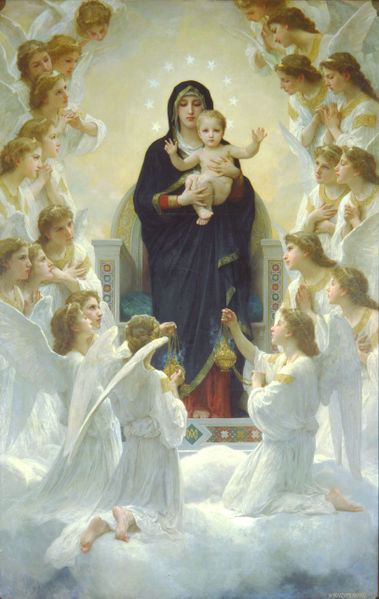
Bouguereau - The Virgin With Angels
Bouguereau – The Virgin With Angels

There is no doubt that the world conspires against anyone trying to have a contemplative Christmas. At this most inward time of year, we are frazzled by last minute obligations and the desire to have home and hearth just right for the holidays. To experience the Virgin Birth, however, we must seek the fire within and go there. Not to neglect our social and cultural duties, mind you, because doing that only nags our attention away from our interior preparations.

The first objection of the mind is that THE VIRGIN BIRTH was a one-time event, and that was for the ONLY Son of God. I capitalize these words, because that’s how loudly mainstream Christianity shouts out this warning to anyone who seeks the reality behind the story. The mind’s second objection is I’M NOT GOOD ENOUGH (as though that had anything to do with it). This is a hand-me-down from the idea that God is everything human times one hundred – all good, all merciful, all giving, etc., not like us! This is just a clever dodge by the ego to keep from having to surrender to God. I actually heard someone say once that he couldn’t seriously pursue the spiritual path because he smoked. Talk about putting the cart before the horse!

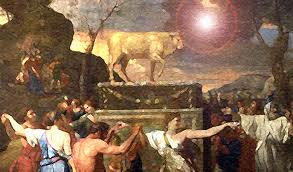
Nicolas Poussin "The Adoration of the Golden Calf"
Nicolas Poussin “The Adoration of the Golden Calf”

The third objection of the mind is I DON’T HAVE TIME. I know, this sounds ridiculous, but it is all the more insidious for its apparent unimportance. Because we have put Jesus on such a pedestal, and made the path of Initiation loom so large, we have made him and it conveniently inaccessible. Anything that great couldn’t possibly leave enough time to have a life. We can still point at Jesus and revel in the richness of his legacy and the wealth of his teachings, and we can claim them as our own in a possession kind of way, but we don’t have to internalize any of it. This is sort of like the way the Israelites built the golden calf. As long as divinity can be objectified and placed far above the reach of mere mortals, the ego can continue partying and still look good. Moses saw right through that, of course, the same way our inner knowing does every time we try to buy our way into attainment with lip service, which is to say philosophy.

So let us not speak falsely now…we must experience the Virgin Birth ourselves if we are to know the reality of Christmas. “Of what use, O Gabriel, thy message to Marie, if thou canst not also give the same message to me?” – Angelus Silesius. And again, this doesn’t mean that we have to be as pure as the driven snow. I cannot emphasize this part enough, because the truth is that we will never be good enough. Besides, we don’t really know what that means anyway, so it’s not up to us to decide. The only thing we need to be is willing.

The experience of the Virgin Birth is an ever-attendant reality waiting only for the “pH” of our soul to shift into a receptive mode. As soon as we drop the reasons why we can’t receive it and open ourselves up and acknowledge that it has already been given, it will happen. It cannot NOT happen. The Star of Bethlehem will appear in our inner nighttime sky, the gifts of the East will be showered upon us, and the world will be transformed. Of course, later on, all hell will break loose, but that’s what Easter’s for. We’ll cross that bridge (no pun intended) when we get to it. 

So, be sure to check out the lights this Christmas, not the ones “out there”, but the ones shining within you. Take time to experience the Birth of Christ. Merry Christmas (in advance), and God bless you.

Posted in Lessons | 2 Comments