Opportunity – the answer to prayer

* invasion of the body-snatchers

Blessings are not so much bestowed as they are made available. When we ask God to do something for us, we expect the answer to be delivered to us on our doorstep, as though God were a cosmic ATM machine from which we can make withdrawals anytime we want. But our purpose here is to grow, not get fat, and growth comes from within. So, we have to move into the openings God provides, the opportunities to step up. This is what makes the spiritual life, the life of a Christian Mystic, an adventure.

Opportunity is a free-floating thing. Whoever said that it only knocks once clearly did not understand the nature of God. Opportunity never ceases to knock. Every experience is a chance to respond to the life power that is expressing itself through us. And when we fix our gaze upon a goal, no matter what that goal is, the universe conspires (breathes with us) to deliver. The more we respond, the less important the particulars become; any movement for whatever purpose becomes its own reward. To experience life is far better than having mere things.

General terms like health, love, and prosperity are highly specific to God. Love is either present or not. You are either making it financially or not. Your body is either functioning well or not. The particulars in these cases are incidental. Who you love doesn’t matter as much as whether you are loving and being loved. How much suffering is caused when we put the who before the what? How many opportunities do we miss by not maximizing the resources we have because we are fixated on an idea of what wealthy looks like? And what price do we pay for trying to fit our body into a pop culture stereotype? God sees the specific things we usually pray for as vague generalities, whereas ideals of health, love, and prosperity are truly specific.

Money is a thing; wealth is an experience. The only reason the economy has us by the balls is because our desire is out of control. Who’s responsible for that is irrelevant – everyone has a hand in this game. When is enough enough? Sustainability has become an abstraction, a generality, a non-sexy, fringe, pie-in the-sky political cartoon, when in reality our system is either sustainable or not. As long as we make things the object of our desire, the system will continue to bleed. We will lose this world and everything we have tried to make of it.

Pray for a loving, healthy, and prosperous world. The opportunities are all around us.


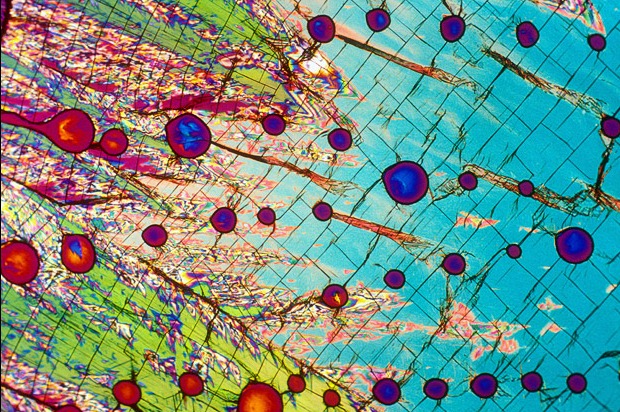
* A smear of vodka at 1000x magnification

Posted in Lessons | 3 Comments

Holistic Spirituality – let the river run

allfinearts.com

You cannot do a spiritual practice in a vacuum. Unless your spirituality is part of everything you do, it is no spirituality at all. Heaven and earth cannot be separated; God cannot be separated from matter. We have to live our spirituality every day, but this does not mean that we have make the world conform to our beliefs. We don’t need a theocracy – the world is holy all by itself.

This doesn’t mean that we should worship the world. Nature is not God. Just as we are more than our body, God is more than nature. But the body and nature are reflections of God, and they are reflected in God’s substance. God’s substance takes the shape of God’s idea, just as the brain takes on the neural structure of our thoughts.

The body is the manifold expression of the cosmos. Everything that exists out there exists in here, and vice versa. As above, so below – the basis of all of the esoteric sciences. To know how something works in this world or any other, we need only to look to the body. It is the key that unlocks every mystery. It is the master plan.

There are many equivalents. The breakdown and digestion of food is the same as mathematically breaking down a problem into its component parts and then constructing a hypothesis. The hand reaching out for a glass of water is identical to the root of a tree reaching out for moisture in the soil. It is the same hand. Raising the chalice at the altar is the same as the blood offering up its matter in the lungs and taking on oxygen. It is the same blood.

Ritual can only be powerful when it is performed physically. One cannot live solely in the mind. If God only lives in our philosophy or in our religion, then God does not live at all. Life must mirror knowing. But this doesn’t mean that the world should look like a church. The outer forms of spirituality are man’s inventions, not God’s. It is the principles that the forms were meant to reflect that are important. What does it matter if we follow the letter of the law and are blind to its spirit? The brain was evolved so that it could tell the difference.

Walking the talk does not mean proselytizing. The more we talk about our spirituality, the less we live it. It is principled action that counts. Not that we have to be right or prove ourselves better than others, secretly holding the world in judgement as we follow the rules. But rather it means being conscious, and then engaging with the world, applying the rules as principles to be used, not lines to be toed. Life is colorful, and we live it outside of the lines. We conform our lives to principles, not rules.

Does God like this, or does God like that? These are foolish questions. God has already painted God’s preferences on the canvas of this planet. We need to catch up. Matter cannot be destroyed, but systems can. What has taken aeons to develop can be brought down in a few decades. Thou shalt not kill doesn’t mean we can’t eat. It means that we must not destroy an entire species, not even our own. It is the system that lives. The stuff is just stuff.

Art by Michael Williams - TagGalleries.com

Posted in Lessons | 2 Comments

A Quiet Mind 2

Art by Nathan Spoor - TagGalleries.com

Quieting the mind is prerequisite to opening the heart. There must be a direct connection to the world before the Spirit can flow – the circuit has to be complete – otherwise we live only in our head. Thinking has to stop if we are to see what is actually there. And what is there will totally and completely blow your socks off.

One of my favorite movie scenes is in Grand Canyon, starring Kevin Kline and Steve Martin. All of the characters have complicated and deeply problematic lives. But at the end of the film (the only place the Grand Canyon appears) a carload of these frenetic people arrives at the Rim to take in the view, none of them having ever seen it before. In a moment, in as long as it takes for their eyes to adjust to the scale and grandeur, their minds and their petty egotistical concerns are wiped away. They are left speechless and thoughtless, their problems overwhelmed by the presence of something larger than themselves. The message is clear: wake up!

We have to find the spiritual equivalent of the Grand Canyon within ourselves. Awe is the juice of spiritual experience. True reverence is a response; it cannot be manufactured. All of the stories in the Bible about how God is this all-powerful, all-pervasive, thunderous presence, making God loom over our imaginations like daddy over our crib are simply the attempts of the early writers to impart this sense of awe, anything to break their readers out of their exoskeletal ego-consciousness.

What is it that brings your consciousness to its knees? Whatever that is, cherish it! Keep it close. Take it into meditation and let it be the backdrop of everything you do there. Like the immense cathedrals of Christendom, designed to draw the eye upward to scenes of heavenly glory, let your innerspace be large. Go there. Let its presence fill you. Let it stop you in your tracks. When you do, your mind will be quiet. And your eyes will be wide open.

Posted in Lessons | 1 Comment

Prayer and Personal Development

Love is in the air

Air is important. Three minutes without it and we start to die. But if all we could do was inhale, it would be the same as no air at all. We must have balance in our relationship with God – it can’t all be about receiving. This is why meditation is nothing without prayer. Prayer is the exhale.

Seven

Breathing out is more than getting rid of toxins. Our breath also carries the life force. We breathe life into the things for which we labor. A part of us goes out with every exhale and enlivens the world. (This is why flowers thrive around positive people.) The air we breathe out is charged with energy – our energy.

Breath and thought are the same. Not as in they are like each other; they are each other. Rhythmic breathing stops the chatter and enables thoughts to synthesize into realization. A harmony is struck, and the undercurrents of mind well up to the surface, and a resolution is reached, usually wordless.

The inability to listen comes from not being able to speak. No one is more unreceptive than the person who has something on his or her mind. Tapping into the unexpressed reservoir establishes the flow that enables dialogue to begin. This is deeper than emotion. Emotion is the reaction to suppressed thought. When our deepest spiritual impulses are allowed to move, emotions subside. Peace comes through expression, which from the soul’s perspective is always positive – the soul does not speak victim-language.

Sometimes we have to work through our complaints, our miseries, our frustrations. There are people who will listen, but they charge a hefty hourly fee. God will listen for free. And there is nothing that you can say that will hurt God’s feelings. Really. But once we get the hard stuff off the table, only love remains. And it is then that real inspiration comes. Miracles happen when we are heard.

People are limited in their ability to help other people. Everyone has advice. So, here’s mine: talk to God. Whoever or Whatever you conceive God to be, get in touch and stay in touch. Develop your inner pipeline. Don’t speak about it to anyone. It’s not secret, just private.

Posted in Lessons | 2 Comments

Sabbath 2

Here is a quote from Gary Rupert’s Blog. While different in tone and direction, I believe that it applies and adds more insight into the Sabbath and why we “keep it holy.”

Miles Davis described his improvisational technique as parallel to the way Picasso described the use of a canvas; the most critical aspect of the work, both artists said, was not the objects themselves, but the space between the objects. In Miles’s case, he described the most important part of his solos as the empty space between the notes. Knowing precisely when to hit the next note, and allowing the listener time to anticipate it, is a hallmark of Davis’s genius.

As I reflected upon this excerpt from This is Your Brain on Music, by Daniel J. Levitin, I wondered about the practical application of this concept to our everyday life. We tend to measure our lives based on the things we do; our actions. What if Davis and Picasso were right? What if the most critical part of what we do is not the action, but the space between the actions? Great musicians will tell you that it is the preparation that occurs between performances that allow them to present such wonderful concerts. Similarly, great coaches will tell you that it is what occurs on the practice field, between games, that determines the success of the team.

Today, no every day, I encourage you to consider the “space between the notes” of your life. Do you find yourself going through life concentrating only on the notes that you play? Perhaps like Miles Davis, you recognize the value of the space between the notes, allowing you to use the relationship between the two, to create beautiful melodies in your life.

Many people have told me that they go to church to get “fed.” All week long it’s push-push-push, which is spiritually draining. Church is a place where the intention is to receive from God. It’s not the sermon, especially, but the shift in receptivity that does it. Combined with high intention and a heartfelt prayer, putting yourself physically in a dedicated, consecrated space can work miracles.

For more on what happens energetically in sacred rituals, see The Science of the Sacraments, by C.W. Leadbeater.

Posted in Lessons | 2 Comments

What Is the Sabbath?

Star of David

In the Bible, spiritual teachings are given in story form. Literal events represent inner realities, the passage from one state of consciousness into another. Spiritual evolution. Numbers carry symbolic significance, each number from one to ten representing a spiritual principle or law. So when in Genesis we find that God created the world in six days and on the seventh day He rested, we know that a deeper meaning is being conveyed.

The number six is graphically depicted as the Star of David, two interlacing triangles, one pointing up and the other pointing down; one applies to heaven, the other to earth. Two sets of three. Three means the fulfillment of a thing, or its completeness – beginning, middle, and end. Since we are talking about God creating, we know that this passage in Genesis is about the act of creation. And what is being created? The world, but not just any world. This world is the Good. Out of God’s goodness, God created the world. So the good only appears to come after the creation, when in fact it was there beforehand. What appears to be second was actually first, and that which appears to come first actually came second.

In order to know a spiritual truth, we have to live it. And in addition to living it, we have to have an idea of it. That idea must be complete. It must have its beginning, middle, and end. The beginning of an idea comes with hearing it. Next, it has to be amalgamated into what the hearer already knows. Finally, the idea is synthesized and becomes part of the hearer’s worldview. The “living it” part has to be complete too. Right action begins with preparation and sound understanding. It grows by way of practice in the face of difficulty and temptation. It matures in a fully developed character, good habits, and a predisposition to act wisely.

The parable of the creation in Genesis is telling us through these symbols that in order to bring an idea into manifestation, we have to both think and act in accordance with it. It also tells us that in order for an idea to resonate, it must be compatible with our notion of good, because it is impossible to act spontaneously out of any part of us that we do not accept as good.

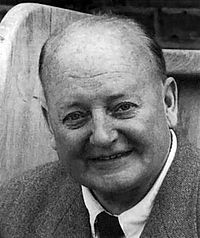
Maurice Nicoll, author of The New Man

Now, the Sabbath. This word means the complete separation from the world and its cares. What does this look like? Here’s an example: your wife (or your husband) is flying to Chicago, and though you know all the statistics about how safe it is to fly compared to driving, you’re still a little apprehensive about it. But once she’s landed and has called you from the airport, your apprehension disappears. (Now all you have to worry about is her being in Chicago.) Your cares about her flight have disappeared. She has landed safely, and that’s that. You no longer have to think about it. It’s done. This is the psychological state we must master if we are to bring our ideas into manifestation. It’s called “letting go,” and it is so important that an entire commandment was assigned to it. Once we have organized our thinking around the idea and we have tailored our actions so that they express those thoughts, we must relinquish all attachment to the outcome. We have built it, and they will come. We have become the idea in our thoughts, our words, and our actions. And the universe responds to what we are.

But rather than be a Sunday-go-to-meetin’ kind of Christian, forgetting to walk the talk the rest of the week, the Christian Mystic knows to separate herself from the outcomes of all of her prayers. She organizes her thinking and her actions, and then goes about her life, knowing that God will give the increase. Taking Sunday off allows the rest of the week, your life, to consolidate its gains and to heal its wounds. It’s a good thing!

The Bible is not a book of rules; it is an operator’s manual. It tells us how to live, not what to live.

Posted in Lessons | Leave a comment

The Fall of Me

Kabbalistic Wisdom

Betrayal is a horrible feeling. It hits us in the most primal areas of our psyche. One person says to another, “I will be there for you,” and then they leave, and you find yourself alone with nothing to stand on. Your home, your sense of self, your means of support – all vanish overnight. Everything you thought you knew is suddenly questionable. It is like being stripped of your clothing and thrown out of the city gates in the dead of winter.

Personal abandonment is the first of all fears – it is built into us at birth, the bare wire that stretches between the heart and the pit of the stomach.  We carry it with us our entire lives, and we learn to substitute the need for parent with the need to belong, whether to another person, our family, a group of friends, or to a society. The larger and more over-arching the projection, the closer it resembles the original dependency – the mother, the father. Ideologies, governments, and social contracts take the parental position in our sense of the world. We make them our providers, our protectors, our comforters, our teachers. And with every attachment we forge, we plug ourselves that much more into the world.

Human beings have the longest period of post-natal dependency of any other species on Earth. Scientists say that this enables us to develop our prefrontal cortex (the reasoning, decision-making part of the brain) further and more exquisitely than any other animal. All of the energies that would have gone into raw survival skills have been re-channeled into growing a better computer. The nurturance/dependency bond between mother and infant also has to be extended in order to serve this longer time in the nest. But while the brain is developing, so is the ego. The weeds grow alongside the grain. What would have been curtailed in order to serve the exigencies of survival in a world full of immediate danger has been allowed to develop far beyond the natural balance of self and other.

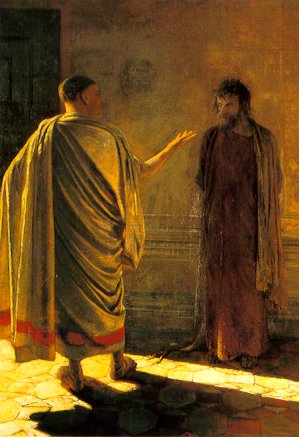
What is truth?

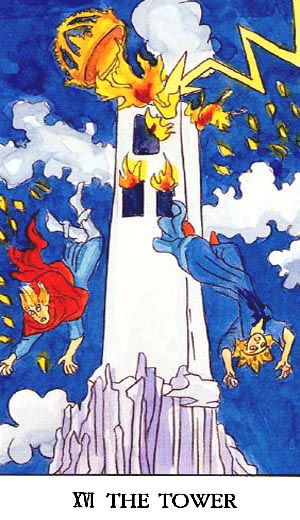
Spiritual development is designed to weed out the false dependencies that grew up alongside the deeper, more reflective self. The cosmo-conception that required a more finely-tuned vehicle for its self-expression foresaw the problem and thus put in place a way for a course correction. One had to compensate for the other. In order for gains to be made on the one side, other less desirable traits had to run loose for a time. The I AM became the Me. But it was known from the beginning that the Me had to die. The Me knew something was wrong, and it knew that the plot laid against it ran all the way to the top. So it developed all manner of counter-measures to buy itself more time. Based on its self-conception, the Me built up institutions, towers of reasoning within which it could hide. The more elaborate its fortifications became, the more confidence it had in its own ability to manufacture truth. Finally, that confidence turned into arrogance. And now the end is being hastened, if for no other reason than to alleviate unnecessary suffering.

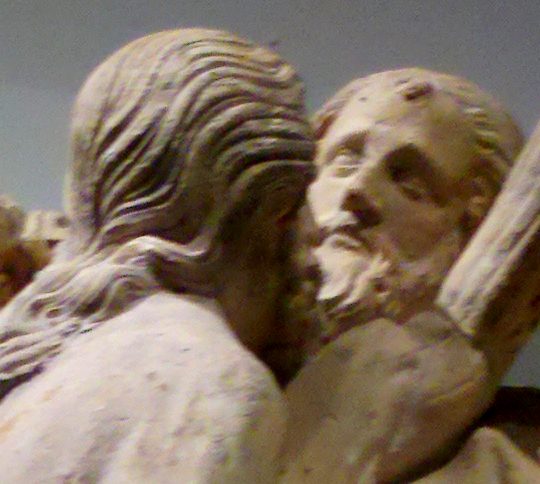
Judas Kiss

It is time to stand in the Holy Place. The problems of the world cannot be solved in the world, because those problems are spiritual, not physical. Scrutinizing the cracks in the foundation stones of our institutions will not bring about change. We have to look up. We have to re-energize our spiritual life and place our dependency where it belongs. Unplug from the 24 hour news cycle and spend that time in prayer and meditation. Counteract greed by giving more of yourself. Fight the “system” by denying its demands, especially the ones that have lodged themselves in your cells.

The day the flesh shapes, the flesh the day shapes.

– the dying thoughts of Duke Leto, Dune

Posted in Lessons | 3 Comments

Presence – not sold in bookstores

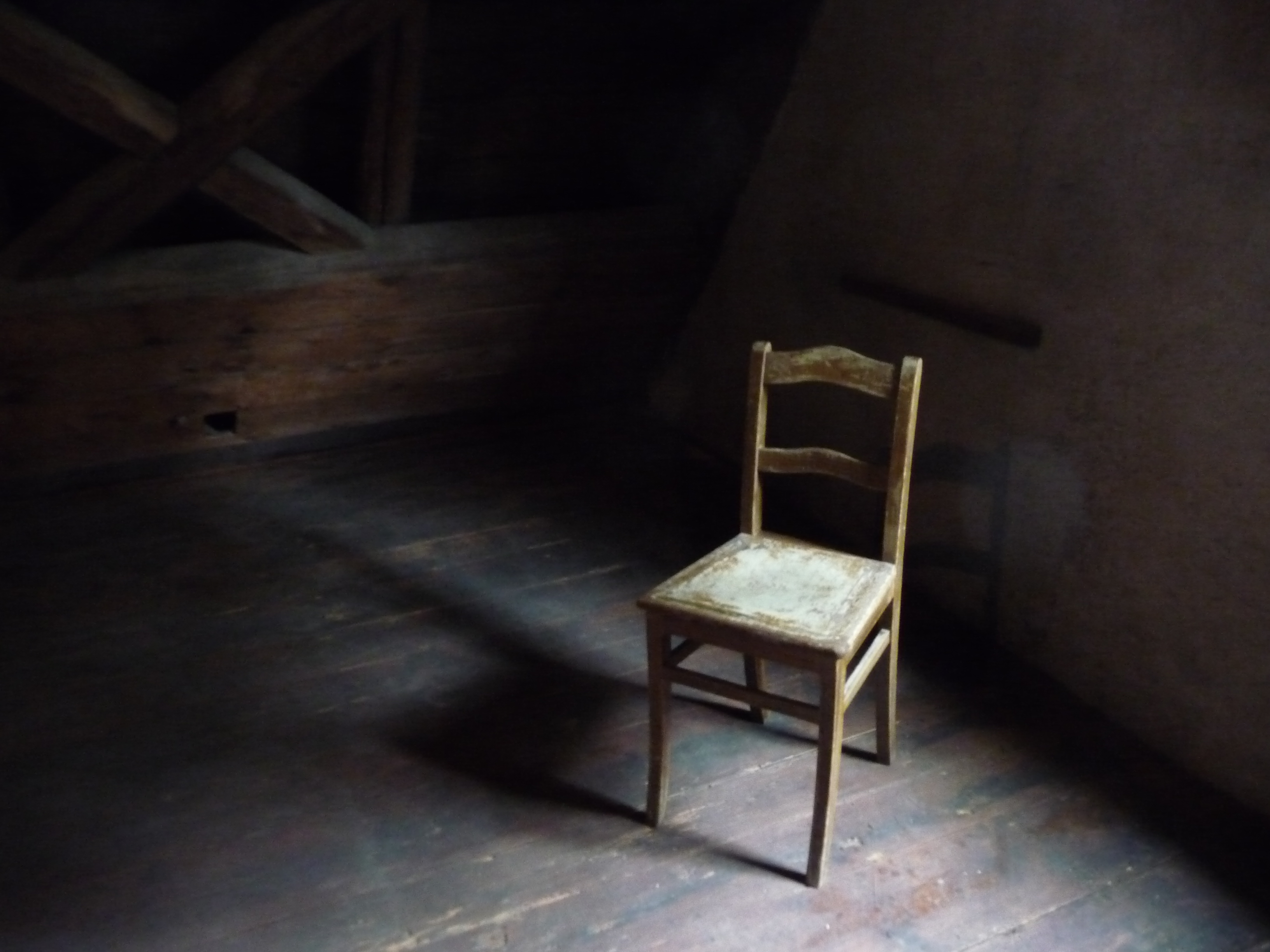
Sometimes you can get to know a thing by its absence. In this article, we are going to examine presence, what it is and what it isn’t. It will require some imagination, but not more than you can muster. It is really quite easy. Here’s how it goes:

If you are sitting in a room, look around and get a sense of it, the way it feels, its atmosphere. Feel the life in it.
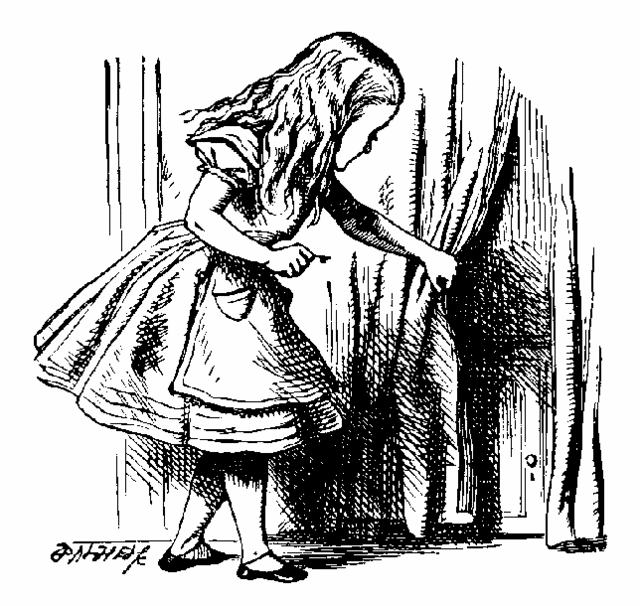
Once you have that flowing in your awareness, see the room the way it is most of the time, namely empty. No one there. Imagine that you are a fly on the wall when the room is not being used. Allow yourself to feel what that feels like. Just a stark, empty room. No atmosphere, no presence, no life.

This can be an unpleasant feeling. Its only purpose is to show by contrast what presence is. Once you’ve gotten the feeling, let it go. Don’t stay there any longer than you have to.

Now imagine that there is a screen in the corner of the room, the kind that people use to dress behind, as in a doctor’s office. The screen goes from the floor almost to the ceiling. You cannot see what’s behind it. For this part of the exercise, imagine that someone is sitting quietly behind the screen, just sitting there, not speaking, but hearing and understanding everything that’s going on in the room. Be with that. Be aware of that awareness, that presence. When you’re comfortable with it, let it go. The purpose here is to simply recognize what the presence of another person feels like when you cannot use your senses to register them with.

Next, think of someone you know pretty well, someone you know the feel of, and imagine that they enter your room, the one you’re sitting in, that they come in without their body. You cannot see them except in your mind’s eye, but try to strip that out of your awareness, so that all that’s left is their presence without any visual or auditory clues whatsoever. How does their presence feel to you? Do you feel good with them around, or do you feel uncomfortable? How does their presence affect what’s going on in the room, or the way you see what’s going on in the room? What is different about the atmosphere of the room when their presence is there?

Now, remember what the room looks like empty? Using that feeling as one pole of the spectrum, put yourself at the other pole. How does your presence affect the room? If someone else were looking at the room in this same way, how would your presence look to them? How would it feel? When you go to a meeting, or to church, or when you arrive at your place of work, what difference does you being there make on the overall atmosphere of the place? What changes when you show up?

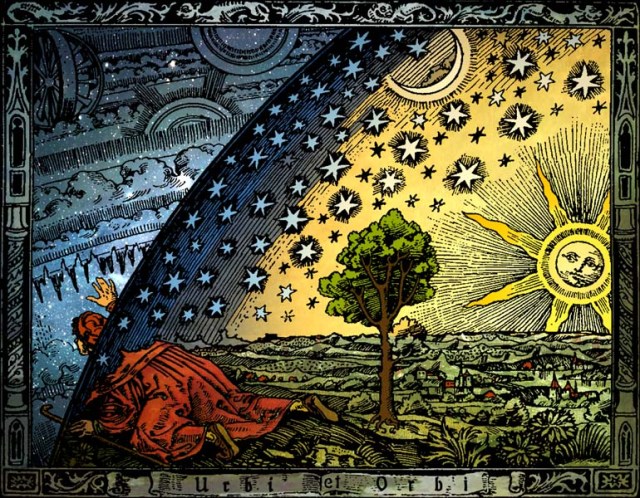
If you do this in earnest, you will become aware of your own presence as surely as if it were a body that you have but were unaware that you had until now. And in fact, this is what it is. It is another body distinct from your physical body but every bit as real. It is the body you will take with you when you die. So it would behoove you to get to know it, how it works, and what you can do when you are in it. And one of the things that you can do is communicate with God. Presence to Presence. Not with your mind, but with your presence. Let’s be really clear about what “mind” is. It is not your presence. It is not “you.” It is a tool that you use, and you use it primarily to navigate in this world with your physical body. You use it to compute, to analyze, and to compare and contrast the situations and events of everyday life. That’s all. You cannot move about in your mind; you can’t use it as a vehicle the way you do your physical body, or your car. You can construct scenarios within it, you can imagine forms, and you can interact with those forms, but unless you bring your presence to the mix, you are simply watching a movie that you have created. Presence is the driver in the “car” of your mind. If you get to know your own presence and you get to know your mind, then you can travel within the realms that interpenetrate this world we live in.

This is fairly advanced stuff. Not the kind of thing they talk about in Sunday school. But unless you get to know this “place” and how to function there, you are not going to know how to function in the afterlife, at least not without a lot of help. And you won’t really know the fullness of your own being in this life either. Unless you know your own presence, all you have to go on is your mind. And what a limited instrumentality that is! The mind is like a computer. Without someone to operate it, it can only do what it has been programmed to do. Nothing more. Look around you. How many people live their lives that way?

Remember the old adage: there is more to the unseen than there is to the seen. Isn’t it time to get to know the real you?
Posted in Lessons | 3 Comments

A Quiet Mind

A quiet mind is not a blank mind. It’s words that crowd out consciousness. Endless chattering, internal arguments/justifications, song-loops, worrying – these keep us from being alive in the moment. And isn’t this the purpose of spiritual practice, to be more alive? Jesus said, “I come that they might have life, and that they might have it more abundantly.”

At one point in my life, I was working twelve-hour days and stressing about all the things that had to be done. So to take my mind off of work and to get some exercise at the same time, I started taking Tae Kwon Do lessons. I thought it would be a good way to get my kicks, which turned out to be true, but they were mostly to my head and abdomen. I did find out, though, that nothing focuses your mind like facing off with a fellow student on the sparring floor. It really captures one’s attention.

I have known many adventurous people in my life who did things like set world speed records on skis, raced motorcycles, climbed El Capitan in Yosemite Valley. Today, we call them adrenaline junkies. Adrenaline can get you high, where “high” means an elevated state of consciousness. Once I slammed my motorcycle into the side of a car when it turned in front of me. I flew over its roof and landed in the street in the middle of traffic. My flying time seemed to last forever.  Today, we know that adrenaline does that; it focuses the mind on the immediate present, making time “slow down.” People who go out of their way to live life on the edge do it to get high, to force the present moment, to live in the now. It’s cheating, in a way, but it works. It’s like looking for God at the end of your rope.

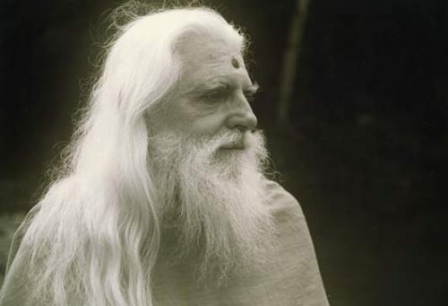
Master Subramuniya

But those who are good at such things have all come to the conclusion that attention, while focused, must not be obsessive. By this I mean that every element in an extreme situation must be given equal attention. Race car drivers, for instance, cannot focus simply on going fast. They must integrate everything in their sensory awareness in such a way that changes in one part immediately trigger a response in all of the other parts. This is called integral awareness, and it leaves almost no time for thinking. In fact, thinking gets in the way.  Intense activity forces integration, so trying to quiet your mind by “doing nothing” does not work. Stopping thought does not mean blanking your mind. The mind must be alive, intensely alive.

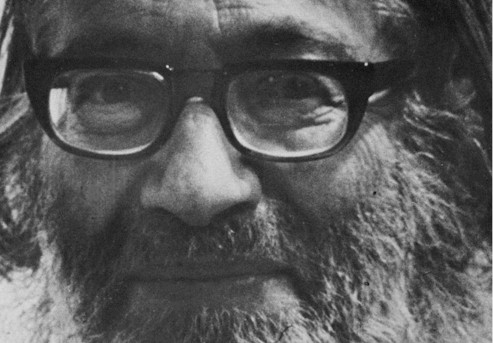
Murshid Samuel Lewis

A guru once said that unless you are as eager as a man whose hair is on fire to jump into a pool of water, you cannot reach enlightenment. We cannot approach our meditation the same as a household chore. We have to come to it as though our life depended on it. The mind has to know that you are serious. Otherwise, it will only play along until it gets bored, which for most of us is about 1 1/2 seconds. Breaking through mundane awareness has to be as important as food is to one who is starving. If not, the cares of this world will eat you alive. In the end, you will wake up and wonder where on earth you have been.

Posted in Lessons | Leave a comment

Loving Your Enemy – the paradox

Photo by William Noland

The commandment to “love your enemy” is pure paradox. After all, the two words are mutually exclusive, strictly speaking. The verbs to defeat and to nurture do not go together. How do you engage your enemy and love him/her at the same time? It just doesn’t make sense. But this is, in fact, what the teaching says: Love your Enemy. So either the teaching is wrong, or there is something deeper.

Many people see paradox as a mental trick, as in, “Everything I say is a lie.” There is no logical conclusion to be had in that statement. It can neither be right nor wrong. Even the Belgian painter, Rene Magritte, who illustrated the difference between a real object and its representation only got it half right. Of course the painting of an apple is not an apple. Representations of things are not the things themselves.

This is not an apple

Paradox is more than a trick; it is a technique. Paradox is taking a real apple, holding it in your hand, and saying with certainty, “This is not an apple.” Absurd, right? That’s what your brain will tell you. In fact, your brain has already told you what an apple is. It has told you what it is, what it was, and what it will be. You “know” what it will taste like even before you bite into it. You know it so well that anything that doesn’t fit in with your preconceptions about “apple” will go by completely unnoticed. Your experience of “apple” can only occur through the filter of what you already know about it. The net effect of holding a real apple and declaring, “This is not an apple,” is to cause your brain to look deeper, to look again. Your refusal to filter the object will reveal more of what it is, above and beyond what you already know.

Using paradox in this way can be a source of great insight and revelation. But it is almost entirely an intellectual exercise. The situation changes drastically when you apply it to your enemy. Here, we encounter more than our intellect – a lot more. If you’ve ever squared off with another human being who intends to do you serious harm, you know what a difficult experience it can be. If you pretend that the person facing you is not your enemy, you are in denial, and you will get clobbered. If you try to reason with your enemy, he will in all likelihood use it as an opportunity to learn your weaknesses, and you will get clobbered. If you lay down your arms and refuse to fight, he will think you a coward, and you will get clobbered. In short, if you regard your opponent as anything but what he is, you are going to lose, possibly in a big way.

The word enemy has a specific meaning. It implies a certain parity, at least at the outset. In a fight, anything can happen. Nothing can be taken for granted, as history has shown us in countless examples. Size and strength, while intimidating, do not always win. So at the critical moment, which can be at any turning point along the way, the ground can shift, and the sure thing can be upended. A real fighter knows this and is always looking for the dime on which to turn. But to hold that consciousness, he/she must never see the opponent as anything other than an enemy. If he sees him as the person who’s kicking his ass, he is no longer an enemy but an oppressor. Parity has been lost. Eye to eye has become flat on the ground looking up. You become the victim and he the perpetrator. Suddenly you are different. You are you, and he is the other. The connection has been broken.

The chances that war and fighting will vanish any time soon are less than 0.00% Small gains have been made in treating the enemy with respect and dignity. The real crime is not so much warfare as it is hatred. Warfare will always be with us, but hatred kills from within.

Posted in Lessons | Leave a comment