Meditation—put it in park and let it idle

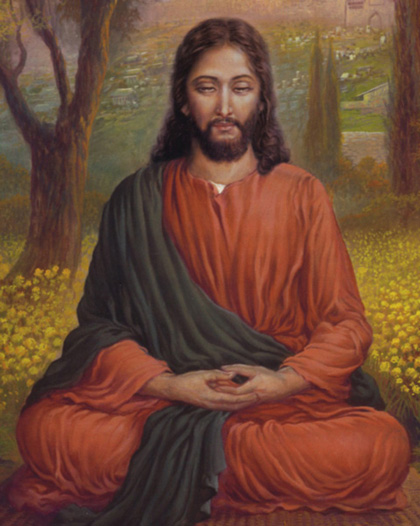
meditation-techniquesThere’s a lot going on in the body that we are unaware of—nerves firing, lungs expanding and contracting, blood moving through arteries, veins, and capillaries. It’s as though these activities have nothing to do with us, that they are happening somewhere else or to someone else, not to us. But, there they are, right beneath the skin, just out of view and, apparently, out of mind.

Shutting down the mind, which is what many people think is the purpose of meditation, is impossible. Even thinking—as much as we like to be in the moment, inwardly silent, focused, and aware—cannot be stopped. Quiet one layer and another reveals itself, like the layers of an onion. It’s thought all the way down.

No wonder meditation frustrates the hell out of us.

meditation 2We are in the universe, not merely on it or of it. We live in a sea of mind, a mind that is intelligent and self-aware. That mind is always thinking, but not in the way we ordinarily think of the word. It is thinking in that one part is relating to another part, which in turn relates to yet another, until the entirety of the thing is connected to itself through every available avenue. How many connections is that? More than could possibly be counted.

The human brain is said to be the microcosm of this vast network, having more connections amongst its neurons than there are stars in the galaxy. That’s a lot. And yet for the most part, we are completely oblivious to what goes on in there. And what keeps us so distracted? Simply, it’s the external inputs. It’s what we see with our eyes and hear with our ears and the thoughts that are nothing more than knee-jerk reactions to those stimuli. That’s it.

Shifting our awareness from the out there to the in here may not be the nirvana you were hoping for, but it’s a whole lot closer than you might think. For one thing, when we get in touch with the inner workings of the body, especially the ones wo-MEDITATION-FOR-KIDS-facebooke can’t control, the closer we are to the autonomic nervous system. Why is that important? Because, the autonomic nervous system is in direct contact with the universal mind through which everything that exists connects.

It is face to face with it, continually and always.

Have you ever opened up a wall and seen the electrical wires that power your lights and appliances? Rather dead and inert, are they not? It’s the electricity that’s important, even more important than the wires, though the wires are certainly necessary. It’s the same with the circuitry in your computer, only infinitely more so. The electrical impulses in a computer are so complex and varied in their tasks that they seem almost mystical. How much more, do you suppose, are the energy systems in your body, the ones you carry around with you 24/7? You have to ask yourself: am I carrying them around, or are they carrying me? Hmmm.

Could we not imagine that the world we “see” is the least important part of our existence, that instead it’s the world we don’t see that is more real?

The human body is layered like the electron shells of an atom or the orbital paths of planets in our solar system, each layer a more subtle and more complex system of vibratory intelligence, scintillating with life and cosmic energies. Is it any wonder why gurus and sages throughout history have instructed us to pay attention to our breathing? Could it be that within that simple physiological act lies the secret to life itself?

Make no mistake, the inner organs of our body are just as much external objects as anything else in the world. They are composed of matter, which by itself is like the wiring in your house—rather dead and inert. But it’s not the matter that we’re focusing on, is it. Instead, we want to sense the intelligence that’s moving through it, that’s using it, using it for…for what? Is it the breathing that’s the interesting part, or is it perhaps something deeper, like maybe the will to breathe?

We have to realize that intelligence—that unnameable thing that informs energy—is absolutely intangible. It has no locus in the physical or non-physical world. It is without beginning or end, has always been, and will always be. It is completely outside of the context of space and time. Before the worlds were, It was. Everything possible exists within it as a potential, and the possible combinations of that potentiality are literally infinite.

All of this is discoverable within the breath.

Who knew?

It helps to know a little bit about the human body—your human body. It is your interface with reality. Not the physical flesh of it, but the energies that course through it. These are the rightful subject of our inner investigations. Follow them, as a fisherman works his way upstream. The more subtle the currents, the higher are their vibrations, the closer they are to the source. Observe them; they are closer than your hands and feet.


Posted in Lessons | 3 Comments

What Are Numbers?

numbersNumbers are the symbolic representations of the relationships that make up reality. Normally, we don’t bother seeing them this way. It is easier to recognize a 2 or to visualize two things than it is to contemplate the nature of two-ness.

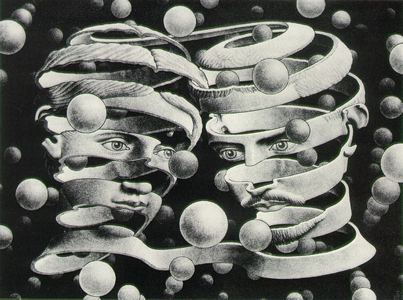
ripplesBut what is two-ness but the principle of polarity, or the principle of division—one into two? Psychologically, we could call it the other, or the awareness of the objective world. Or, it could be the recognition that everything we see “out there” is really a projection of what’s going on “in here.” Two-ness, then, is also the principle of reflectivity.

drum-beatIn sound, there is one thing striking another, producing a secondary manifestation—a shock wave moving out in all directions. Two-ness, therefore, also represents action and reaction, the very foundation of physical reality.

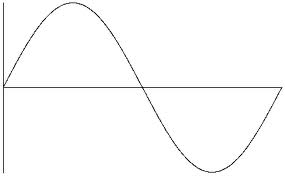
The Sanskrit word for the heart chakra is anahatha, which means “not hit”— the sound that is not made when two things strike each other. This gives us a direct insight into one-ness, or what in metaphysics is known as the Unmanifest. In one-ness, nothing moves, nothing is reflected, and there is no “other.” It is the stillpoint between oscillations, the horizontal line resting at the mid-point of every sine wave.

SacredHeartWhy is this important? Because, in order to contemplate spiritual things, we must be able to think in terms of principle and not merely in terms of appearance.

sine waveWhen theologians say that God is omnipresent and omniscient, this is what they are talking about. Principles are in all places simultaneously. And they are the “intelligence” of all that is. Likewise, when they say that God is invisible, they are saying that God is not a “thing.” God is the Principle underlying everything that exists, has existed, or will exist. God is the potentiality of all things, the realization of all things, and the history of all things. There is nothing that exists or can exist that is not God.

So, when we work with numbers, what we are really doing is exploring relationships. Four-ness is not a 4 any more than the word “orange” is an orange.  If we are to think intelligently about real things, we must learn to think in terms of principle and not in terms of appearances only.

Sure, it may look like a rabbit hole, but the real world always does.

rabbit hole

Posted in Lessons | 1 Comment

The Five Vows

The Five Vows is now available on Amazon in ebook format. The soft-cover edition will be available soon.

This book is a compilation of everything I have written on the vows of Humility, Purity, Poverty, Obedience, and Service here on The Mystical Christ website. But, I discovered early on in the process that there is a BIG difference between writing short articles for a blog and writing a book. Therefore, all of the material I gathered from the blog has been greatly expanded, modified, and edited—in many cases completely re-written. You will love the results!

And for those of you who have wondered why I haven’t been posting new articles on The Mystical Christ of late, now you know.  I have spent hundreds of hours putting this thing together—a real labor of love.

For an excerpt, check it out on Amazon!

The Five Vows

Posted in Lessons | 2 Comments

Our Elephant

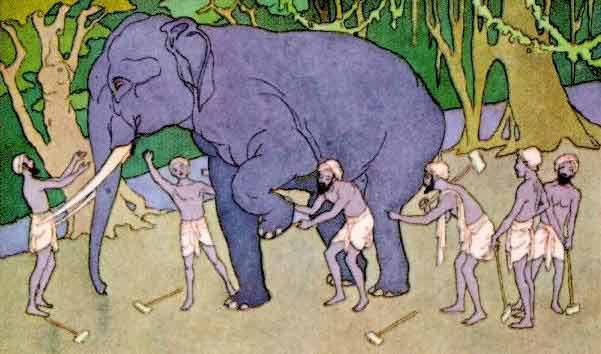
elephantThere’s a Hindu parable about four blind men who attempt to describe an elephant: one, touching its leg, says, “The elephant is a pillar.” The second, touching its trunk, says, “The elephant is a thick club.” The third touches its belly and says, “The elephant is a big jar.” The fourth blind man feels an ear and says, “The elephant is a winnowing fan.” Spiritual seekers argue about religion in the same way. The “true” religion is the one that most closely resembles their experience of God.

As travelers on the spiritual path, we cannot afford to ignore the reports of our fellow sojourners. We are all experiencing the same God—only our individual descriptions differ. We need to respect the approaches of others, and perhaps learn something new about our own in the process.

Like trunk and tail, the basic principles of Christian Fundamentalism and the New Age Movement seem poles apart. But if we relax our opinions about them, and if we delve deeper into the spirit underlying their beliefs, some surprising similarities begin to emerge. Both groups are trying to describe the same “animal”—God.

crossGiven that polarized issues tend to grow farther apart with time, these two bodies of believers (cousins after all) view each other with increasing suspicion and antagonism. Yet both lack, to some degree, the best of what the other has to offer.

Criticisms on both sides abound. Fundamentalists say that New Agers are too open-minded. Their non-traditional interpretation of scripture is heretical, and their description of God as “principle” is too mental. But to the New Agers, the Fundamentalists’ interpretation of the Bible is overly literal and inconsistent with modern science. Its “Spirit-filled” enthusiasm is not mental enough, and its insistence on possessing the “only” truth is chauvinistic. However, if we examine the teachings of these two groups with a spiritual consciousness, we find that both Christian Fundamentalists and the proponents of the New Age Movement are really saying the same thing:

1. The Truth
Fundamentalists say that the Bible is the only true scripture because it is the inspired word of God. This strikes New Agers as narrow-minded, anti-intellectual, and bigoted; and yet, they too believe that the intellectual mind is not the source of Truth. In other words, God cannot be figured out. Where do the two sides agree? Both are saying that Truth is larger than the individual and that it must be received from above—inspiration comes from a larger dimension than the limited human mind.

arrowsFundamentalists, however, say that the inspiration has already been received, and has been exclusively and infallibly written in the Bible, whereas New Agers say that Truth is an ongoing, personal experience and that anyone can get it (if they try hard enough) through meditation and by living Truth principles in everyday life. But the common denominator—receiving—is the one thing that both sides agree on. Both are saying that God is not a product of the intellect.

The importance of this cannot be overstated. The current trend says that God, sacred mythology, and all things religious are merely human inventions—coping mechanisms to help us confront the meaninglessness of existence. Secular science wants to seal the mind within the tomb of the human skull, and make death the ultimate fade to black—the end of life’s drama. So the Fundamentalists and New Agers are united on this score. But neither side realizes it.

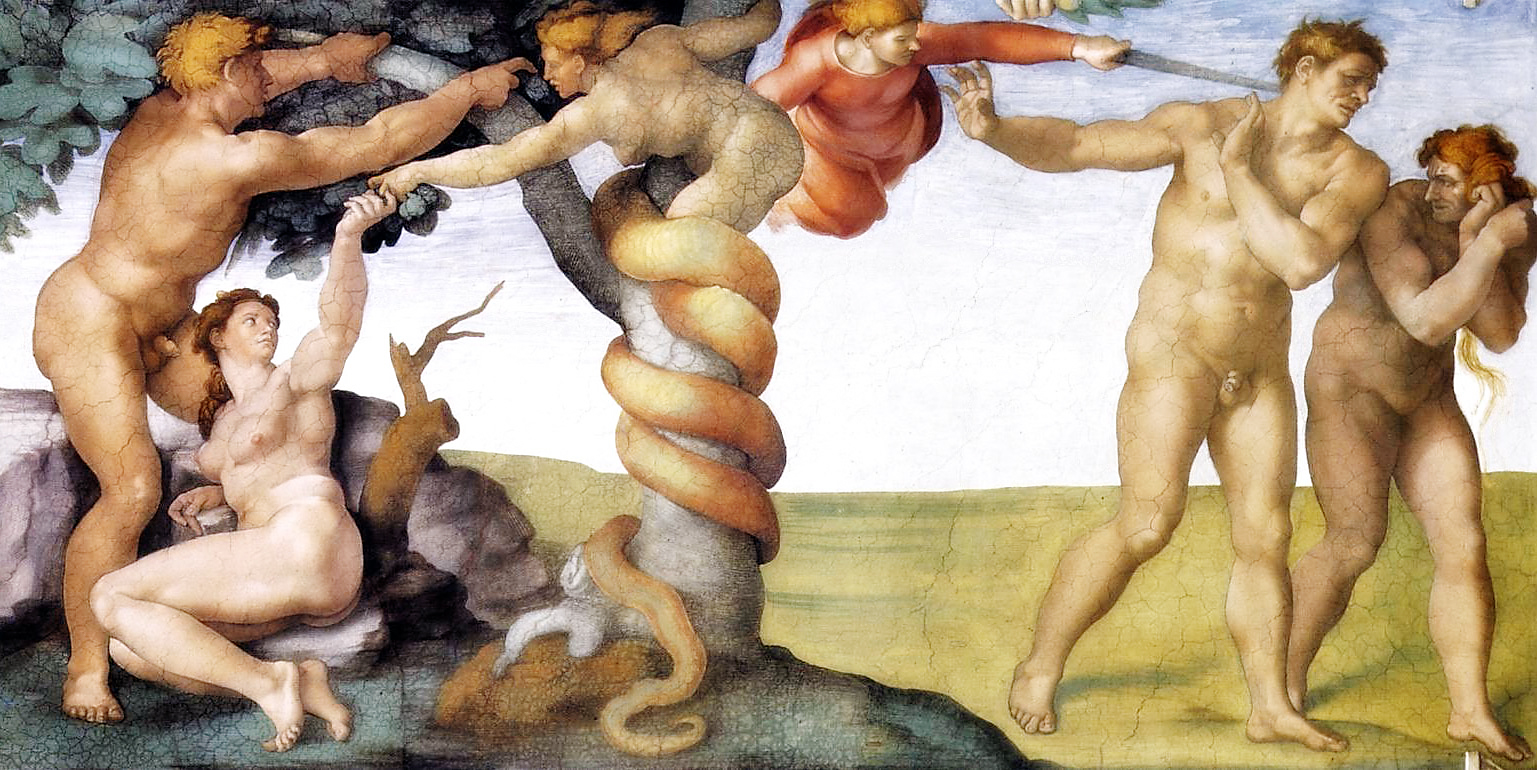
adam2. Born in sin
Fundamentalists separate humanity from God by claiming that people are inherently sinful. We might be an expression of God, they say, but we are a fallen expression in need of redemption. On the other hand, New Age teachings say that people are perfect just the way they are; we have never been separated from God; the sense of separation is an illusion, and is, therefore, an error in our thinking. If it’s an “error,” it cannot be an inherent quality. The only thing inherently sinful is the identity entity of ego-consciousness. This is the source of the illusion of separateness—the “father of lies,” as Jesus called it.

The Fundamentalist term “sinful humanity,” therefore, is spiritually identical to the New Age term “ego-consciousness.”

3. Spiritually identical
What does this term “spiritually identical” mean? It means that what is specific to us is general to God, and what is specific to God is general to us. We have multiple definitions for the word “love,” for example, but God has only one. Love is either present, or it isn’t; actions are either motivated by love, or they aren’t. We try to get specific by saying that love is kind, accepting, patient, and so on, but this is simply the mind’s attempt to define a feeling.

Feelings cannot be defined—they can only be felt.

The feeling of love is far more real than the concept of love. It is a state of being, not an idea. Therefore, when two things appear on the surface to be dissimilar, they can actually be identical in spirit, because they derive from the same principle.

guru4. Your personal savior
Christian Fundamentalism says that in order to be saved you must have a personal relationship with Jesus Christ. But…if we consider that Fundamentalists believe that Jesus Christ is the mediator between God and man, then what they are really saying is that our access to Truth is within us and not through an external teacher, priest, or guru.

This declaration of spiritual independence is a fundamental New Age concept. God is not in the church, temple, or ashram, and God is certainly not limited to any one individual, such as a teacher or guru. We do not have to go anywhere or to anyone except within ourselves to find the kingdom of heaven. Even if we believe that Jesus is separate from us, connecting with him is an internal, personal affair.

The keyword is “personal,” meaning that there is a direct connection between us and God.

Anatman5. Jesus Christ is the only Son of God
A Course in Miracles (a major influence in the New Age Movement) calls our true collective spiritual estate the “Sonship.” It implies that our sense of separateness from each other is an illusion, that there is only one Son of God, and together WE are it.

Another contributor, Buddhism, also expounds on the illusory nature of an individual “self.” This is precisely what spiritual seekers in both the New Age Movement and Christian Fundamentalism are trying to rise above—the illusion of ego-consciousness, or the sinfulness of humanity.

6. Sin and Evil
It is impossible for anything to be separate from God, and yet sin is defined as being just that. Hence, for the New Age Movement, sin is an illusion—it cannot exist.

Fundamentalists say that all are made one in Christ (the Sonship), and that sinfulness cannot abide in his presence. Christ knows no separation from God: “I and my Father are one.”

Fundamentalists undeniably place great emphasis on the reality of sin, the duality of good and evil, on God and the devil. New Agers do not. Though their emphases are different, it’s easy to see that both are striving to realize the same ideal—oneness with God. In Fundamentalist terms, any of us could reasonably “confess” that we are sinful because most of the time we are all in ego-consciousness.

ChristJesus said, “Know ye not that ye are gods?” And Paul the apostle continually refers to “Christ within you, your hope [potential] of glory.” In principle, we can restate Jesus’ question as an assertion: “You do not know that you have infinite potential, and until you do, you are stuck in your limited ego-consciousness.”And we can restate Paul’s statement as “Sure the Christ is within you, but when are you going to let him out?”

To say that Jesus Christ is the “only” Son of God is just another way of saying that the Godly part of us is the only part that is Godly. It has no more to do with the personality of the man Jesus than it does with our own personality. He may have overcome the limitations of his ego-consciousness and realized his oneness with God, but he was careful to say that we must do the same.

This is not to say that there is anything unholy about the physical body or its functions. It simply says that the Christ within us, that part of us which is in perfect at-one-ment with God, is the only real part of us. This is who we are. All the rest of it we made up.

Spiritual-Awakening4In conclusion:
It is discouraging to see good people fight with each other. Fundamentalism can only be a threat to free thought as long as free thinkers fail to recognize their own core beliefs within Fundamentalism.

In their essential doctrines, the two camps share the same values. But, unless both sides can look to the powerful similarities they share, they will suffer the loss of what the other has to offer. The poet Shelley wrote, “The eye sees what it brings to the seeing.” Each of us must look beneath the outer shell of the other’s teachings, so that we can see their original intent, and then embrace those who love God and strive to do God’s will.

Who knows, if we can bridge the gaps within our own Christian Community and learn to respect and support each other, maybe someday we can reach out in harmony to the world’s other believers, not just with tolerance but with genuine understanding. Maybe this broader point of view will serve as a catalyst to help the fundamentalists of the world see the deeper dimensions of their own teachings. After all, “only” one Son, “only” one Prophet, “only” one Truth—are we really that far apart?

“Blessed are the peacemakers, for they shall be called the children of God.” –Jesus 

Posted in Lessons | 8 Comments

Everyday Spirituality for the New Year

SUN

Peachpit.com

by Michael Maciel

Learning how to access our own wisdom is more important than learning someone else’s techniques and practices. Doesn’t it make sense that everything we need in order to grow spiritually is already right at our fingertips? Here are eight spiritual tools that we were born with:

  1. Fill your body with light. Every cell in our body is filled with light and energy. When we allow ourselves to experience this directly, it enlivens our entire system. It also tunes us in to the divine intelligence that created us, and it reboots the original programming we were created with in the beginning. This light energy in our bodies, and the intelligence inherent within it, is the interface between us and God. When we put our attention on it, it grows stronger, and so does the interface. Our intuition gets better, events occur with greater synchronicity, and our thoughts manifest much more quickly. This is not a patented technique. We were all born with it.
  2. Sit up straight and stand erect. This is a yoga exercise you can do all day long. In Buddhism, there is a concept called axis mundi. It means “center of the world.” It’s where Buddha sat when he came into enlightenment, and it’s represented in Christianity by Christ on the cross. It is the lifting up of the serpent by Moses in the wilderness, and it is the Central Mountain of the World of the Ogallala Sioux. When the ancient philosophers insisted that the Earth was the center of the universe, they were talking about axis mundi (philosophy and science had not yet separated). By sitting up straight and standing erect, we are telling the universe, with our bodies and our intention, that we are one with axis mundi.
  3. Breathe. This is the first and last thing we do on Earth, and it is the most important tool in our spiritual tool bag. I saw a bumper sticker once that said, “Stop Holding Your Breath.” My reaction was, “Who, me?” It’s fear (apprehension and stress) that makes us hold our breath. And if Saint Paul was right when he said that perfect love casts out all fear, then breath and love are directly related. The formula is simple: when we breathe properly, our heart chakra opens.
  4. Be grateful. Don’t be grateful for what you are experiencing, be grateful regardless of what you’re experiencing. Gratitude is the reset button of spiritual energy work. No matter what’s happening or how you’re feeling, gratitude restores the flow of grace. Gratitude is the one virtue within everyone’s immediate grasp. Why is gratitude so important? Because it dissolves resistance. And resistance, according to Ohm’s Law, restricts the flow of energy.
  5. Relax. When I was a teenager, I was into alpine ski racing. You wouldn’t believe how slippery snow can be when it turns into ice, especially when you’re skittering across a steep slope of it at sixty mph. Next to strong leg muscles, controlled relaxation is the most important acquired skill. If your upper body gets tense, it becomes impossible to maintain balance and control, regardless of how strong you are. Similarly, when you’re walking on icy pavement, relax your shoulders and let them drop. This lowers your center of gravity and keeps your weight over your feet, making you less likely to fall. Spiritually, it works the same way: When we try to carry the weight of the world on our shoulders, we tense up. Rapid changes can throw us. Also, the smooth muscles in our bodies, like the ones in our stomach and small intestine, react to stress in a way that we cannot immediately control. They have a mind of their own, and like a tortoise with its head pulled back into its shell, they won’t relax until the coast is clear. Just telling yourself to relax is not enough. The body has to be trained over time to relax, through practice and repetition.
  6. 747Pay attention to your attention. If you’ve ever flown an airplane or sat next to a pilot in the cockpit, you know that the instruments inside the airplane are just as important as what’s going on outside. We have instruments, too, and they’re always reporting valuable information to us. But, if our attention is always on the externals of our life, those inner reports will go unnoticed. We’ll be flying blind in the dark. Remember, in life there is more to the unseen than there is to the seen. Learn how to read the unseen. Pay attention to your instruments!
  7. check valveFind a way to serve others. In water pumps, there is a component called a “check valve.” It’s a spring-loaded valve that lets the water flow in one direction only. We all need an activity in our lives that employs the spiritual equivalent of a check valve. This means giving one hundred percent without getting something back. The keywords here are giving and one hundred percent. Giving means giving something of value, such as your time or your money. (Compliments, promises, and pats on the back don’t count.) One hundred percent means that you give to everyone, not just those you like—no room for prejudice and bias here. Like the rain that falleth on the just and the unjust alike, you have to give freely without thought of return. Serving and gratitude go hand in hand. Whereas gratitude dissolves resistance, self-forgetting service brings that resistance right up to the surface and into the light where you can do something about it. So simple, so fast, and so elegant.
  8. storytelling2Change the past. Everyone has a story to tell, and the stories are usually loaded with drama. So and so did this; so and so did that. And now I’m a mess because of it. But these are just stories. The actual events are like the lines of the drawings in a child’s coloring book; we’re the ones who add the color, and sometimes it gets very messy. Unfortunately, the drama is too deeply embedded for us to do much about it. It’s like a bad computer program—only a skilled technician should attempt to change it. God is that technician. Ask God to change the story. The events will stay the same, but the story you tell yourself about them will work for you instead of against you. 

We do not need exotic and complicated spiritual practices to cultivate our spiritual energies. Everything we need is already within us. By simplifying our approach and our understanding of spiritual principles, we can achieve greater health, a higher consciousness, and a clearer conscience. The oracles of Delphi had it right: “WoMan, know thyself.” After all, what good is a spiritual practice if you can’t live it every day?

Posted in Lessons | 9 Comments

Mystery vs. Superstition

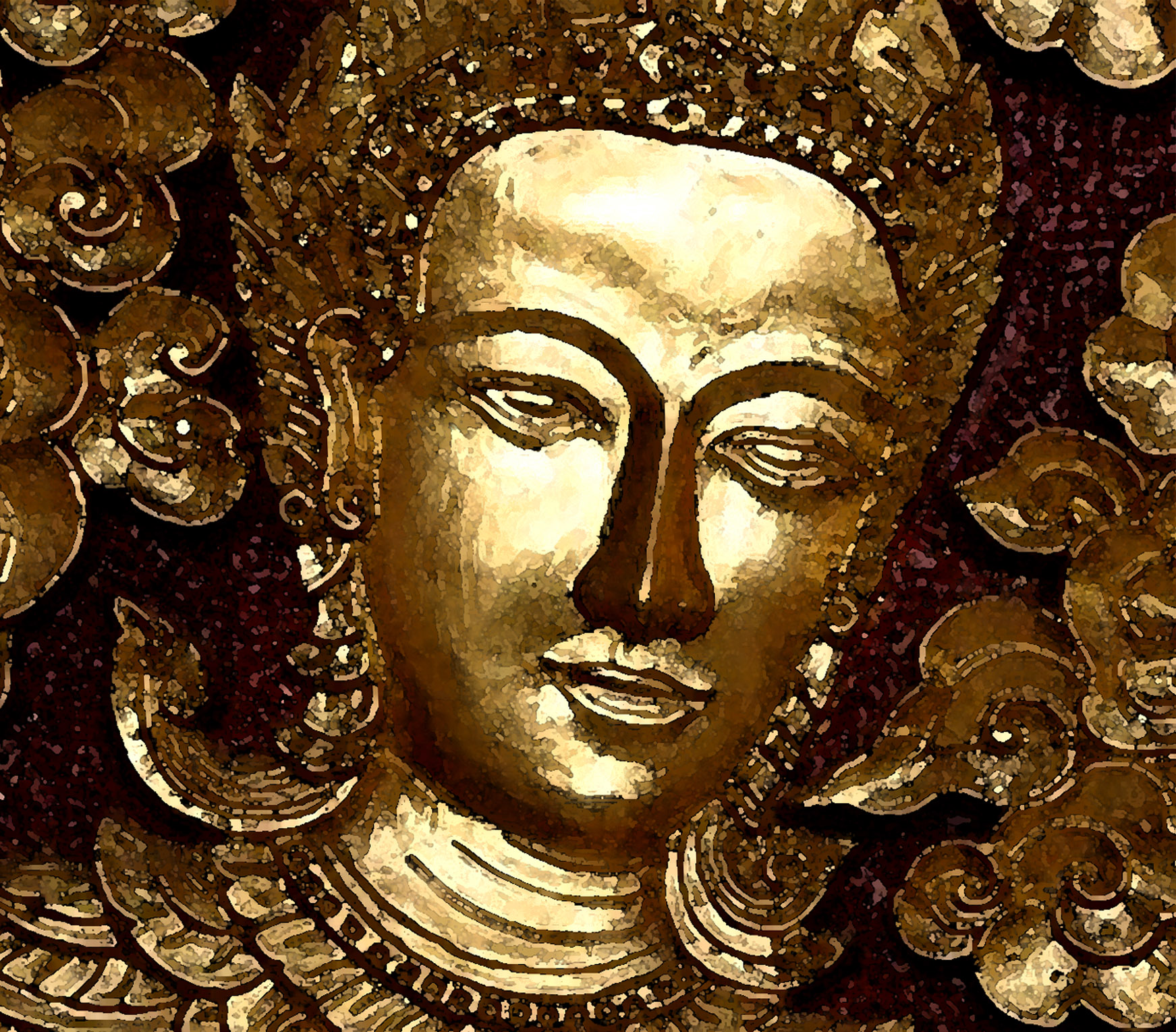
gold buddhaIt takes a certain kind of person who can be blown away by the Mystery of God and who at the same time can be in love with solving that Mystery. It’s not that we can ever know everything there is to know (who would want to?) but that we can know our place in the cosmos—we can know our own being, even if we can’t articulate that knowing to everyone’s satisfaction.

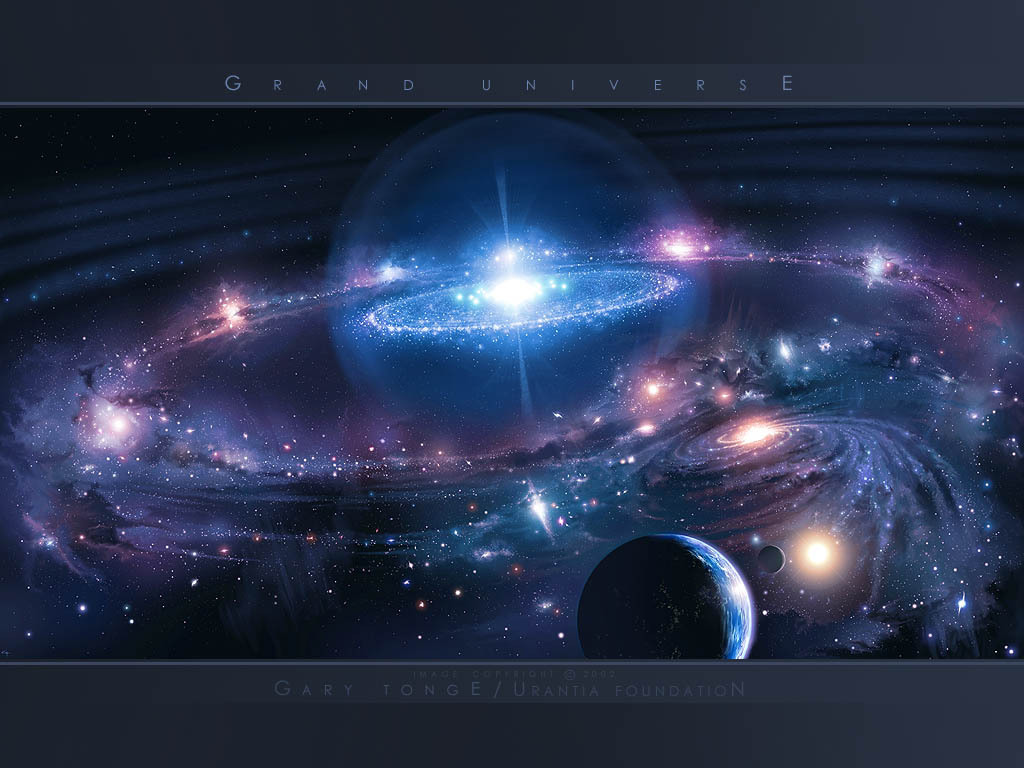
In this day and age, we are all that kind of person. Who among us has not looked at images from the Hubble Telescope and not been filled with a trembling awe. Those who haven’t had that feeling simply have not thought about what they were looking at. The sheer magnitude of the space we occupy is enough wipe your mind clean in an instant, if you let it.

cosmosThe same goes for Inner Space. We know that the distance between the atoms in our body is proportional to the distance between stars. Each one of us is both figuratively and literally a galaxy. If that doesn’t stop you in your tracks, nothing will.

We live in a Mystery. It is a mystery as holy as any devised by theologians, a mystery that at least in part inspired those theologians to write about the deeper truths and their inherently inexhaustible contents. We tend to think that science, as we know it, did not exist before the Middle Ages, but the truth is that it had not yet emerged as a separate way of thinking. Science was simply enfolded in the vestments of theology.

HierophantSir Isaac Newton, the father of modern physics, was a profoundly religious person, intimately familiar with the Bible and also the technicalities of astrology and numerology. He could see how it all fit together. He was a person filled with awe, but he didn’t let that stop him from investigating the Mystery to the fullest extent of his mind’s capacity.

It wasn’t until it started to gain traction that science, and the power it represented, began to lure the brightest minds away from the sanctuary and into the laboratory. It was then that the Mystery became a kind of enemy, something to be conquered rather than be swept away by. Carl Sagan was the first, in recent memory, to recapture the awe at the immensity of the cosmos, the “billions and billions” of worlds out there, each one a Mystery in its own right.

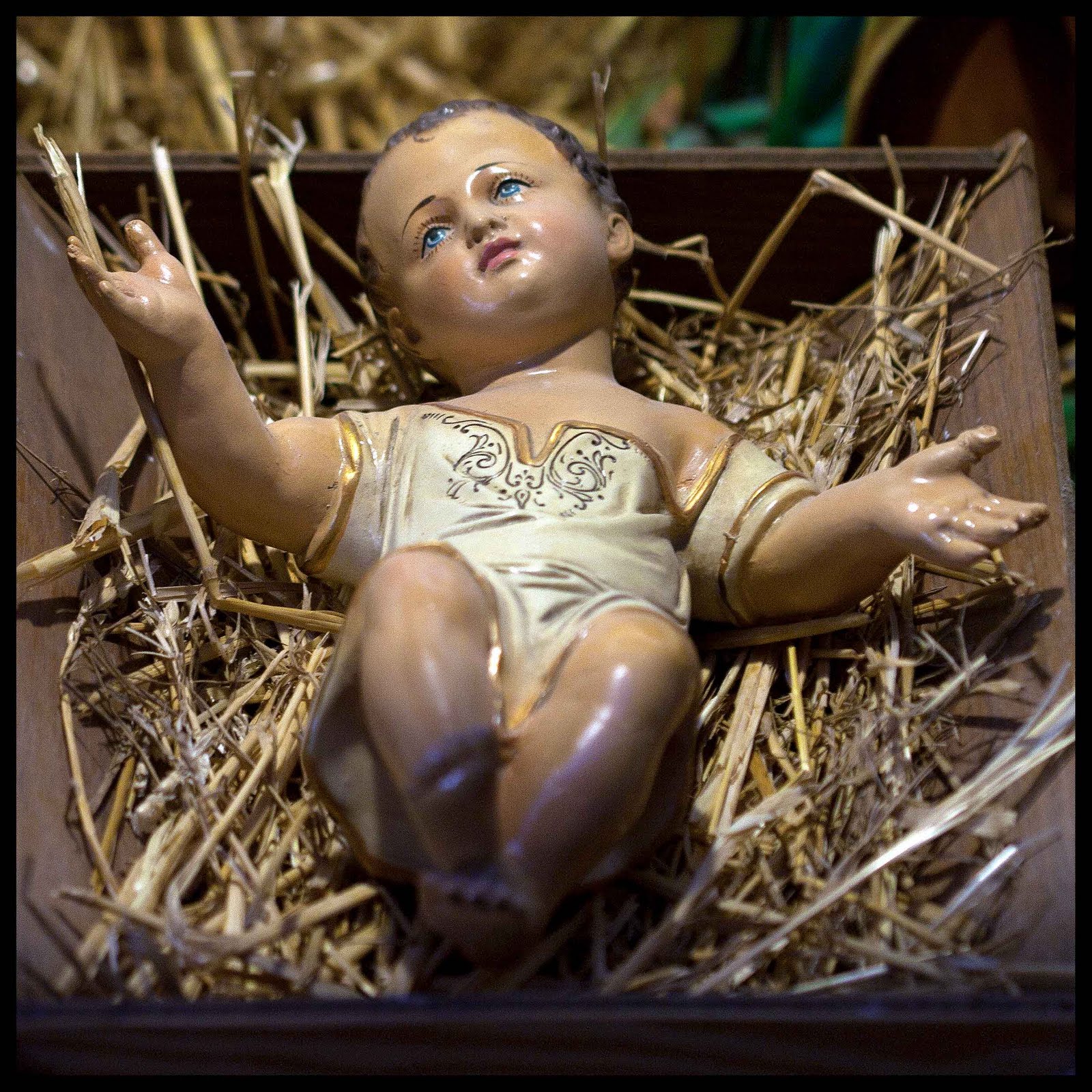
Baby-JesusSo, this is the question: Can we be both—can we see God in the world? Or will we, as those who have become intoxicated with the power of science, see the world as nothing more than a soulless stockpile of raw materials? Or…will we turn our backs on technology, letting our awe turn into horror, and see it, as Robert Oppenheimer did when the first atom bomb was created, as the “destroyer of worlds“? Will we abandon reason and the spirit of inquiry for the comfort of quaint superstitions and over-literalized myths? Will we opt for the mindset that sees God and Matter as separate? God the Absentee Landlord and the world as His failed experiment.

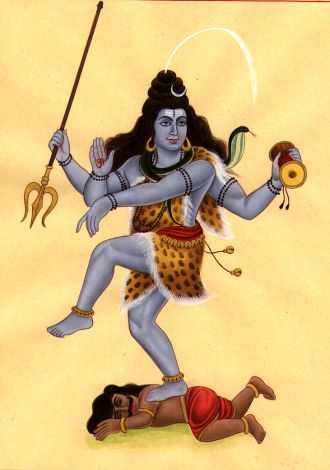
SivaIf we do take the latter course, we are no better than the power-mad scientists who abuse the world and its biosphere (those scientists whose sole motivation is their own profit and the profit of their corporate sponsors). In fact, we hand it to them on a silver platter. We say, in effect, “Take it! It’s not real anyway. It’s all going to end soon, and when it does, I’m gonna be raptured out of here!” This is the worst kind of superstition, the kind that justifies the abdication of personal responsibility for how it all turns out. This is where the pendulum turns into a wrecking ball—instead of restoring balance, it slams into a brick wall.

So, again, can we be both? Can we embrace the Mystery, be blown away by the magnificence and the splendor of it all, and at the same time peel back its outer garment and see the true rapture that lies underneath? This is the kind of person the world so desperately needs today. This is us—we are that person.

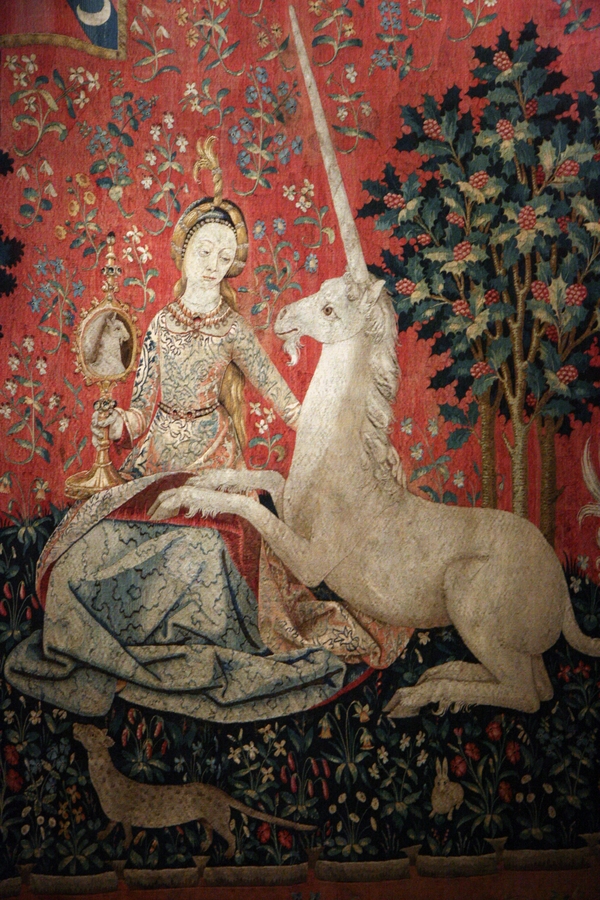
The Lady and the Unicorn: Sight

Posted in Lessons | 6 Comments

Birth of the Sun

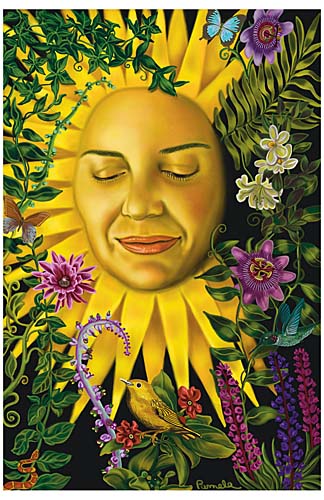
Three million miles is a lot. That’s how much closer we are to the sun at this otherwise “darkest” time of the year. Is it any wonder that our inner lights are amped up, shining brighter than in any other season?

We are used to making energy do what we want it to do. Etch a silicon wafer with an electronic circuit, string high-tension wires across the landscape, wrap copper around an iron core and spin it inside a magnetic field – mastering energy has changed the way we live. But have we learned to let energy master us?

Right now, our inner circuits are humming. Our powers of intuition and empathy are at their peak. The intelligence inherent in sunlight is in-forming the way we conduct our spiritual business – what we give and what we receive. This wave of altruism is landing on the roof of our skull and whooshing down the chimney of our spinal cord, bearing the gifts of the Spirit and lighting our inner world. What we do with our increased capacity will determine much of how our spiritual journey will unfold in the coming year.

The more we become aware of the Christ force within ourselves, the more we see it in others. More than religion, nationality, or ideology, this is what connects us. The light in you is the same as the light in me. And in this oneness lies the opportunity to give and receive love.

Posted in Lessons | 3 Comments

Virgin

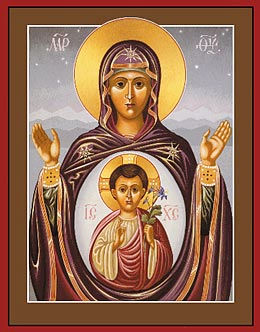
Mary surrendered to God. All she wanted to do was to live long enough to see the Messiah. Material possessions meant nothing to her, because all of her desire was focused on seeing God. She was the empty chalice into which the Blood of Christ would be poured. Who is she? She is us, both men and women, in our desire nature. When we empty ourselves of materiality and focus our heart and mind on the coming of the Light, Christ will be born in us.

It’s hard not to want things. There are lots of nice things to want. And there’s nothing wrong with wanting nice things, as long as you don’t let them come between you and God. There has to be a place within you, a sanctuary, where the things of the world do not go. This is what it means to be virginal—untouched.

You have to have that place where you leave your shoes at the door, your worldly desires, a place where only God exists. Mary symbolizes that place within us. Why? Because the energy that permeates and sustains that inner sanctuary is her energy. It is her energy, because she devoted her life to allowing the energy of her own inner sanctuary to radiate outward into everything she did. She became that energy, and that energy became her.

Because Mary was able to do this in her own life, it is now possible for everyone. This is a distinct aspect, the feminine aspect. And you don’t have to be a woman to experience it in yourself.

Virginity is of the mind. You are a virgin every time you leave the world and enter into your inner sanctuary. You are the Temple Virgin, just like Mary was and like her mother before her. God comes first—in all things. This is what it means to be a virgin.


Posted in Lessons | 4 Comments

The Virgin Birth and the Phoenix

phoenixby Michael Maciel

Christianity, like Buddhism, is a world religion, not an ethnic one. We do not automatically become Christian simply because our parents are Christian. Hinduism and Judaism are ethnic religions. To be a Jew, for instance, one has to be born of a Jewish mother.

Being born into a religion, according to Jesus, is not enough to ensure salvation. When Jesus said that we have to be born again, he was saying that we have to leave the second womb of our religious and mythological support matrix. All religions are second wombs, whose purpose is to prepare us for a life of spiritual realization, not religious or ethnic identity.

As a type of philosophical inquiry, metaphysics assumes that there are universal truths, such as goodness and virtue, which are imbedded in the fabric of reality. The word metaphysical means beyond the physical, referring to that which lies behind the apparent thing—its underlying principle. Metaphysical interpretations go much further than religious interpretations, because they go beyond location, ethnicity, and time.

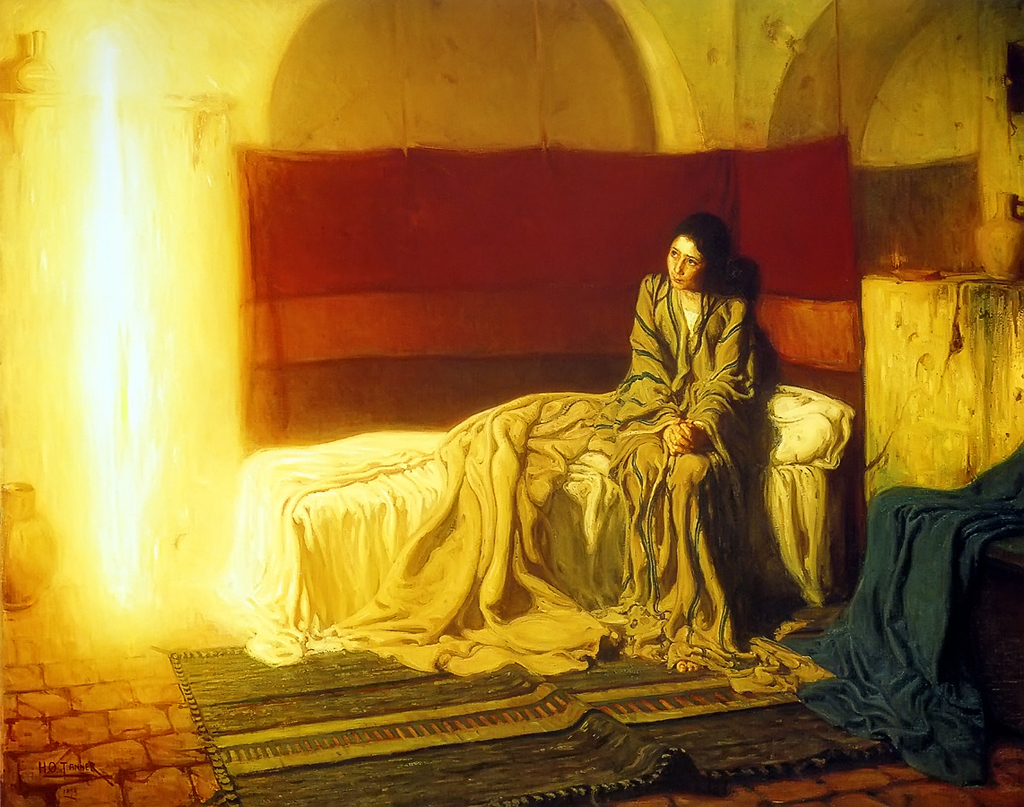
The Annunciation by Henry Ossawa Tanner 1896The virgin birth is a metaphysical proposition. It presupposes a universal state of purity out of which we are born. It says that we are essentially spiritual. Jesus identified himself (and us) as such when he said, “I am not of the world.” The fundamental premise of the Virgin Birth is that it is a birth of being, not of body. It is an ontological event, not a physiological one. It has to do with being and becoming, not ethnicity or cultural self-identification.

The Phoenix
The phoenix does not simply reconstitute itself, as when someone puts his or her life back together. Rather, the phoenix is the spirit of the life’s original intention, which is liberated once its imprisoning structure has been destroyed. The spirit behind the original intention has been encrusted with the very form it created to serve that intention. Once the form has been burned away, the spirit of the original intention is liberated, and the Phoenix is free to build a new form, one that will better serve that which it is seeking to accomplish.

Rising out of one’s own ashes is a spiritual act. It is spontaneous and authentic. But when we act out of pre-existing circumstances, our action is dead. By dead, I mean unconscious,in the sense that it is machine-like. We act predictably, in a manner pre-dictated by others. A living action, however, comes from Spirit—not from our cultural conditioning, not from a sense of what is right to do, not even from what we are capable of conceiving. Rather, the living action comes from nowhere. It has no predicate, no pre-existing assumptions, and no basis. It comes from “out of the blue.” This is the true creative act, which depends for its success upon unknowability—the extension of Spirit into the unknown. Everything else is mere replication, which is crystallization.

Western philosophy calls this the “Unmanifest,” but this is usually misunderstood as nothingness, not action proceeding out of nothingness. Big difference. Jesus describes someone acting out of Spirit as being “like the wind,” the origin and destination of which are unknown. He uses action words, because he is the incarnation of Spirit, which is the activity of God. The key here is spontaneity, which is an aspect of Being. It cannot be understood by the mind, nor can it be described in words. It’s what makes the universe want to get out of bed in the morning. It is the motivator of all action, but it itself is action-less. When we let go to its impulse and take our cues to act from it instead of from the world “out there,” our actions will be “born of a virgin,” and the fruits of our actions will save us.

A leap of faith
That which is revealed (Phoenix) after the imprisoning structure is destroyed is a living thing—not an object, not an idea or philosophy. It’s not even predictable (because it is living), so the new life has no ties to the old, no patterns by which to act. Paradoxically, however, it will fulfill the old, because, though imprisoned, it was the animating spirit of its former life. The old form was brought into being by the spirit of the intention and was a reflection of that spirit. But it’s important to remember that it was only one possible form and not the only form possible. The spirit is always greater than the vehicle it generates, and it is free to generate another when the first one is no longer useful. The first one, however, must first be destroyed before another can be created. The doorway between the two conditions is known as the Abyss, which is crossed by a “leap of faith”, because one cannot see what one is stepping onto.

Marys_conceptionJesus and us
Jesus’ life and mission did not merely stand on the shoulders of the traditions of his day. They held elements entirely new and foreign to those traditions. His message was truly a new covenant, not merely a revitalization or reformation of the old. It was strictly a top-down affair, which is not a popular concept in today’s “grassroots” mentality (the ego doesn’t like to be told what to do). One metaphysics teacher put it thus: Jesus reincarnated from the future.

Metaphysically speaking, our actions are driven by forces within the subconscious mind, which were put there by our conscious thinking. They are “born” in the regular way: the female (subconscious) is impregnated by the male (conscious) and gives birth to manifested action, or, as Ovid said, “Habit becomes character.” In this way, our thoughts are out-pictured in our activity.

This does not translate into ontological language, because Being does not occur by process—it simply is. The Virgin Birth ontologically, then, is a state of being that is process-less—it doesn’t come from anything. To live in the virgin birth state (which is not Nevada, I can assure you), we cannot act from pre-existing assumptions, ideas, philosophies, beliefs, or cultural conditionings—nor can we think that way. We do not borrow our ideas from anyone, and we do not derive our vitality from an external source. The world “out there” is for us a dead world, a world of ashes from which we rise. We are in the world but not of it, which is to say that we are not a “product” of our environment, but rather the animating force within our environment. And the impetus, the input, for that force comes from a “place” that is super- to the world. It comes from above, from the sky or heavens, as it were—the abode of birds, such as the dove and the Phoenix.

silesius

Angelus Silesius—17th Century German priest and physician

Which interpretation is correct?
It is not necessary for us to regard the Biblical story of the Virgin Birth as a non-event. Neither is it necessary to choose between a literal and metaphysical reading of the birth of Jesus. From an ontological perspective, from the standpoint of being, the two renditions are entirely compatible. The important thing is, as the 17th Century German philosopher-priest Angelus Silesius said, “Of what use, O Gabriel, thy message to Marie, if thou canst not also say the same thing to me?” Unless the Christ is born of a virgin in us, the Cave of the Nativity is just so much religious propaganda designed to validate Church doctrine. We do not destroy the story, however, by understanding its deeper meaning.

Having the experience
Whether parthenogenesis (asexual reproduction) is possible in humans is a scientific question, even if we approach it from the spiritual standpoint. Spiritually, we can ask if one can cause pregnancy by speaking the Word, or if a female initiate of high degree, as Mary is reported to have been, can self-induce pregnancy. The theological assertion that God Himself, through miraculous means, fathered Jesus is too general and non-specific to be of real use to us. It relies heavily on assumptions of faith (as does most theology), regarding the natural world as different and separate from the Causal Plane, which is scientifically implausible. Philosophically, we could say that the story of Jesus’ birth reinforces the idea that our physical bodies are vehicles for our soul, that our origin is divine, and that who we are is not a mere product of biochemistry. But all of these notions are themselves meaningless, unless we can actually have the experience that they point to. They are all interpretations of an event that must take place in us, if we are to know God. Our physical body is the “world” into which the savior is born; the Cave of the Nativity is the center of our being.

Mary and the life force
Mary’s acquiescence to Gabriel’s proclamation is our own willingness to receive the Word—not the written word of the Bible (or any other sacred text) but the divine impulse, that which fuels our spiritual/physical evolution—”the force that through the green fuse drives the flower…” of Dylan Thomas. If we look at it in this way, the Virgin Birth story tells us emphatically that the Life Force is anything but blind, that life is imbued with intelligence and motivated by love. Rather than make Jesus look good and the rest of us bad, the Virgin Birth points up our inherent divinity—all of us, not just Jesus. We can no longer say, “I’m only human” and use that as an excuse to ignore the higher part of our nature. By insisting that the Virgin Birth is strictly an external event, we hold the experience at arm’s length, and thereby avoid having to surrender to the Indwelling Spirit’s urge to open our eyes to the world of God.

Placental tree

Placental tree

Posted in Lessons | 4 Comments

Buddhism and Christianity—why one is good for the other

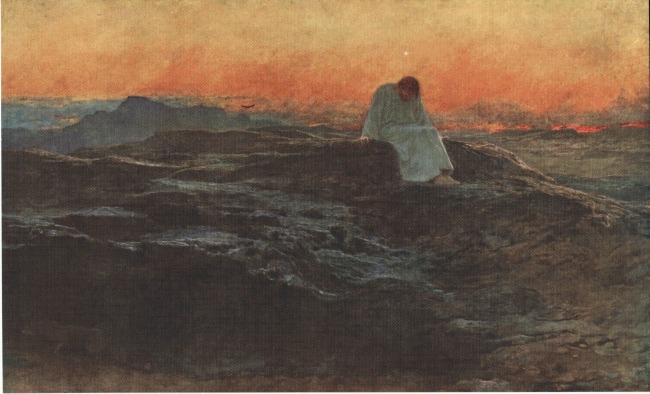
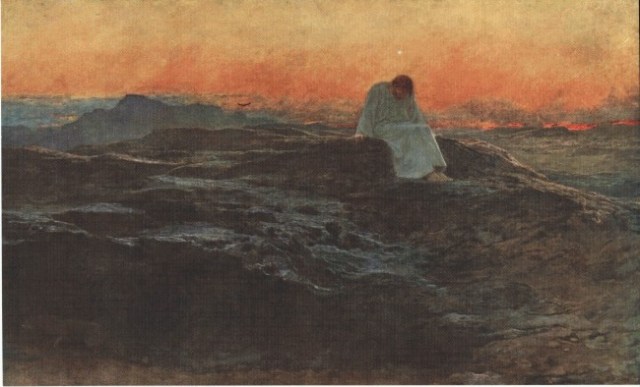
Jesus in the wilderness

by Michael Maciel

Buddhism and Christianity mirror each other in many ways. And why not? Hinduism was around for 2,500 years before Christianity, and Buddhism sprang from Hinduism just as Christianity sprang from Judaism. It doesn’t take a lot of investigative work to detect the golden thread of truth that winds its way through both religions. Once we find it, we discover that the different accounts of the lives of Buddha and Jesus have striking similarities.

Here’s the premise: The lives of Buddha and Jesus are not particularly important as history. It’s not the historical accuracy of what these two individuals did that counts; it’s what their actions symbolize. Neither is it important whether the events actually occurred, because the point of their stories is to reveal the path we must all follow in our spiritual quest. We gain nothing in the way of spiritual development by believing in a literal translation of these stories.

Nothing.

Unless, of course, there is an entrance exam at the pearly gates, in which case, only scholars and blind believers will get in. And who would want to live in a place like that, especially for eternity!

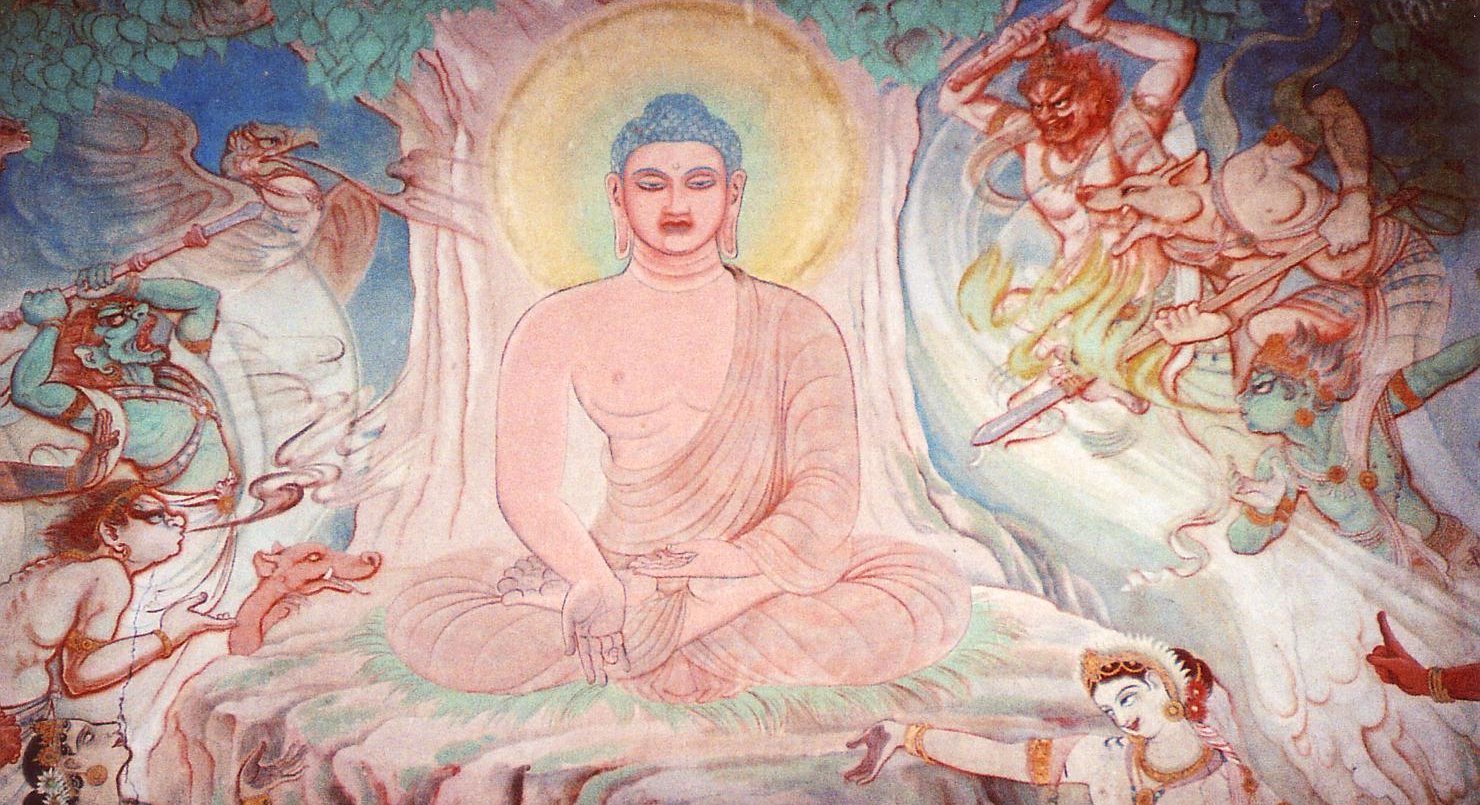
buddha-with-maraThe Three Temptations

Here’s an example of the symbolic value of a significant event in the lives of both Buddha and Jesus: As Buddha sat under the Bo Tree seeking enlightenment, Mara, the Lord of the Underworld, presented him with three temptations—sex, fear, and pride. First, he offered Siddhartha (Buddha) his three beautiful daughters, to which Siddhartha replied, “Hmph.” Un-phased. Next, Mara arrayed his army before him, and sent thousands of arrows straight at the head of Siddhartha. Again, “hmph,” and the arrows turned into blossoms, falling at his feet. Finally, Mara appealed to Siddhartha’s sense of civic duty (Siddhartha was heir to his father’s throne), but Siddhartha would not be lured by the promise of Earthly power.

Five hundred years later, Jesus, immediately following God’s famous proclamation—”This is my beloved son, in whom I am well pleased”—at Jesus’ baptism by John in the River Jordan, Jesus underwent the same three temptations at the hand of the Lord of the Underworld, this time calling himself Satan. First was “turn these stones into bread”—not exactly sex, but an appeal to the physical appetites just the same. Jesus had been fasting for forty days, and bread had to have had a strong attraction. But, Jesus said, “Hmph.”

Next, Satan took Jesus to a high cliff and said, “Jump.” This was an attempt to provoke fear in Jesus, just as Mara wanted to see if he could make Siddhartha flinch at the sight of arrows. But, like Siddhartha, Jesus held steady.

Next came the big guns. Satan says to Jesus, “You think you’re so smart. Prove it. Worship me, and I will give you the chance to solve all the world’s problems. After all, who could be better suited for the task?” But Jesus knew that pride could only corrupt his soul, so he told Satan to beat it.

Both Buddha and Jesus had to first overcome the very same things we all have to overcome—physical appetites, fear, and pride—as we travel along the spiritual path.
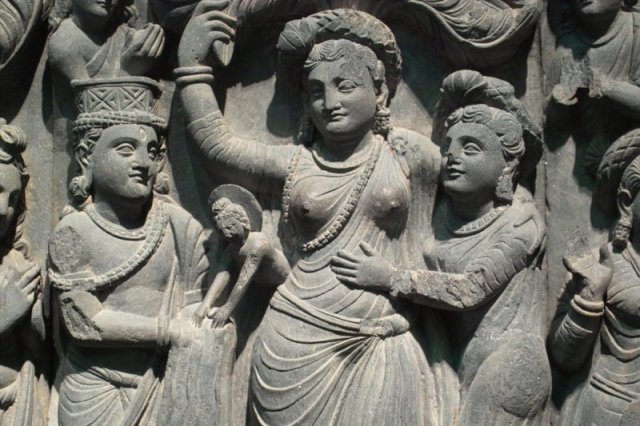
Birth of BuddhaThe Virgin Birth

This is a touchy one. Why? Because, who doesn’t love a baby? Or a baby’s mother. In Bhakti Yoga (the yoga of love), the first stage in the development of love is the love of a mother for her infant. This kind of love is pure—virginal you might say— devoid of eros and agape. It is one-focused. It’s a touchy subject, because…don’t you talk about my mother! Never has there been a subject as taboo as Mary’s sexuality. She has been and forever will be (apparently) a nun.

But, what about Buddha? Was his a virgin birth? Yes, although the particulars of his birth are a little more cryptic than those of Jesus. Buddha is said to have been born out of his mother’s side, not through her birth canal. Why out of her side? Because, he was born from the level of the Heart Chakra, not from the lower, Earth-centered chakras. In this way, his was a “heavenly birth,” just like Jesus.

Of course, both Buddha and Jesus were born in the normal way—in painful labor from a mother who was also in painful labor. Naturally. But, the point of the story is that our divine nature manifests itself in the world through the agency of our purified sub-conscious mind. This is the esoteric meaning of the Virgin Birth. Whether Mary had sexual intercourse is not even remotely relevant. As sentimental a notion as her virginity might be, we have to admit that this story has caused women nothing but trouble for over 2,000 years.

Isn’t it time we raised the story to a higher level?

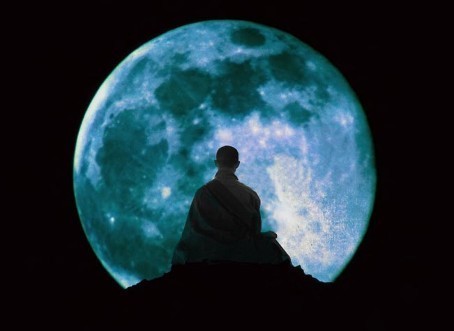
Buddha moonTeaching The Way

Every spiritual teacher runs the risk of becoming God to his or her followers. It’s an occupational hazard. On the one hand, they have to let their students believe that as their teacher they can do no wrong. But, at the same time, they have to slowly but surely undermine that idea by redirecting their students’ devotion to the Almighty. After all, no one is perfect, not even spiritual teachers. As long as people inhabit a physical body, they are fallible. Sure, there’s that part of them that is never wrong, just as there is that part of all of us that’s never wrong. But, that part simply does not sit in the driver’s seat 24/7. Believing that it can or does has been nothing but trouble for men even longer than 2,000 years. A lot longer.

How did Buddha handle it? He said (referring to himself), “The finger pointing at the moon is not the moon.” When Buddha came into enlightenment, his first thought was, “This cannot be taught.” But, the gods asked him to teach it anyway, to which Buddha replied, “I cannot teach enlightenment. Instead, I will teach the way to enlightenment.” Quick thinking.

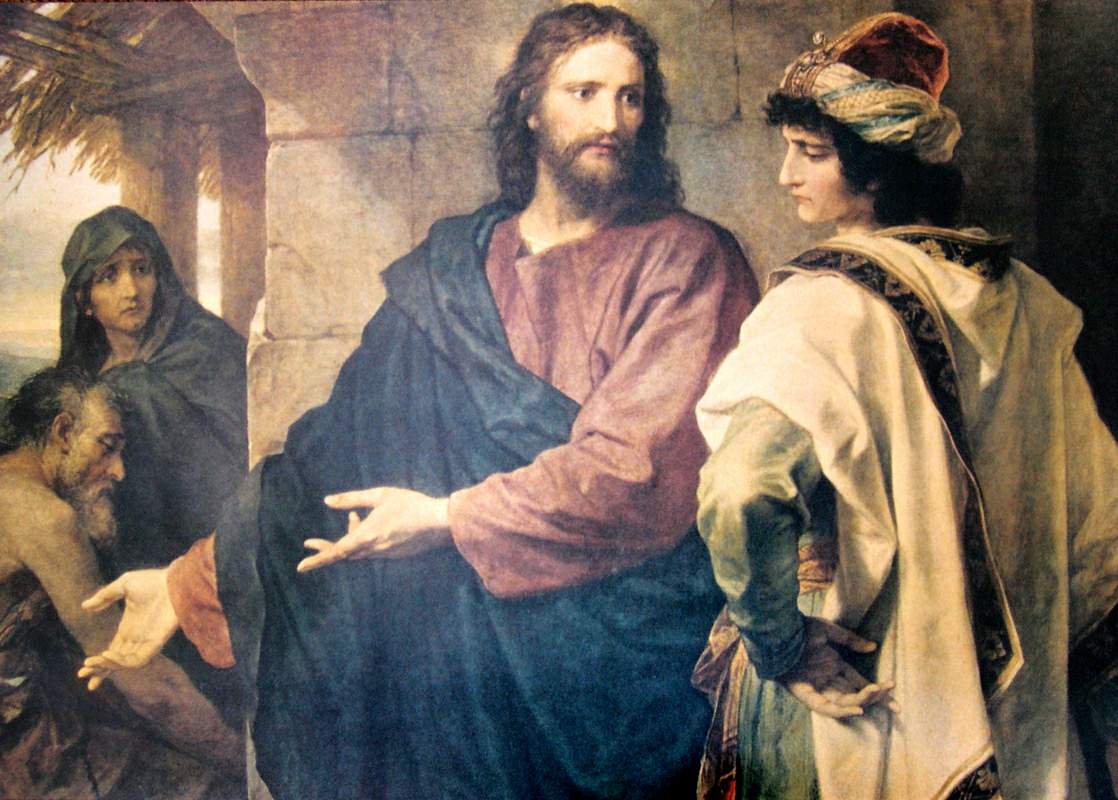
Jesus-and-Rich-Young-ManAnd Jesus? When the rich young man addressed him as “good Master,” Jesus cut him off abruptly, saying, “Why callest thou me good? There is only one who is good, my Father in heaven.” Also he said, “Through me shall you see the face of the Father.” He didn’t say, “I am the Father.” He did say that he had attained unity with God, but never did he claim to be God. That which is lesser can never comprehend that which is greater.

Only later did the Church fathers say that Jesus was equal to God. But, this was a political move, not a statement of existential fact. You can’t claim that your religion is the One True Religion unless it was founded by God himself—early branding at its best or worst, depending on which side you were on. Besides, equating Jesus with God made him permanently unattainable, thereby institutionalizing the authority of the clergy. They made themselves the gatekeepers, the sole brokers of heaven.
Nicodemus_Jesus

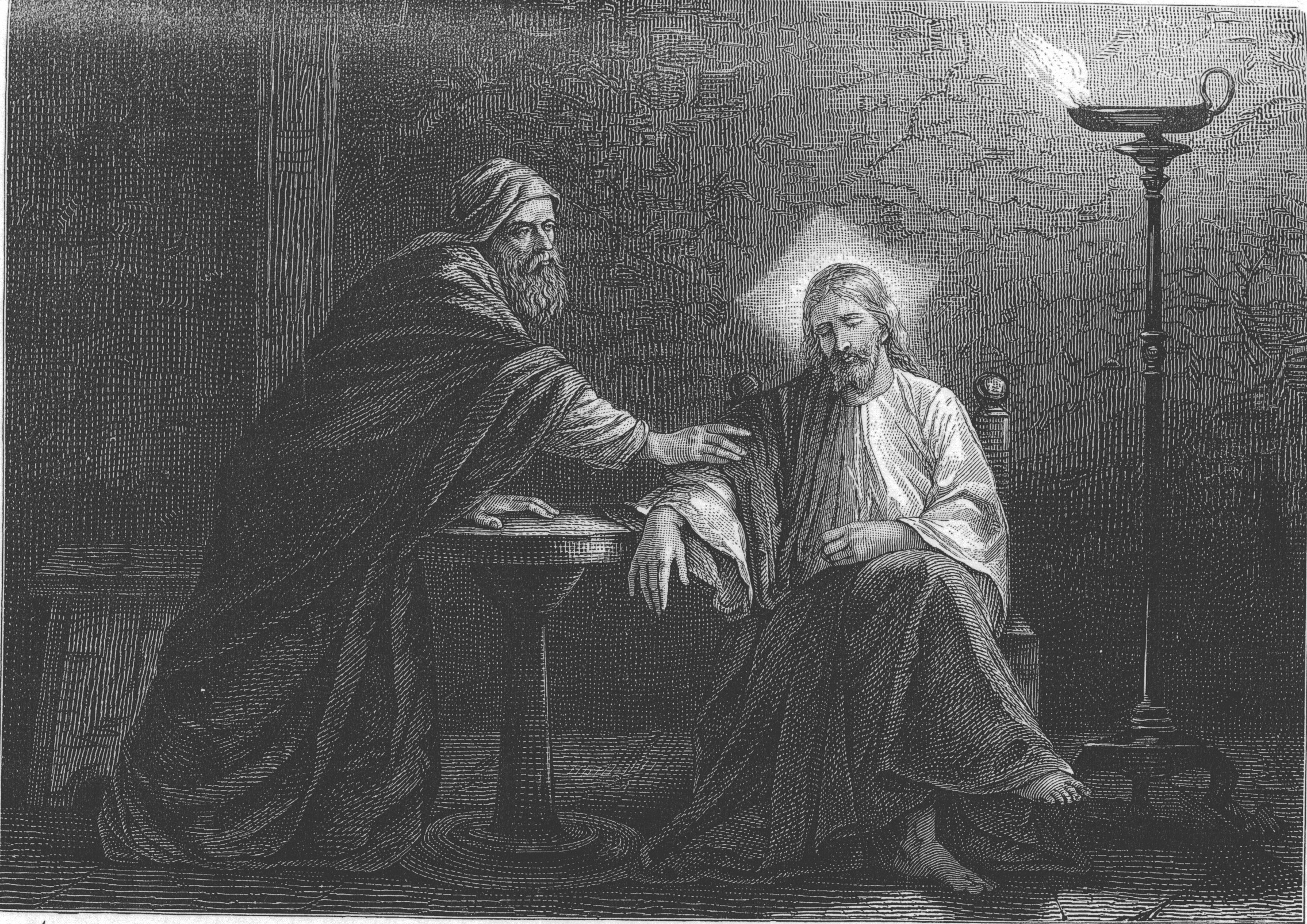
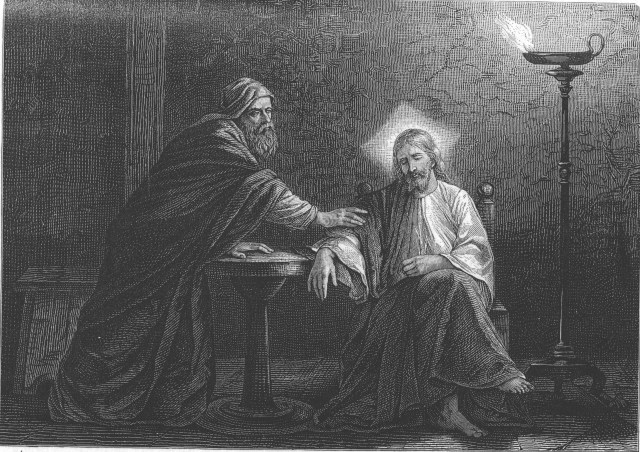
Nicodemus comes to Jesus at night

There are two types of religions, ethnic religions and religions of faith. Ethnic religions are those you have to be born into. Religions of faith require only that you believe in them. Buddhism came out of Hinduism, the world’s oldest religion. To be a Hindu, you must be born a Hindu. Not only that, you are born into a particular caste. The same goes for Judaism. To be a Jew, you must be born of a Jewish mother. No exceptions. And in the old days, Judaism had its own caste system, called the Twelve Tribes. Which tribe you were born into said a lot about your “ordained” place in Jewish society.

While it’s possible to convert to both Hinduism and Judaism, they’re just being polite. No one can actually be a member of the club unless they were born in the clubhouse. Those are the rules.

Buddhism and Christianity, on the other hand, welcome new members without pre-qualifications. Just sign here, and you’re in! They do not require that you be of a certain ethnicity. Membership requires only that you believe in the Way, the dharma.

Consider this:

When Nicodemus, “a Master of Israel,” as Jesus called him, came to Jesus saying he believed in him, Jesus said, “Verily, verily, I say unto thee, except a man be born again, he cannot see the kingdom of God.” Astonished, Nicodemus said, “How can a man be born when he is old? Can he enter the second time into his mother’s womb, and be born?” Jesus replied, “Except a man be born of water and of the Spirit, he cannot enter into the kingdom of God. That which is born of the flesh is flesh; and that which is born of the Spirit is spirit.”

Nicodemus betrayed his belief in the ethnic nature of religion when he implied that to be saved, one must be born into the right ethnic group. Jesus disabused him of that notion when he told him that salvation comes by means of the Spirit, not by way of ethnicity. Simply being born a Jew does not save you. Neither does being born a Catholic move you to the front of the line at the Pearly Gates. Getting to heaven (realizing God) comes by living the Way, not by the religious affiliation listed on your birth certificate.

St. Paul was big on this, too. The Jews of the early Christian sect wanted to enforce Jewish law on all converts, effectively making them Jews (sort of). Their emphasis was on adherence to outward forms and rituals. Paul, however, understood what Jesus had said to Nicodemus. He knew that the Way is an inner path, not one of following the letter of the law. He knew that Christians are brothers in the Spirit, not members of a tribe.

Buddha also understood the ethnic nature of the caste system into which he was born. He actively set about dismantling it by doing such things as ordaining a servant before ordaining the servant’s master, thus putting the servant in authority over his master. He did this on purpose as a way to break down the old system.

Spiritual paths have a way of becoming encumbered by social law and order. They become the agents of a society’s maintenance program, a means by which to make their way of doing business appear to be sanctioned by God. They strongly believe in the Law of Karma, which says that your current station in life is a direct result of your own behavior. This belief justifies passing laws designed to keep you in your place.

Religions of faith, however, emphasize forgiveness and equality. All people are equal in the sight of God and are thus equally capable of obtaining a spiritual life—merit vs. entitlement, faith vs. works. Karma doesn’t play such an important role. Karma can be lifted; sins can be forgiven. In the ethnic religions, sins must be paid for, eked out, until the uttermost farthing is paid.

And so…

These questions are bigger than any one religion. In fact, religions are the continual search for the answers to these questions. We cannot understand our own religion if we think it was created in a vacuum. The ancient world was not as insular as many would have you believe. People got around back then, maybe not as much as we do today, but they were not ignorant of the religions of foreign lands. Israel was just as much a crossroads then as it is now, perhaps more so. When we look at Christianity through the eyes of Buddha, or Buddhism through the eyes of Jesus, we can learn a lot about our own religion.

When we realize that religions were invented for our sake and not the other way around, it’s easier not to identify with them. And the less we identify with our religion, the more tolerance we have for other people’s religions. Eventually, that tolerance turns into curiosity, and the more we find out about them, the more similarities we see. Then, our tolerance turns into acceptance. And that’s the object, isn’t it? Acceptance and respect, leading to universal peace and brotherhood.

“The Sabbath was made for man, not man for the Sabbath.” – Mark 2:27
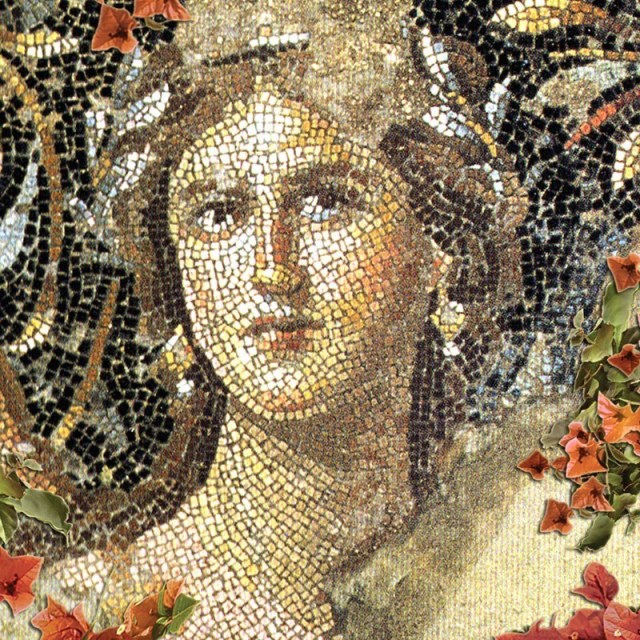
 

Sephora was a Greco-Roman city just four miles from Nazareth when Jesus was growing up. He and his father undoubtedly worked there, meaning that they would have been multi-lingual. Given Jesus' precociousness, he would have known much about about the world's philosophies and religions. Buddhism was already 500 years old when he was born.

Sepphoris was a Greco-Roman city just four miles from Nazareth when Jesus was growing up. He and his father undoubtedly worked there, meaning that they would have been multi-lingual. Given Jesus’ precociousness, he would have known much about the world’s philosophies and religions. Buddhism was already 500 years old when he was born.

Posted in Lessons | 5 Comments