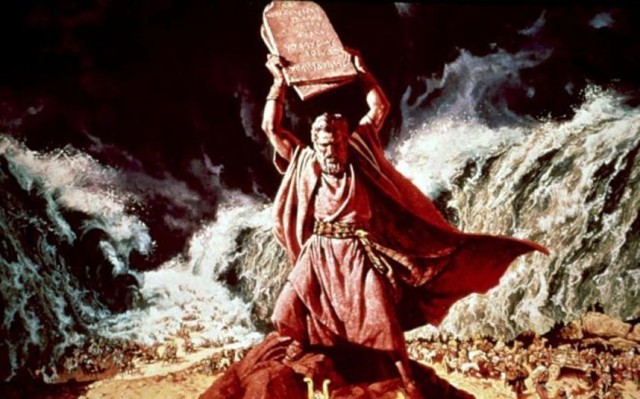
The First Commandment—It’s Not What You Think!

10commandments

by Michael Maciel

I am the Lord your God, who brought you out of Egypt, out of the land of slavery. You shall have no other gods before me. – Exodus 20

This is the First Commandment, and boy is it a doozy! On the face of it, it sounds like a rallying cry for the new nation of Israel, a way for the Jewish people (and later, Christians) to separate themselves forever from the heathens. In one stroke, it sets up future holy wars and a subconscious fear of a jealous and wrathful God.

But let’s look at it differently. Let’s take it out of the context of space and time, and let’s strip it of all ethnic and religious connotations. Instead, let’s look at it, not as “the Law,” but as the Law of Mind—a veiled set of instructions on how to become a conscious co-creator with God.

The first sentence sets the tone: freedom. Obviously, the “Land of Egypt” means something symbolically, probably the lack of individuality implied in the word “slavery.” It’s a metaphor for being tied to the Wheel of Karma. What greater bondage is there than to be caught in the grip of the Law of Cause and Effect with no way to control it?

The Jewish People’s escape from Egypt is the first step towards the Western ideal of individualism. It makes possible the rights of the individual and the rule of law, setting the stage for each member of humanity to take personal responsibility for his or her own destiny. And to do that, there has to be an awakening to self—the recognition that each person is a living soul with a direct connection to the Almighty.

There’s only one way to escape from the Wheel of Karma, and that is to learn how to use the Laws of Creation. Because until you learn how to be a cause in the universe, you will forever be a slave to it. And the surest way to stay a slave is to remain asleep—to be a nameless face in the crowd going along with the flow, having no thought of your own, and having no sense of yourself as a free and independent agent.

table

The Ten Commandments introduce the notion that the universe runs according to law, not the law of a capricious dictator, but laws that are written in stone—laws that are interwoven into the fabric of reality. In a sense, the Ten Commandments not only make possible the rights of individuals, they also form the basis of modern science, because modern science also says that the universe is governed by law. Do this, and that happens.

There are two key concepts in the first sentence: one is that God is a savior and is, therefore, a God of love interested in our freedom, and two, that God is a personal God, that the universe is alive, conscious, and self-directing. After all, something called “God” is calling itself “I.” And it’s talking to a “you.” So the context is hugely significant. We are IN the universe and not merely on it or of it. Our relationship to the universe (to God) is just that: a relationship. We’re not balls being bashed around on some cosmic billiards table.

So, if the theme of this set of instructions centers around the idea of individuality, what is it that makes us most individual? What makes a person stand out from the crowd? Is it not self-determination? If it is self-determination, what is the key factor in that? It is, I think most would agree, integrity—being true to oneself, to your beliefs, to what you know to be true, and most of all to the goal you have set for yourself in this life. Integrity is to a human being what the cell membrane is to a living cell.

eye

For all intents and purposes, these things I have enumerated are God, as far as we’re concerned. They are our highest conceptions of reality, are they not?—our Highest Good. You could even say, in the most realistic sense, that we worship them. Or at least, according to the First Commandment, we should.

The wisest people in the world pretty much agree on one thing: there is no greater power than a disciplined mind focused on a single idea. Is it any surprise then that a divine set of instructions on the laws of creativity would begin with that one all-important principle—focus.

What is it that you want? What do you want to create? What is it that you are asking the universe to deliver? Whatever it is, whatever vision you have, whatever ardent desire you hold in your heart, wouldn’t it be better if there was nothing competing with it?

Now, I know that some people might see this as a stretch, just an attempt to force an interpretation on traditional teachings. But I think you will see that as we go through the remaining nine Commandments that there is an unmistakable pattern at work here. What most people see as a set of rules I see as a set of instructions. And if you want to test my theory, please do.

My interpretation might not be the only way to see this, but it is certainly a way. God isn’t telling us what we can’t do but what we can. The Ten Commandments are a means to lift us up, not keep us down. And I think that this is closer to the truth and that it was hidden in plain view by Moses as he taught his people how to behave as a people and his Priesthood how to function as priests.

You be the judge.

See also:

The Second Commandment—is it really about worshipping idols?

The Third Commandment—get over yourself!

The Fourth Commandment—do I really have to go to church?

The Fifth Commandment—my mother, drunk or sober

The Sixth Commandment—Thou Shalt Not Kill Bill

Scrambled Eggs—Thou Shalt Not Commit Adultery

Books by Michael Maciel

World Priest—Bringing Heaven to Earth

The Five Vows—Raising Your Spiritual Commitment to the Next Level

Michael Maciel – Author 

Posted in Lessons | 3 Comments

Monkey Mind and Yapping Dogs

monkey-brain-monkey-on-head


by Michael Maciel

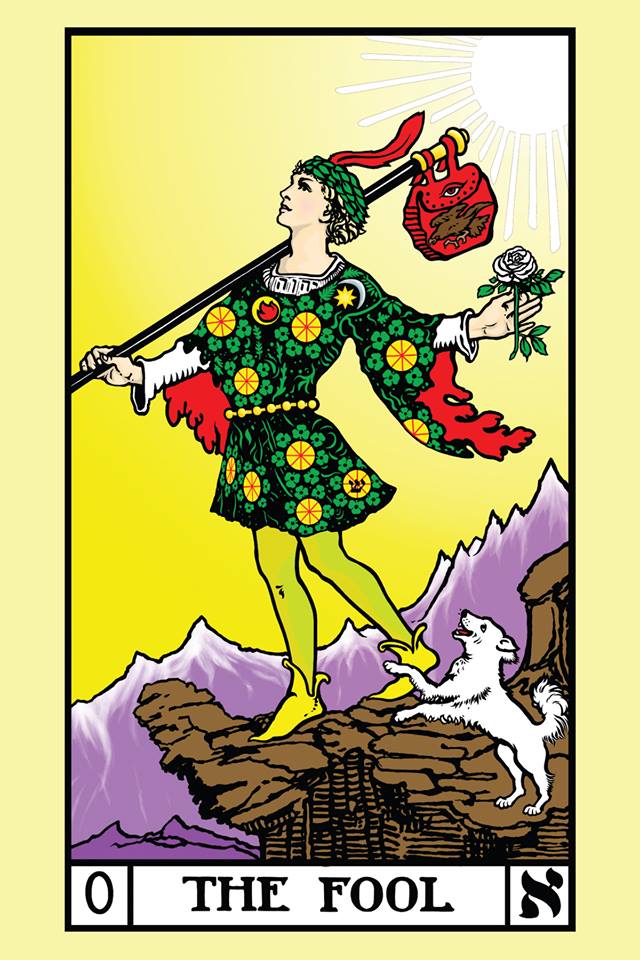
Ever wonder what the little white dog symbolizes in The Fool card of the Tarot?

Think of it this way: if the Tarot were an Eastern system of enlightenment, the little white dog would be a little brown monkey—the “monkey mind.”

Buddha compared our unruly thoughts to hundreds of monkeys screeching and running wild in the trees of our consciousness. But in the West, we don’t have monkeys except in zoos. Instead, we have dogs—lots and lots of dogs.

Is there anything more annoying than an undisciplined dog? The only thing worse is undisciplined thoughts barking at you all night inside your brain.

But you can’t put your thoughts in a cage like you can a dog or a monkey.

Caging a dog isn’t the same as training it. It’s not good for the dog, and it goes against nature—yours and the dog’s. Both of you will be miserable.

00 fool

This is where the little white dog in the Tarot comes in. It symbolizes our thoughts. Notice how it stays close to its master. But more importantly, notice where it’s looking—it’s looking up at him.

This little bit of symbolism is a lesson in attention. The Fool’s attention is on Super-consciousness; the dog’s attention is on the Fool.The Fool represents our innermost self, the Spirit. Its attention is always on God. So, when we place our attention on our innermost self, our thoughts are naturally directed upwards into realms of peace and harmony.

Instead of running all over the place, our thoughts are constantly looking within. When we are confronted with a problem, we first look there, to the place where everything tends towards balance and reconciliation.

Our attention is master to our thoughts. Where it goes, our thoughts will follow.

If you want to learn how to train your mind, get a book on how to train dogs. It will tell you everything you need to know.

Or, visit Margot Whitney‘s blog on Tarot Symbolism, Gates of Light.

Note: 
Why is our innermost self called “The Fool”? Because it is non-rational, or supra-rational. Our innermost self is greater than our mind, greater than our intellect. It is our point of connection to the All.

Posted in Lessons | 3 Comments

Cycles and Symbols in the Bible

sinewave

by Michael Maciel

The ancients who wrote the Bible saw science and religion as one and the same thing, and they expressed their knowledge in symbolic language. Unless we understand what the symbols mean and how they were used, we cannot fully understand the Bible. Symbols were the “scientific notation” of the day, which the writers of the Bible and their readers already knew. No one had to be told that the stories were not necessarily literal accounts of historical events. So, let’s consider some of what we know about the symbolic language of the ancients.

yin-yangWhereas we only use numbers to quantify things, the ancients also used each number to symbolically represent a principle or law of nature. The Greek philosopher Thales said, “God’s first thoughts were in numbers.” He and the other early philosophers saw a direct relationship between mathematical and spiritual truth.
When numbers in the Bible are taken literally, the stories become nonsensical, which only serves to discredit them. They lead us to believe that in order to accept what the Bible says, we have to separate our rational mind from our intuition. This “divorce” has literally torn the world apart. If we refuse to admit our ignorance of the deeper wisdom of the ancients, this ignorance threatens to destroy the world altogether.

The prime example is the current debate about the age of the earth—that the earth was created in seven days. Since the Bible says that each day is the equivalent of a thousand years, a Seventeenth Century minister calculated the age of the earth to be 6000 years. Because of this, a deep schism now exists between fundamentalists and scientists, which has led to dangerous political polarizations regarding pollution and global weather patterns. But if we examine the symbolic meaning of the number 1000, these accounts in the Bible suddenly make better sense.

Each number represents what we now call a “scientific principle.” By combining numbers, the ancients could indicate the relationships between different principles of nature. The number one, for example, indicates “unity,” the condition in which there is no “other.” In modern scientific language, we would express this as an “integrated system,” one where everything has a functional relationship to everything else.

In order to make this integrated system universal so that you didn’t have multiple systems opposing each other, the ancients modified the number one with their own brand of exponential value—the zero. Zero symbolically represents universality. But when you add three zeroes, it indicates that the laws of the universe are absolutely unified—the entire universe becomes an integrated system.

“Hear, O Israel, the Lord our God is One.”

star of david

Jesus reiterated this principle when he said, “A house divided against itself cannot stand.” Scientifically, we could say that mathematics is “one.” NASA uses the same math here on earth as it does to calculate the trajectories of spacecraft millions of miles out in space. What works on earth works in heaven.

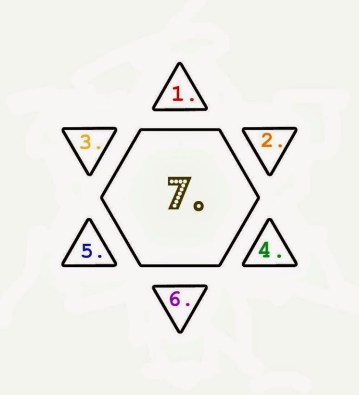
So now what does it mean that God created the earth in seven days? If each day is a universal principle, it becomes immediately evident that we are not discussing a period of time. Instead, we are looking at a sequence, the steps that God took in His creative act. Rather than an historical account, the story becomes a formula hidden within the narrative. The reason for hiding the true meaning was simple: stories are less subject to interpretation; they tend to survive intact over time.

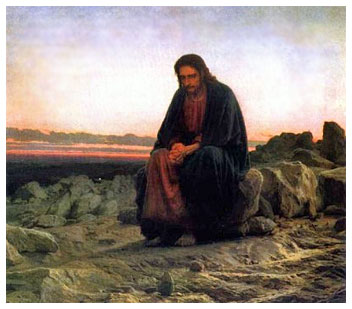
jesus-desert1Forty is another number that stumps most theologians: forty days and nights of rain for Noah, forty years in the house of Pharaoh for Moses followed by forty years wandering in the wilderness, and forty days in the desert for Jesus. If you believe that God wrote the Bible Himself, then forty must have been one of His favorite numbers!


But forty is actually an exponential value of the number four, which symbolically represents the principle of crystallization or solidification. And because forty is always used in the context of time, we know that adding a single zero means that what we are really talking about is a process. It also indicates that this process has a cyclical quality to it. It is ongoing. It happens in time, but it is not restricted by time. We know this as the spiral—each cycle of evolution places us one level higher than where we began. So, Jesus’ forty days in the desert is a story of the process he went through in order to prepare for his mission.

Forty weeks is the human gestational cycle. Four years is how long it takes to graduate from college, at which time we are “matriculated.” Four-year-olds reach a new level of independence from their mother, typically starting pre-school at that age. Interestingly enough, the grand cycle of time in Hinduism is the Yuga, which “lasts” 400,000 years. This, of course, was never meant as a literal length of time, because it is used in the context of eternity or timelessness—the symbolic number four raised to the level of one hundred, then placed in its cosmological context by raising that to the level of 1000. This points to the largest frame of reference, the ultimate or eternal interpretation of the symbolic meaning of the number four.

zodiac-horoscope-aquarius-Cathedral-d-Amiens-Vassil-sign

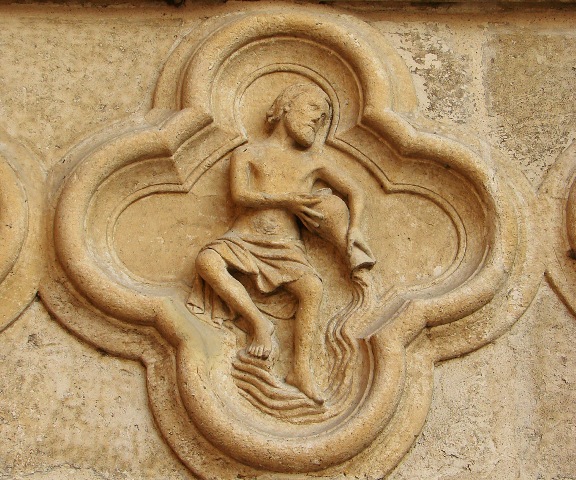
The number twelve symbolizes the Zodiac, the twelve aspects of the personality of God. Because of this, twelve also represents wholeness of being. When the Bible says that only 144,000 people will be allowed to enter into heaven, the writers assumed that the reader would know that they did not mean it as a literal number. Multiplying a number by itself, or squaring it (square = four), and then adding three zeroes to it, raises the meaning of the symbolic number twelve to the level of absolute universality.

This just barely scratches the surface of how symbols are used in the Bible, and it shows that our tendency to take them literally is a product of our current scientific mindset. Unless we understand that the teachings of the Bible were written in story form and that the stories were written in symbolic language, we cannot understand the teachings themselves. We will always try to overlay our way of thinking onto theirs. So far, this really hasn’t worked out well for us.


Note: this is a rewrite of an article posted in 2001.

Posted in Lessons | Leave a comment

It’s Your Call – connecting with God through prayer

rotary-phone

by Michael Maciel

My wife refuses to wear a Bluetooth device when using her cell phone. She also doesn’t like to hold her phone next to her head, so she wears earbuds instead. When I call her, I can tell right away if I’m getting her and not just her voicemail, because I can hear the rustling sounds of her putting her earbuds into her ears. I get to relish the fact that I have connected with her and not just her phone.

It reminds me of the old days before answering machines, when all we had was land lines, the kind of phones that were attached to the wall with a heavy cord. Phones weighed several pounds and were usually black. The headset was large and felt warm against your ear. It had a close, personal feel made even more personal by the way you could hear your own voice coming back at you through the earpiece, the way you can hear yourself when you speak. This made it possible to express the most subtle emotions with the tone of your voice, the way you can when you’re lying next to the person you love with your lips close to their ear. It was marvelously intimate.

Prayer is like that. Contacting God is just like contacting someone on one of these old phones – you know you’ve made the connection before the person on the other end of the line says anything. You can feel it. When they pick up, your hearing is suddenly made larger, extended to someplace else, somewhere far away, and you know that even in the silence before your conversation begins that the one receiving your call is aware of you and is just waiting for you to say those magic words: “Hey, it’s me.”

The very thought of reaching out to God is your phone call. And God always picks up on the first ring. Thinking about God as though God were a person (imagine that!) and not just some kind of cosmic wireless network is an intimate act. You’re connecting with someone. It’s very different from merely leaving a message. Voicemail is impersonal, especially when the outgoing message isn’t the person’s voice but an automated one that the carrier provides, which feels more like leaving a note on the refrigerator, or worse yet on a public bulletin board.

But placing a call to God isn’t like that. Getting God on the line feels like walking into a church or a temple. It’s a sacred space that feels big, the way a blind person can tell when they suddenly enter an auditorium. An inner door opens and you step in. What happens next is what this conversation is all about.

What do you say? Sometimes, you don’t say anything. That’s called meditation. You make the connection, and then you just bask in it. You’re aware of God, and God is aware of you. Nothing needs to be said. God’s presence feels like a fine incense permeating you, filling you with a holy, wordless message, like a divine download. You know you’re getting something, but you have no idea what it is, only that it’s good. This kind of connection we should make every day, sometimes twice a day. The more you establish it, the more you can’t do without it.

But with prayer, the idea is to say something, to begin a dialog, even if it’s simply to say hello. But it’s not just a message. It’s more intimate than that. It’s like when you call someone special on the phone, and when they answer, you turn your back on everyone else in the room so that you can have a private conversation. It’s that close. And when you call that special someone, you don’t have to say, “Hey, I just wanted to thank you for being in a relationship with me.” That would sound a little stiff. No, the fact that you’re calling is a clear signal of your appreciation, the way you might say, “Hi, beautiful.” But that kind of closeness with God comes with practice, the same way it does with another person. There’s a warming-up process – not a routine, but a rhythm.

It’s this word “rhythm” that best describes a good relationship with God. “Routine” is fine, but rhythm implies partnership. A dance routine is one thing, but dance partners have something special. The word “partner” has a broader meaning, too, as in “life partners,” the kind of relationship where both parties rely on each other to fill a certain space in their lives. Too often, we think of our relationship with God as a child-to-parent arrangement. But a partnership is much more exciting. A partnership means that you are never alone. If you believe in some of the deeper teachings that say that God created us in order to know himself, then you can say along with Meister Eckhart, “God needs me.” And that’s the essence of partnership – both parties need each other.

But need each other for what? In a relationship, just hanging out can be fun, but partnership spans a whole lot more. Partnership engages all aspects of life, not just gazing into each other’s eyes. Partnership allows us to share our day-to-day living, and not just the routines but the hopes and dreams as well. Partnership thrives on the what’s possible, on a shared vision and long range goals. It’s the “shared” part that’s important. When the foundation of your prayers is a shared vision, one that you share with God, then your life becomes a creative venture, and your prayers will reflect that. When you pray, it won’t be just for things that you need, but for conditions that will allow for greater creativity. After all, we are “co-creators,” are we not? The “co-” means we’re partners – not master and slave, king and subject. It’s when we realize that God has every bit as much to gain out of our relationship as we do that life gets really, really good!

Consider it this way: If you wanted to see the country, would you rather drive a car or ride a bus? In a car, you get to choose which routes you will take. On a bus, you go where it goes, period. The purpose of a bus ride is simply to get to your final destination. Well, God’s will is either a car or a bus. Which way do you see it? If you see it as a car, your life will be creative and fulfilling. If it’s a bus, then life will be little more than a routine, a way to get to heaven when you die. Life devolves into a thing to be endured, not enjoyed. No one on a bus actually expects the trip to be enjoyable. And who wants to partner up with someone who sees life as a test of endurance?

Strangely enough, that’s how many people understand “God’s will,” and so that’s how they pray. They’re constantly feeling bad about wanting to get off the bus. They beat their chests and beg for forgiveness. And if they don’t do this consciously, it nevertheless forms the backdrop of their relationship with God. They see their life as inherently wrong, and God becomes someone who is impossible to please. Who can love such a person? Can I follow all the rules? Can I behave? Will I do what’s expected of me? Such thoughts are the antithesis of a creative life.

Don’t you think that there might be another way to approach life, one that is empowering and life-affirming and doesn’t treat your time here on Earth as a kind of probation? Is it wrong to feel joy or excitement or fulfillment? How about pride? In a partnership, pride, especially pride in accomplishment, is shared, and is therefore a good thing. When we partner up with God, and we do it creatively and not as though God were an employer or our parent, then we can’t help but feel proud when our visions and our dreams come to fruition. Together with God we can say, “Look what we did!” There is no greater satisfaction.

In order for prayer to be alive, it must be creative. Get this, and you will never have trouble praying again. Prayer will become as natural to you as getting up in the morning. It’s one thing to say, “Thank you, God,” when you pray. It’s much better to approach God with your “thank-yous” built in. It’s like closing your eyes and going within, and in that vast inner space looking at the All and saying, “Hey, beautiful!”  No one is the totality of God. But then, who would want to be? It’s always better to have a partner whose assets are greater than yours.

Posted in Lessons | 2 Comments

How to maintain inner peace in the face of fear…

SKI ALPIN - FIS WC Soelden, RTL, Herren


by Michael Maciel

You know, for me personally, I find it easy to be at peace as long as I’m safely ensconced in my safety zones—my work routines, my office, my home—anywhere I feel like I have some control over my life. But it’s when I’m challenged, when someone disrupts the tempo of my routines, or when dark events loom on the horizon, or circumstances seem to block my path that it’s difficult to maintain any kind of internal peace.

I suspect that I’m no different from anyone else in this regard. Because of this, I am most interested in how to maintain inner peace when things aren’t going well, especially when I feel threatened or in some way find myself in the presence of real danger. It’s easy to be at peace when I’m safe but not so easy when I’m not.

And I know that I’m “always protected,” but I live in a fast-paced, crowded, multi-cultural urban area that’s highly competitive and always on edge, so there are times when I feel exposed. So, any “inner peace development program,” it seems to me, has to be in some sense strategic, meaning that it has to include a plan for how to deal with difficult situations as they arise unexpectedly.

It has been my observation that it is those people who know what they’re about, who know where they’re going in life who are the ones with the most inner peace. It’s those people who know what they will put up with and what they won’t, who don’t back down in the face of danger when confronting the danger is what’s called for. It’s those people whose only fear is the fear of self-betrayal.

When I was a teenager, I was a ski racer, and the downhill, where speeds are frequently 60 to 70 mph, was my biggest challenge. It was always dangerous. I have known people who were killed or permanently disabled by this brutal sport. But my coach was unequivocal in the strategy he gave me for surviving the downhill: get strong! His workout routines were merciless, concentrating mostly on the leg and stomach muscles. I know it sounds trite, but “peace through strength” works.

You have to be strong to stand up when the winds are blowing hard against you, when it seems like life is trying to knock you down, or when serious problems keep you awake at night. And for us—people on the spiritual path—strength comes through prayer and meditation. It comes through our proficiency in using the Law, our ability to say how it’s going to go. And when we don’t know the answers, we have to stand firmly in our knowing that God knows and that God will provide exactly what we need when we need it.

Meditation

It’s not enough to wait until the day before the race to work out. We have to anticipate those events that can throw us into inner turmoil and prepare for them—not out of fear, but in spite of it. We have to remember to use those times when we are feeling most threatened to practice our inner knowing, to see ourselves completing the task before us successfully, to keep our eyes focused on what is good and right and not let fear and worry erode the vision we have for our future.

Certainly, there are times when going with the flow is necessary. Surrendering to circumstances can be a powerful strategy. And it’s true that every adversity contains within him or her a lesson. But it’s important to understand that “circumstances” have a tendency to take on a life of their own and can persist long after they are useful or helpful. Sometimes, the lesson to be learned is “learn your lesson and MOVE ON.”

Another saying that is trite but true is “Failing to plan is planning to fail.” We should all plan our spiritual development. Spiritual practice is as the term implies: practice—practicing how we will respond in difficult situations. Practice being spiritual outside of your comfort zone. Practice being steady when someone gets in your face, when multiple attempts to complete a task meet with unrelenting failure, and when failure, even your own death, is inevitable.

look

It’s not what you do that counts; it’s what you do automatically. This more than anything else sums up the meaning of “spiritual practice.” Because when life starts coming at you fast, you won’t have time to think it through. You have to develop a kind of muscle memory in your spiritual life, and you can only do that with daily practice. Set a time to meditate. If you can’t meditate, pray. And if you can’t pray, write. Keep a journal. Write down your highest aspirations, your ideals. Write about what you love, the things that you would do if money were no object. Do something. Some people find strength in ordinary tasks like doing the dishes or cleaning the house. Find the inner equivalent of those kinds of tasks. How would you wash the dishes of your mind? How would you clean the spiritual chambers of your heart? Contemplate these things, and then act on them.

Remember, your most valuable possession is yourself. Be self-possessed. Be like Jesus when he said, “These things I have spoken unto you, that in me ye might have peace. In the world ye shall have tribulation: but be of good cheer; I have overcome the world.”

Overcome the world!

Posted in Lessons | Leave a comment

Grace on Demand

god and adam

by Michael Maciel


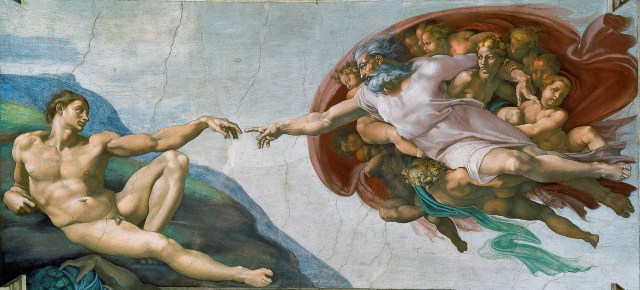
Having mastered some physical skills in my youth, I tend to understand “grace” within the context of training, the way practice leads to “breakthrough,” where we connect with a higher level of proficiency, not because of our own efforts, but by tapping into a pre-existing potential. One reaches up, and the other reaches down. No amount of trying can circumvent the reaching down, nor can we create the potential we aspire to. It’s already there—”We love because God first loved us.”

In this sense, we are a “new creation” every time we reach up to God, no matter how weakly, and God responds, much like the way it’s depicted on the ceiling of the Sistine Chapel with God and Adam. We cannot renew ourselves, but we cannot be renewed unless we reach up. That’s the mystery of effort/non-effort.

Emerson-Ralph-WaldoI say that nothing is finite except our perception. The physical world only seems separate from the Infinite, when in fact it is itself boundless and fathomless. There is a point where (in the same way that the difference between matter and energy dissolves) where the two become one. But as in the science of physics, such realities can only be described mathematically—”God’s first thoughts were in numbers.” They cannot be understood in the same way we understand the visible world.
Our concepts of scale prevent us from seeing the infinite. “There is no great and no small to the Mind that maketh all,” said Emerson. It’s our perception that keeps us in chains, and it’s our concepts that are chained to our perceptions. It’s only when we “die” to our perceptions, to “lose your life for my sake,” as Jesus said, that the scales fall from our eyes, both the “scales” of judgement and the “scales” of our reptilian mind, the mind that desperately clings to a continuity of identity.

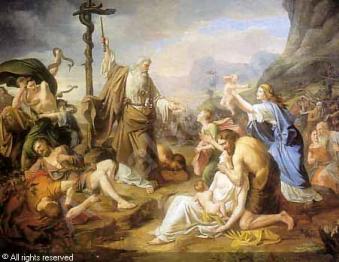
serpent.jpgThis is the man on the cross, the serpent raised in the wilderness, the death of the self and the realization of the Self, the final barrier, the veil of the Holy of Holies, where at the last moment the initiate says, “My God, my God, why hast Thou forsaken me?” It is not until one has given all that the All reveals Itself. The reaching up and the reaching down, the attunement or atonement—God becoming Man, and Man becoming God, not in quantity but in quality.
It is our innate divinity that rises from the tomb of our forgetting. God is remembered in man, not inserted there. What makes us human and not merely bio-machines is always born of the Holy Spirit, since the very beginning before heaven and Earth were formed. The melding of mind and body is the Redemption, whether we do it on our knees or in the dance studio or on a race course. The spirit is the same. The process is the same, regardless of place and time.

Posted in Lessons | Leave a comment

Is it God’s fault?


god

by Michael Maciel

It is said that when you take only one step toward Him,
He advances ten steps toward you.
But the complete truth is that God is always with you.
– Muhammad

This idea has been said in many ways by many different teachers throughout history. It has been said so often by the popular spiritual teachers of today that it has become a meme, an idea that can be gulped down all at once without having to think about it.

What does it mean that “God is always with you”?

This question deserves a closer look, because if your life is in the toilet, believing that God is always with you might tend to make you think that “in the toilet” is where God wants you to be.

You must have done something really, really terrible for God to want you to be in the toilet! It might make you believe that God is someone you should never, ever piss off! You might become fearful of breaking God’s rules, which (thank God!) are always interpreted for you by more knowledgeable people (usually men in funny hats) than yourself.

The other thing you might start believing, if you accept the teaching that “God is always with you” without contemplating what that actually means, is that wherever you happen to find yourself (in the toilet included) is somehow EXACTLY where you are SUPPOSED to be.

Now, this little pill is particularly slippery. Because on the one hand, you are exactly where you’re supposed to be, because that’s the way the universe works. The universe is perfectly intelligent and knows where everything is supposed to be at all times. But to use this as a way to justify being where you are (in the toilet included) robs you of understanding your agency in the process. In other words, who put you there?

This is where the pill gets stuck in most people’s throats. It’s just too much to swallow. Why? Because it brings up that nasty little subject of responsibility, which, of course, no one wants to claim. It suggests that you might be in the toilet because that’s where YOU either jumped or fell in. No one pushed you.

WAIT A MINUTE!!! Are you telling me that it’s MY fault that I’m sick or poor or lonely or ________ (fill in the blank)? Well, let me ask you this: is it God’s fault? Did God somehow decide that that’s where you should be? What kind of God is that? If that’s the kind of God we’re dealing with, then count me an atheist! I want no part of that kind of belief system.

You know what this reminds me of? Apocalypse. Are you one of those people that think the world is going to end soon and that all the good people are going to be whisked away into heaven, leaving the rest of us poor slobs to burn in hell? Thinking that your life is in the toilet because God put you there is the same kind of apocalyptic thinking. Someone’s gonna get punished, and this time, it turns out to be you. What kind of God is that?

It’s this kind of belief system that perpetuates the craziest ideas that plague the world today. Why shift to a sustainable energy program if the world is going to end anyway? Why help poor people improve their quality of life if God wants them to be poor? Why do anything if things are “perfect” just the way they are?

Bullshit.

Saying that “God is always with you” does have meaning, and it’s a meaning that can actually empower you instead of leaving you resigned and depressed. I mean, it’s all well and good to know that God is there with you in your lousiest moments, comforting you, loving you, etc., but do NOT think for a moment that that’s where God wants you to be. The real meaning of “God is always with you” is one that can HELP you get to a better place, not just hold your hand while you’re miserable.

Here’s an analogy, one that’s eerily close to not being an analogy at all, but the way this thing actually works. Saying that “God is always with you” is the same as saying that a radio station is always broadcasting, that every cubic centimeter surrounding you is filled with the radio waves being broadcast from the radio station’s transmitting tower. If your radio is tuned-in to the right frequency, and you have it turned on, AND if you’re listening, you WILL get the program. But, if your radio is not turned on, or you don’t have it tuned-in to the right station, the information you need to lead a successful life will be unavailable to you.

Everyone these days likes to say that the word “sin” means “missing the mark,” that there are no “sins,” only mistakes. This is a great teaching, one that is easy to swallow in one gulp. But in light of what we’re talking about, if there is no such thing as sin, then how on Earth is it possible for us to be “in the toilet” because of God’s will? That’s like saying that it’s God’s fault we missed the news because we forgot to turn on the radio!

Sometimes (no, always) a mistake is just a mistake. We aimed for the stars and landed in the toilet. We missed the mark. But mistakes are the result of not being tuned-in. They are what happens when we are out of touch with reality—or, if you like memes, the “present moment.” It’s not like you’re going to be rich, famous, loved, _______ (fill in the blank) a la The Secret if you tune-in (water cannot rise above its own level). This is not magic. What it means is that it will be far less likely that your life will go down the drain. You will make fewer mistakes.

Living a spiritual life is the most important thing you can do (oh, oh, is that another meme???) What does it mean to live a spiritual life? It means, simply, TUNE-IN. Get quiet. Go into the silent part of you. Meditate. Pray. But don’t just pray—listen for the answer. The news is always being broadcast. And it’s really good, I promise you!

Posted in Lessons | 2 Comments

Understanding those ??? parts of the Bible…


by Michael Maciel

“Wives, submit yourselves to your own husbands as you do to the Lord. For the husband is the head of the wife as Christ is the head of the church, his body, of which he is the Savior…Husbands, love your wives, just as Christ loved the church and gave himself up for her, to make her holy, cleansing her by the washing with water through the word…In this same way, husbands ought to love their wives as their own bodies. He who loves his wife loves himself…Children, obey your parents in the Lord, for this is right…”
– Ephesians, Chapter 5.

The key to understanding these teachings is in Ephesians 5:32—”This is a profound mystery—but I am talking about Christ and the church.”

bibleThe Bible is written from four different perspectives, from the most mundane to the most mystical. Here, the writer is careful to say that this is a “profound mystery,” which means that it cannot be understood with a mundane mind.

Profound mysteries are meant to be internalized, meaning that every element—the people, the places, the actions—are all parts of us individually. There is the “husband” part, the “wife” part, and the “children” part. All are aspects of ourselves.

On one level, the Bible is about societal relationships—the relationships we have with each other and the relationship between society and God. But on the “profound mystery” level, it’s about our one-on-one relationship with God and, in a sense, our relationship with ourselves.

skepticJust because the writers of these epistles lived almost 2000 years ago doesn’t mean that they were primitives. They understood the soul perhaps better than we do. They knew that there is that part of us that is conscious of daily life, the part that interacts with other people and takes care of necessities. But they also knew of the internal aspect, the deeper part of us that does not readily show the cause and effect relationships that make us do things that we cannot explain.
Today, we have sophisticated names for these internal aspects. We call them the conscious and unconscious minds. This is the “profound mystery” that the writer refers to. The “husband” is the conscious mind; the “wife” is the unconscious mind; the “children” are the things we do that we cannot explain.

On the surface, the teachings of Ephesians 5 reflect the patriarchal, hierarchical structure of the times and places of that day. But the “inner” message is timeless and universal. The inner message teaches us that the thoughts we harbor by day will haunt us by night. What we do not resolve openly will come back upon us disguised as inexplicable circumstances.

And those “circumstances” cannot be forced back into the box out of which they came, just as “children” cannot be coerced to behave, not without driving their problems further underground. The only way we can change our lives for the better is by closely watching the thoughts that we allow ourselves to think. Just as thoughts of injustice will create feelings of anger and despair, so does the conscious mind “dictate” to the unconscious how it will feel—”husband” to “wife.”

The husband loves his wife as his own body when the conscious mind realizes that the world reflects back to him (or her) the thoughts they think into it. “Be it done unto you according to your belief.” This is the profound mystery—our words are made flesh (children).

We dishonor the Bible if we constrain its teachings to mundane affairs only. By doing that, we imply that it no longer applies to we who live in the modern world. The mundane teachings of the Bible are but poor reflections of its higher mystical truths—those teachings that truly are deeper and universal. It was written for all people and all times, not just as a code of ethics but as a handbook for our inner life, the soul.

Posted in Lessons | 6 Comments

Praying on the Upswing

by Michael Maciel

swing

You know the feeling. Everything’s going your way, you’re getting things done, the items on your to-do list are helpless before you. It’s exhilarating. Life is never better than when you feel like you’re making progress. Whatever was holding you back no longer does. You feel like like a racehorse bursting out of the starting gate, and the finish line is yours for the taking!

And while we don’t feel like this all the time, it’s important that we take advantage of it when we do. It’s in those moments when the life energy within us is surging forward that we want to redirect our focus to our highest aspirations—our prayers.

The best prayers are spontaneous. They arise as an expression of our deepest longings. But prayers, like good poems, rarely work as a first draft. More often, they are a work in progress. Sometimes, we pray so that we can find out what it is that we really want. So they evolve. They build slowly (like a good poem) and as they do they slough off their ambiguities, their contradictions, and their headiness. What remains is clear-cut and to the point. What remains is powerful.

As we build our prayers, their energy increases, and that energy will break through whatever is standing in the way.

Prayer is one part of a triad: Prayer, Meditation, and Blessing. Prayer is the act of giving voice to our deepest longings. Meditation is listening for the echoes of our expression, a way of feeling our way through the corridors of our inner life. Blessing is when we project the energy of our prayer into the world. Blessing is a movement of power.

So it is precisely when we are feeling powerful that we need to tell God what we want. Not what we hope for, but what we absolutely, unequivocally, will-not-accept-anything-less-than what we want. Spirit responds to hot, never to lukewarm.

This is not to say that you can’t pray when you’re down. You should pray no matter how you’re feeling. That’s part of the discovery process I mentioned before. Praying when you’re feeling low is comforting. It makes you feel like God is hearing you, that you’re not alone in your time of trials. But when you pray on the upswing, all the energies of your life work for you. They drive home the point. They tell God what you want, not what you don’t want. What you want has power. What you don’t want simply does not compute.

Be a force for good in the world. Pray powerfully. Look God straight in the eyes and tell Him exactly what you want. Don’t flinch. You flinch, you lose. It’s a simple proposition: do you want the world to change or not? Stand up, know what you know, speak what you know, be what you know, and God will do the rest.

Posted in Lessons | 1 Comment

More on the Law of Leverage

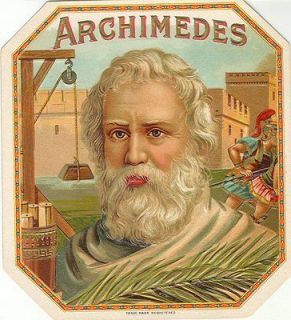
161121938_archimedes---outer-cigar-label-antique-lithograph---“Give me a place to stand and a long enough lever, and I can move the world.” – Archimedes

Many people think that changing yourself is the sum total of spiritual work, and in a sense, they’re right. But when people dedicate themselves to a life of service, changing themselves is no longer enough.

The term “leverage” has to do with power, and the definition of power is the ability to do work.

First, you move yourself with the “lever,” then you move the world. A person who has any degree of illumination and Self-realization is a powerful force in the world simply by virtue of being in it. But when such a person sets out to DO something, that power is multiplied exponentially.

By applying the principle of “As Above, So Below,” anywhere we see a single person, or a small group of people, having an enormous effect on the world, we are seeing the principle of leverage at work. By studying how it’s done in the world, we can discover ways to do it in the world of Spirit.

archimedesOne of the most effective uses of the Law of Leverage is in changing the context of a situation. You see it done in politics all the time. It’s called “spin.” Most of the time, spin is used to deceive or deflect, but it can be used to empower people just as easily.

The sad truth is that we use spin against ourselves much of the time. We create an erroneous context and then live our lives into it. In many ways, spiritual training is all about changing the context of our lives. That’s the “changing yourself” part of the work. But when a person successfully changes him or herself by changing the context within which they live, they find themselves in an extraordinary position (Archimedes’ “place to stand”) to do great good in the world.

This is the Age of Activity. It’s no longer enough to “go within” to find God. Now, we must manifest God outwardly in our living. This goes beyond simply doing the right thing. (The world is not changed one righteous act at a time.) It means that we have to bring spiritual principles to bear on the world’s most pressing problems.

We cannot solve the problems we have created by using the same level of thinking that we used to create those problems. We have to raise the level of our activity to include the Law of Prayer, the Word, the Law of Correspondence, the Law of Assumption, and the Law of Leverage. If you’re going to work for the betterment of the planet, work smart, not hard.

Posted in Lessons | Leave a comment