The Seventh Commandment—Scrambled Eggs, Thou Shalt Not Commit Adultery

adultery

by Michael Maciel


Adulterate (verb): to render a substance poorer in quality by adding another substance, typically an inferior one: “The meat was ground fine and adulterated with potato flour.” Synonyms: to make impure, degrade, debase, spoil, taint, contaminate; doctor, tamper with, dilute, water down, weaken; bastardize, corrupt.

This commandment is similar to the First Commandment (You will have no other gods before me). Their common theme is fidelity. This means that when you formulate your prayer and begin the creative process, you mustn’t allow contradictory thoughts to cloud your intention. You can’t pray for sunshine and worry that it might rain.

This is where most people get hung up about the Law of Mind—how can I see myself as healthy when I am obviously sick? I don’t have a job; where’s the money going to come from? I’m fat and ugly; who’s going to find me attractive? The problem stems from an over-identification with the world of appearances. Your senses are telling you that what you see is what you get, while your knowing is saying, “What you image is what you will get.” But you can’t adulterate the image with the “facts.” If you do, you change the image. And when it comes to the Law of Mind, the image is everything.

“Where there is no vision, the people perish: but he that keepeth the law, happy is he.”
– Proverbs 29:18

One of the misconceptions about the Law of Mind is that all you have to do is hold the vision of what you want in your mind, and it will magically appear. This is definitely not the case. Just look at those people who have accomplished really great things, people like Martin Luther King, Jr. or Mahatma Gandhi. Both men had extraordinary visions, but were their paths easy? No. They had to work long and hard—incredibly hard—to turn their visions into reality.

Does this mean that the Law of Mind only works when we apply great effort, the way King and Gandhi did? It does if our vision is as large as theirs were. They were out to change the world, not buy a new car. But what made it possible for them to succeed where others had failed? Was it simply a matter of good timing, or was something more at play? The thing they had above all else was fidelity. They were true (faithful) to their vision. And they were also willing to pay the price.

“Ask for what you want, then pay for it.” – Sufi saying

How does this apply to you? You’re probably not out to change the world, not in the way these two men were, but your vision—the thing you want to manifest in your life—will most likely change your world, right? So, what can you learn from Gandhi and King? How can you approach your creative act in the same way they did? Well, one way is not to settle for anything less than your vision. Fidelity. Don’t grab the first thing that comes along as a result of your prayer. Because it will, you know. The universe will try to bargain with you just to see how serious you are. “You want a red convertible? How about a blue one instead?”

This is a silly example, I know, but extend it out to the bigger picture. If you’re in pain, do you just want the pain to go away, or do you want to be healed? If your company is on the verge of bankruptcy, will you settle for a stopgap measure, or do you want the opportunity to adapt to changes in the marketplace? It’s not as though the universe is playing games with you; it’s unfolding the possibilities in a logical way. The more faithful you are to your vision, the more opportunities will show up. It’s up to you to resist the temptation to lunge for the first thing that catches your eye. Why cheat on your dream?

This is what separates the men from the boys, the women from the girls, and the whatevers from the whatevers. Are you mature enough to hold out for the best? Can you stare down the universe and call its bluff when it tries to approximate your wishes? Can you override its autocorrections to your vision? Just because the Law of Mind is automatic doesn’t mean your demands have to be logical. Dream Big. Push the envelope. The cosmos will adjust. It has to.

Marriage is a long term project. You have to work on it. In the same way, your life vision is a lifelong commitment as well. The bigger the vision, the greater the commitment. Divorce can be tragic, but giving up on your dreams is even worse. Be faithful to your first love. Whatever it is that lights you up, be true to it. The key to using the Law of Mind is fidelity. It’s the one time you really should put all of your eggs in one basket.


See also:

The First Commandment—it’s not what you think!

The Second Commandment—is it really about worshipping idols?

The Third Commandment—get over yourself!

The Fourth Commandment—do I really have to go to church?

The Fifth Commandment—my mother, drunk or sober

The Sixth Commandment—Thou Shalt Not Kill Bill


Books by Michael Maciel

World Priest—Bringing Heaven to Earth

The Five Vows—Raising Your Spiritual Commitment to the Next Level

 

Michael Maciel – Author 

Posted in Lessons | 1 Comment

Scrambled Eggs— Thou Shalt Not Commit Adultery

adultery

by Michael Maciel


Adulterate (verb): to render a substance poorer in quality by adding another substance, typically an inferior one: “The meat was ground fine and adulterated with potato flour.” Synonyms: to make impure, degrade, debase, spoil, taint, contaminate; doctor, tamper with, dilute, water down, weaken; bastardize, corrupt.

This commandment is similar to the First Commandment (You will have no other gods before me). Their common theme is fidelity. This means that when you formulate your prayer and begin the creative process, you mustn’t allow contradictory thoughts to cloud your intention. You can’t pray for sunshine and worry that it might rain.

This is where most people get hung up about the Law of Mind—how can I see myself as healthy when I am obviously sick? I don’t have a job; where’s the money going to come from? I’m fat and ugly; who’s going to find me attractive? The problem stems from an over-identification with the world of appearances. Your senses are telling you that what you see is what you get, while your knowing is saying, “What you image is what you will get.” But you can’t adulterate the image with the “facts.” If you do, you change the image. And when it comes to the Law of Mind, the image is everything.

“Where there is no vision, the people perish: but he that keepeth the law, happy is he.”
– Proverbs 29:18

One of the misconceptions about the Law of Mind is that all you have to do is hold the vision of what you want in your mind, and it will magically appear. This is definitely not the case. Just look at those people who have accomplished really great things, people like Martin Luther King, Jr. or Mahatma Gandhi. Both men had extraordinary visions, but were their paths easy? No. They had to work long and hard—incredibly hard—to turn their visions into reality.

Does this mean that the Law of Mind only works when we apply great effort, the way King and Gandhi did? It does if our vision is as large as theirs were. They were out to change the world, not buy a new car. But what made it possible for them to succeed where others had failed? Was it simply a matter of good timing, or was something more at play? The thing they had above all else was fidelity. They were true (faithful) to their vision. And they were also willing to pay the price.

“Ask for what you want, then pay for it.” – Sufi saying

How does this apply to you? You’re probably not out to change the world, not in the way these two men were, but your vision—the thing you want to manifest in your life—will most likely change your world, right? So, what can you learn from Gandhi and King? How can you approach your creative act in the same way they did? Well, one way is not to settle for anything less than your vision. Fidelity. Don’t grab the first thing that comes along as a result of your prayer. Because it will, you know. The universe will try to bargain with you just to see how serious you are. “You want a red convertible? How about a blue one instead?”

This is a silly example, I know, but extend it out to the bigger picture. If you’re in pain, do you just want the pain to go away, or do you want to be healed? If your company is on the verge of bankruptcy, will you settle for a stopgap measure, or do you want the opportunity to adapt to changes in the marketplace? It’s not as though the universe is playing games with you; it’s unfolding the possibilities in a logical way. The more faithful you are to your vision, the more opportunities will show up. It’s up to you to resist the temptation to lunge for the first thing that catches your eye. Why cheat on your dream?

This is what separates the men from the boys, the women from the girls, and the whatevers from the whatevers. Are you mature enough to hold out for the best? Can you stare down the universe and call its bluff when it tries to approximate your wishes? Can you override its autocorrections to your vision? Just because the Law of Mind is automatic doesn’t mean your demands have to be logical. Dream Big. Push the envelope. The cosmos will adjust. It has to.

Marriage is a long term project. You have to work on it. In the same way, your life vision is a lifelong commitment as well. The bigger the vision, the greater the commitment. Divorce can be tragic, but giving up on your dreams is even worse. Be faithful to your first love. Whatever it is that lights you up, be true to it. The key to using the Law of Mind is fidelity. It’s the one time you really should put all of your eggs in one basket.


See also:

The First Commandment—it’s not what you think!

The Second Commandment—is it really about worshipping idols?

The Third Commandment—get over yourself!

The Fourth Commandment—do I really have to go to church?

The Fifth Commandment—my mother, drunk or sober

The Sixth Commandment—Thou Shalt Not Kill Bill


Books by Michael Maciel

World Priest—Bringing Heaven to Earth

The Five Vows—Raising Your Spiritual Commitment to the Next Level

 

Michael Maciel – Author 

Posted in Lessons | 1 Comment

The Sixth Commandment—Thou Shalt Not Kill Bill

kill bill

by Michael Maciel

In the ancient mystery schools, candidates for initiation had to undergo many tests to see if they were qualified to receive the higher teachings, especially those pertaining to the Law of Mind. They weren’t tests to tell how much the candidate knew intellectually; they were tests of character. One of the most important of these tests was (and still is) harmlessness. Candidates had to prove that they would never use the Law of Mind to hurt someone.

Harmlessness is a quality of the heart. It describes the nature of one’s overall intention. What kind of person are you? Do you have unresolved issues that cause you to want to retaliate, to seek revenge, or to harbor feelings of ill-will towards others? Would you resort to using the Law of Mind as a weapon of vengeance? Would you pray for someone to die? Would you use it simply to dominate others? Would you use it to block the legitimate interests of those with whom you do business? These are important questions.

They are important, but they still pertain to one’s outer life. How do we apply the principle of harmlessness to our inner life?

When we use the Law of Mind, our inner landscape changes. We become aware of the hidden aspects of the situation at hand. Predictably, new information will arise, information that may or may not conform to our original purpose. As this new information arises, we have to treat it with care. We must not kill it off. We have to be willing to make course corrections if the new information deems it necessary. This is the deeper application of the principle of harmlessness in our use of the Law of Mind.

Harmlessness must be tempered with discernment. When operating on the level of mind, you will encounter many autonomous entities. Some will be living forms that have a purpose and trajectory of their own. These have to be dealt with carefully because until you know what their purpose is, you have to let them unfold as they will. But other forms are not alive. They are strictly thought-forms that have been infused with emotion. The only life they have is that which you give them or what they can derive from the collective mind of humanity. These forms must be dealt with in the same way you would treat any other extraneous thought. You simply get rid of them.

You can only kill that which is alive. The problem with extraneous thought forms is that they can sometimes appear to be alive when, in actuality, they are not. They can even take on the appearance of a person or an animal. Sometimes, they can look monstrous, or they can appear benign. This is why discernment is important.

Discernment only comes through practice. It comes as a result of your devotion to the real. It comes through an assiduous mindset of renunciation, the ability to cast out of one’s consciousness everything that is not of God. But this requires patience. You have to let a thought emerge fully so that you can see what it is before dismissing it simply because it doesn’t fit in with what you already know.

Meanwhile, back in the realm of everyday life, “Thou shalt not kill” is fairly unambiguous. It applies to other human beings, and some argue that it applies to animals as well. But it can also be argued that when it comes to human beings or animals, there are much worse things than death. In the case of animals, the destruction of an entire species is far worse than the death of an individual member of that species. Likewise, the destruction of an ecosystem is worse than cutting down a few trees. Similarly, building a hydroelectric dam or cutting the tops off of mountains and dumping the dirt into stream beds can destroy a watershed, something that most would consider a nonliving system but which in reality supports the life of both animals and humans alike. So, “Thou shalt not kill” has its hierarchical levels of interpretation in the physical world as well, not just in the realm of metaphysics.

Unless we apply the underlying principle of harmlessness to the commandment “Thou shalt not kill,” it seems hopelessly unworkable. Life lives by eating life. This is the law of the jungle, the ubiquitous reality of nature. If we try to remove the layers of meaning from this commandment by reducing it to a flat image, it becomes useless, because we cannot possibly use it successfully in all situations. And for it to be a true doctrine, it must be universal. There can be no exceptions.

We are thrown into a system of competing interests, a system that feeds on itself and does so with extreme prejudice. But it is also a self-sustaining system that, while presenting us with some pretty horrific challenges, also gives us extraordinary opportunities for soul growth and development. “All life is painful,” said Buddha. If it were not, we would have no reason to seek higher ground.

Our search for truth is a battlefield. As we rise up in our understanding, old concepts must go. Once they have proven themselves obsolete, we must uproot them without a second thought. The antithesis of this is to hang on to old concepts and murder the truth as it emerges, the same way Herod did in his Slaughter of the Innocents. Will you suppress the truth when it arises in your consciousness?

See also:

The First Commandment—it’s not what you think!

The Second Commandment—is it really about worshipping idols?

The Third Commandment—get over yourself!

The Fourth Commandment—do I really have to go to church?

The Fifth Commandment—my mother, drunk or sober

____

Scrambled Eggs—Thou Shalt Not Commit Adultery

Books by Michael Maciel

World Priest—Bringing Heaven to Earth

The Five Vows—Raising Your Spiritual Commitment to the Next Level

Michael Maciel – Author 

Posted in Lessons | Leave a comment

Thou Shalt Not Kill Bill

kill bill

by Michael Maciel

In the ancient mystery schools, candidates for initiation had to undergo many tests to see if they were qualified to receive the higher teachings, especially those that pertained to the Law of Mind. They weren’t tests to tell how much the candidate knew intellectually; they were tests of character. One of the most important of these tests was (and still is) harmlessness. Candidates had to prove that they would never use the Law of Mind to hurt someone.

Harmlessness is a quality of the heart. It describes the nature of one’s overall intention. What kind of person are you? Do you have unresolved issues that cause you to want to retaliate, to seek revenge, or to harbor feelings of ill-will towards others? Would you resort to using the Law of Mind as a weapon of vengeance? Would you pray for someone to die? Would you use it simply to dominate others? Would you use it to block the legitimate interests of those with whom you do business? These are important questions.

They are important, but they still pertain to one’s outer life. How do we apply the principle of harmlessness to our inner life?

When we use the Law of Mind, our inner landscape changes. We become aware of the hidden aspects of the situation at hand. Predictably, new information will arise, information that may or may not conform to our original purpose. As this new information arises, we have to treat it with care. We must not kill it off. We have to be willing to make course corrections if the new information deems it necessary. This is the deeper application of the principle of harmlessness in our use of the Law of Mind.

Harmlessness must be tempered with discernment. When operating on the level of mind, you will encounter many autonomous entities. Some will be living forms that have a purpose and trajectory of their own. These have to be dealt with carefully, because until you know what their purpose is, you have to let them unfold as they will. But other forms are not alive. They are strictly thought-forms that have been infused with emotion. The only life they have is that which you give them or what they can derive from the collective mind of humanity. These forms must be dealt with in the same way you would treat any other extraneous thought. You simply get rid of them.

You can only kill that which is alive. The problem with extraneous thought-forms is that they can sometimes appear to be alive when, in actuality, they are not. They can even take on the appearance of a person or an animal. Sometimes, they can look monstrous, or they can appear benign. This is why discernment is important.

Discernment only comes through practice. It comes as a result of your devotion to the real. It comes through an assiduous mindset of renunciation, the ability to cast out of one’s consciousness everything that is not of God. But this requires patience. You have to let a thought emerge fully so that you can see what it is before dismissing it simply because it doesn’t fit in with what you already know.

Meanwhile, back in the realm of everyday life, “Thou shalt not kill” is fairly unambiguous. It applies to other human beings, and some argue that it applies to animals as well. But it can also be argued that when it comes to human beings or animals, there are much worse things than death. In the case of animals, the destruction of an entire species is far worse than the death of an individual member of that species. Likewise, the destruction of an ecosystem is worse than cutting down a few trees. Similarly, building a hydroelectric dam or cutting the tops off of mountains and dumping the dirt into stream beds can destroy a watershed, something that most would consider a nonliving system but which in reality supports the life of both animals and humans alike. So, “Thou shalt not kill” has its hierarchical levels of interpretation in the physical world as well, not just in the realm of metaphysics.

Unless we apply the underlying principle of harmlessness to the commandment “Thou shalt not kill,” it seems hopelessly unworkable. Life lives by eating life. This is the law of the jungle, the ubiquitous reality of nature. If we try to remove the layers of meaning from this commandment by reducing it to a flat image, it becomes useless, because we cannot possibly use it successfully in all situations. And for it to be a true doctrine, it must be universal. There can be no exceptions.

We are thrown into a system of competing interests, a system that feeds on itself and does so with extreme prejudice. But it is also a self-sustaining system that, while presenting us with some pretty horrific challenges, also gives us extraordinary opportunities for soul growth and development. “All life is painful,” said Buddha. If it were not, we would have no reason to seek higher ground.

Our search for truth is a battlefield. As we rise up in our understanding, old concepts must go. Once they have proven themselves obsolete, we must uproot them without a second thought. The antithesis of this is to hang on to old concepts and murder the truth as it emerges, the same way Herod did in his Slaughter of the Innocents. Will you suppress the truth when it arises in your consciousness?


See also:

The First Commandment—it’s not what you think!

The Second Commandment—is it really about worshipping idols?

The Third Commandment—get over yourself!

The Fourth Commandment—do I really have to go to church?

The Fifth Commandment—my mother, drunk or sober

____

Scrambled Eggs—Thou Shalt Not Commit Adultery


Books by Michael Maciel

World Priest—Bringing Heaven to Earth

The Five Vows—Raising Your Spiritual Commitment to the Next Level


Michael Maciel – Author 

Posted in Lessons | Leave a comment

Spiritual Apprenticeship—do you need a teacher?

swankby Michael Maciel

Apprentices learn by emulating their master. The master says, “Do it exactly how I show you. Later, you can make your own adaptations.”

Formal spiritual development always involves the deconstruction of the student. Everyone comes with ideas about what “oneness with God” looks like, and that has to be unpacked. This is why many gurus and ashrams won’t take students who are beyond a certain age—they simply have too much baggage. But while this may be impossible, with God, all things are possible.

In the movie “Million Dollar Baby,” Eddie Dupris (Morgan Freeman) says this about apprenticeship:

“To make a fighter, you gotta strip them down to bare wood. You can’t just tell ’em to forget everything they know, you gotta make ’em forget it in their bones… make ’em so tired they only listen to you, only hear your voice, only do what you say and nothing else… show ’em how to keep their balance and take it away from the other guy… how to generate momentum off their right toe and how to flex your knees when you fire a jab… how to fight backing up so that the other guy doesn’t want to come after you. Then you gotta show ’em all over again. Over and over and over… till they think they’re born that way.”

The law of spiritual development is simple: “Water can only rise to its own level.” But like any law, this one can be broken, or at least bent, meaning that there are ways to push apprentices beyond their normal limits. This is best done by a master teacher, but students do find ways to do it on their own, either by certain kundalini exercises or psychedelic drugs. But force the water over its banks and it will always come sloshing back. Drugs and extreme exercises can offer but a glimpse. Their beatific visions are unsustainable.

True oneness with God is more than an “aha” moment. It takes commitment and training. A gemstone has a jewel within it, but it takes a master craftsman to cut away the excess.

Posted in Lessons | 1 Comment

The Fifth Commandment—My Mother, Drunk or Sober

Bad-Motherby Michael Maciel

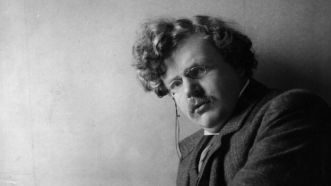
In his Defense of Patriotism, G.K. Chesterton wrote, “Saying ‘My country, right or wrong’ is like saying, ‘My mother, drunk or sober.'” We love our country, and we love our mother, usually, but it does beg the question: do they really deserve our honor? One of the definitions of the verb “to honor” is “to regard with great respect.” Right away, we have a problem, because how can you honor people, including your parents, if they haven’t earned it? This obvious contradiction has led many to believe that “Honor your father and mother” is outdated and hardly applicable in today’s world. And if one of the Ten Commandments is archaic, why not the rest of them? Why take them seriously at all?

gkc

G. K. Chesterton

Part of the answer lies in the definition “to regard with great respect,” which, when you think about it, can just as easily be applied to a stick of dynamite. Parents can either blast away obstacles in our path, or they can blow our life apart. Either way, they are a force to be reckoned with. They will shape our lives for good or ill in significant ways, and we will carry those influences with us for the rest of our lives.

But this is the literal interpretation, perhaps a little more enlightened by the benefit of 21st Century hindsight. How can we apply it to the Law of Mind? If the Ten Commandments are the veiled instructions (hidden in plain sight) on how to use the Laws of Creation through the agency of our mind, then what are these “parents” that this commandment refers to?

BabyDeadlift-300x188The answer lies not so much in the “what” as in the “how.” How do we approach our hopes and dreams; how do we formulate our prayers, our vision, and our goals in a way that gives us the best chances for success? What is realistic to pray for, and what by anyone’s judgment is nothing more than a pipe-dream?


Setting the trajectory for your life is like throwing a ball. The better your stance and the stronger your arm, the farther and more accurately you will be able to throw it. But, here’s the overriding condition: your target must be close enough to hit. No one can reasonably expect to hit a target a mile away. When it comes to prayer—the Law of Mind—this principle works in exactly the same way.

Kelly-McGillis

Actress Kelly McGillis

Do you remember Charlie? She was this gorgeous, twenty-something-year-old expert in fighter jet tactics in the 1986 movie Top Gun. Her character fed directly and ingeniously into the teenage fantasy that you can be anything you want to be, as long as you want it badly enough. Innate talents and years of training are nothing compared with sincerity and desire, so why bother? Just see yourself as a world-class whatever, and you can be one.

Add to this the belief that you deserve the best, not because you’ve earned it but because you’re you, you know? and anything’s possible, at least in your mind. But any way you look at it, this is off-the-charts narcissism, nothing more. Charlies don’t exist in the real world. Just because you want something doesn’t mean it’s within your reach, not even with the forces of the universe working for you.

When an apple falls from an apple tree, it usually lands somewhere close by. It doesn’t immediately launch itself into orbit around the Earth. Our goal might be something similarly spectacular, but unless we break the journey down into bite-sized chunks, we will never reach it. This requires thought. What do I have to do first to get one step closer to realizing my dream? Pray for what you want and you will get what you need.

Keep your eye on the endgame, but put your spiritual and mental resources into attaining that first step. When it comes to mastering the Law of Mind, this is what “Honor your father and mother” means. Start with what you have and build from there. Every successful entrepreneur knows this.

The clichés about this are endless: bloom where you are planted; a journey of a thousand miles begins with a single step; there are two kinds of people—those who think they can and those who think they can’t, and both are right. The list goes on and on, and most of them are true. But there is one that is perhaps truest of all, namely, “Turn your weaknesses into strengths.”

Whatever you have to work with, work with it! You can only conceive that which your mind is capable of conceiving. Start with that. Sometimes, we get discouraged because our dreams don’t seem large enough. We feel limited by the cards we’ve been dealt. But when we face our limitations and truly accept them for what they are, we find within them the power to overcome them. This is how we turn lead into gold.

So, now we’ve covered the first five commandments. We’re halfway there. We started with focus, the single-minded devotion to our highest conception of truth. Next, we learned how our vision can grow and evolve the closer we get to it. Then we learned that power is impersonal. After that, we learned what it means to let go of our prayers so that the forces of the universe can work on them on the unseen planes. Now, we see how to work with those same forces in a realistic way—how to work with what we have.

After this, we’ll take on the big ones, murder, adultery, and theft. Everyone’s favorites. Stay tuned!

See also:

The First Commandment—it’s not what you think!

The Second Commandment—is it really about worshipping idols?

The Third Commandment—get over yourself!

The Fourth Commandment—do I really have to go to church?

____

The Sixth Commandment—Thou Shalt Not Kill Bill

Scrambled Eggs—Thou Shalt Not Commit Adultery

Books by Michael Maciel

World Priest—Bringing Heaven to Earth

The Five Vows—Raising Your Spiritual Commitment to the Next Level

Michael Maciel – Author 

Posted in Lessons | Leave a comment

The Fourth Commandment—Do I Really Have to Go to Church?

relaxby Michael Maciel

Remember the Sabbath day, to keep it holy. – Exodus 20

As we examine the Ten Commandments through the lens of mystical and occult teachings, a simple, religious rule like “Keep the Sabbath holy” begins to reveal its deeper and more relevant meaning. That meaning has to do with mathematics, cycles, and process. But before you let those words turn you off completely, let’s skip to the important part, the part that lets you apply the principle today, in both your spiritual and your mundane life. Then, if you’re still interested, we can explore the underlying principles.

archery3The Fourth Commandment is about letting go, as in “let go and let God”—not the letting go as in giving up, but the letting go as in not pushing the cue ball across the table with your stick. In other words, it’s about action, then non-action. In archery, it’s not “pushing the arrow,” as in pulling the string back with a jerk before releasing the string, as though the extra effort will make the arrow fly farther. In gardening, it’s leaving the seed alone after you’ve planted it, instead of digging it up to see if it’s germinating. In child-rearing, it’s resisting the urge to call your kid every day after they’ve moved away to college. At that point, your parenting is, for all intents and purposes, done. Now you have to let your young adult discover and develop the skills you taught them.


This is letting go. This is what it means to “rest.” This is the conventional wisdom of the ages hidden within what on the surface looks like a simple obligation to go to church on Sunday. This, however, is just the tip of the metaphysical iceberg.

Okay, here we go:

number-sevenSeven is a peculiar number. It is the only number in the numbers one through ten that cannot be constructed geometrically with a compass and square. For this reason, the ancients called it “virgin.” As a symbol, the number seven represents the vibrational architecture of the cosmos. It shows up in the number of endocrine glands in the human body, the number of crystal systems, the number of chakras, the number of “heavens,” and the number of notes in the Pythagorean musical scale— the basis of the principle of “octave.” As such, it describes the process of growth, the way life spirals upwards in its evolutionary journey towards complete self-expression. Each return recapitulates what has gone before, only this time it’s happening at a higher level, having gained the experience of previous rounds.

TetragrammatonSeven also has a unique relationship with the number four, which is the fundamental number of the process of creation, as expressed in the Tetragrammaton (the Jewish name for God—Yod, Heh, Vav, Heh). Four describes the four cardinal directions, the four elements, and the four stages of the creative act: to will, to dare, to do, to be silent. It’s the “to be silent” part that is the theme of “keep the Sabbath holy.”

binaryWhen you set four fence posts in the ground, you have an implied seven—the four posts and the three spaces between them. This might seem to be a childish observation, but it’s not. It reveals a most important aspect of the creative act, what we might call “layering.” It is the fundamental binary system of the mental/physical world we live in. What occurs in matter occurs in iterations. What we call physical substance is anything but solid—it occurs in a series of blinks, an on-again, off-again kind of existence. It’s there, then it’s not there. Then, it’s there again, ad infinitum.

Unless we allow our creations to “blink,” which is to say, unless we let go of them, they cannot manifest in the world. The word “Sabbath” indicates to the educated reader this principle of cyclic action in nature, both in the natural world and the super-natural world. We cannot separate God from Matter.

vibratoryLayering is two things mediated by a third, a separator. We see it everywhere. In a battery, the positive and negative poles are separated by an electrolytic medium. Soil-building requires the successive layering of sediments along with decaying plant matter, facilitated by the freeze/thaw cycle which breaks up larger particles into smaller ones. The transfer of short-term memory into long-term memory requires a consistent sleep pattern—the layering of conscious states with unconscious states. Everywhere we look we can see that the principle of process consists of two things separated by a third, like the spaces between fence posts.
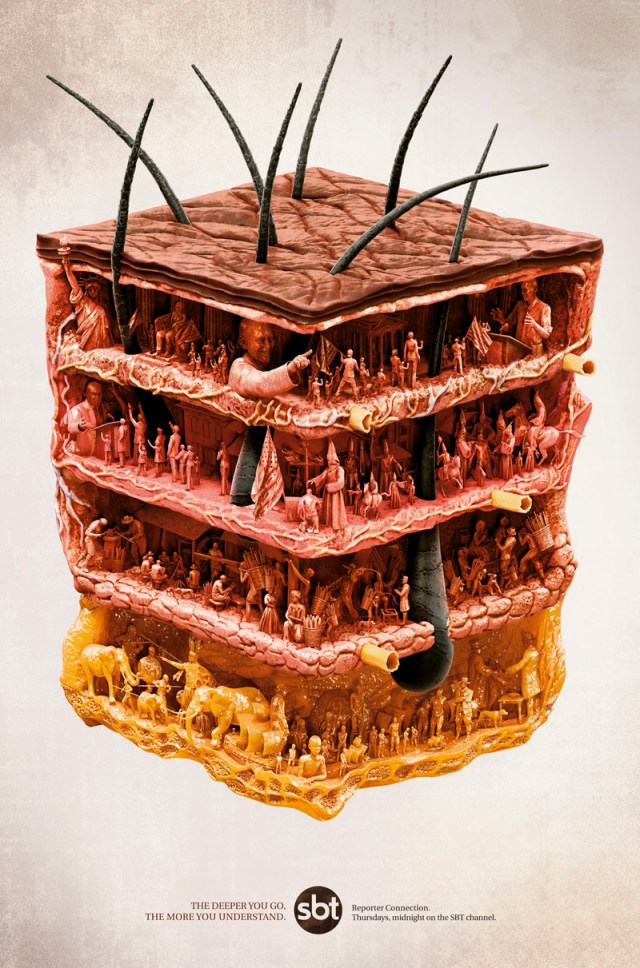
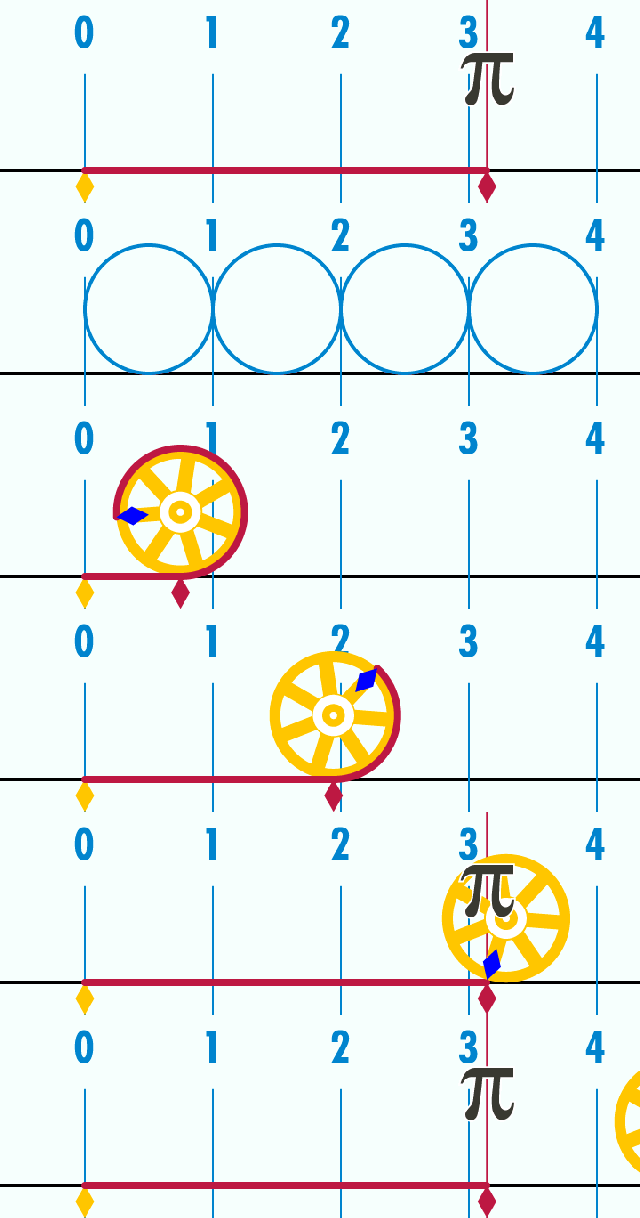
sbt_skin_layersDividing the week into seven days was not an arbitrary decision. It has a basis in reality. To form a habit, it takes three cycles of twenty-one days (three times seven). The human gestational cycle is 280 days (forty weeks—another expression of the relationship between seven and four). The enigmatic pi (3.14159…, the relationship of a circle’s diameter to its circumference) is roughly three and one-seventh, which brings us to perhaps the most important principle hidden within the Fourth Commandment:
Grace.

Pi-unrolled-720.0Grace is the principle of epigenesis, which simply means that every action will produce an equal reaction plus a little bit more. That “little bit more” is the one-seventh expressed in pi. If the cosmos were a business, pi would be its profit margin. It is the forward momentum of the Creation. The Fourth Commandment to keep the Sabbath holy is the implication of grace. All of the commandments, really, imply this—the idea that if you keep God’s law, you will be blessed—you will receive a bonus, a little bit more that isn’t a direct result of your efforts. But keeping the seventh day as a day of rest fairly screams—for those who have ears to hear—that understanding cyclical activity is the key to getting your prayers answered.



So, when it comes to prayer—which is really planting a seed thought in the subconscious mind—letting go is essential. And the best way to let go is to turn your thoughts to something entirely different. You layer an unrelated thought on top of your original prayer. In other words, think about something else!

This is the secret to successful prayer, a successful act of creation. You have to completely turn away from it, the way an Orthodox Jew turns completely away from the activities of the world and rests on the Sabbath. This is the principle that’s being described in the Fourth Commandment. It’s the science part of religion.

It works.

letting go

See also:

The First Commandment—it’s not what you think!

The Second Commandment—is it really about worshipping idols?

The Third Commandment—get over yourself!

____

The Fifth Commandment—my mother, drunk or sober

The Sixth Commandment—Thou Shalt Not Kill Bill

Scrambled Eggs—Thou Shalt Not Commit Adultery

Books by Michael Maciel

World Priest—Bringing Heaven to Earth

The Five Vows—Raising Your Spiritual Commitment to the Next Level

Michael Maciel – Author 

Posted in Lessons | 1 Comment

The Third Commandment—No False Idols, Get Over Yourself!

vanity

by Michael Maciel

We are looking at the Ten Commandments as a kind of occult document, a set of explicit instructions on how to use the Law of Mind to produce results in the world. Moses had been trained in the highest echelons of the Egyptian Priesthood, the same group who over the centuries had curated the vast storehouse of knowledge that had produced feats of engineering that even today’s scientists cannot duplicate, much less understand. Their mastery of geomantic architecture, cosmology, and cosmic consciousness forms the basis of what we call today the “Ancient Mysteries.” It is that body of knowledge that Moses inculcates into his new Priesthood, the Tribe of Levi, and he writes it in stone so that it will never be lost. As it turns out, more than a nation was “called out of Egypt,” a lot more.

Ancient-egypt

So, here we have the third dictum: “Thou shalt not take the Lord thy God’s name in vain.” It is both an occult principle and a bit of conventional wisdom. It draws into focus an underlying theme, one hidden in plain sight up until now—Humility. More than a state of mind, humility is the deep recognition that there is always more—more knowledge, more wisdom, more reality—than we as human beings can ever comprehend. As a spiritual orientation, humility makes exploration and discovery possible. Without it, any sense of more would threaten the status quo. It is arrogance, regardless of which field of discipline you find it in, that spoils progress. It always has.

Vanity is pride, pure and simple. Many spiritual teachers throughout the arc of their careers have experienced instances of this kind of pride. When people gain insights into those around them, it’s human nature to want to use it to the hilt. The smarter you are, the dumber those around you appear, and controlling them, for some, is more seductive than mountains of gold. Such abusers of spiritual power become giddy with controlling what people do by controlling what they think. It’s like an addictive drug.

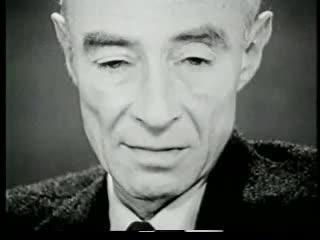
oppenheimerThe 19th Century British politician and writer, Lord Acton, said, “Absolute power corrupts absolutely.” We don’t have to look very far to find proof of his statement. Modern science is a prime example of it. From bioengineering to nuclear technology, science has found more than a few ways to play God. That most ominous quote from the Bhagavad Gita that atom bomb builder, J. Robert Oppenheimer, used to describe his first thoughts after unleashing the power of the atom says it all: “Now I am become death, the destroyer of worlds.” Later, like Dr. Frankenstein, he realized that he could not control his monster, and he deeply regretted having exposed humanity to such danger.

But power, whether spiritual or scientific (is there a difference?), doesn’t have to be abused. It just has to be respected. Whether we use our knowledge to understand the human psyche or the inner workings of nature, we must always keep in mind the possibility—no, the inevitability—of unintended consequences. No one knows the full extent of the interconnectedness of the Web of Life. We can’t always predict what will happen when we pluck one of its strands.

knighthoodThe context within which the Third Commandment was written is the same as the First and Second. It recognizes that the governing principles of the universe are more than blind forces of nature, that the intelligence inherent in the cosmos isn’t some kind of computer program set to operate in the background but that it is also self-aware. It is conscious, and it is self-determining. What primitive man didn’t understand was that this omnipresent, omniscient, and omnipotent intelligence must obey its own laws. Moses certainly understood this, because he uses the word “covenant” to describe our relationship to the Divine. “Covenant” means “contract.” Both parties are bound to it by law. It’s not that Moses believed that there was some third party involved that would enforce the contract; he understood that law is the very nature and fabric of the universe. It cannot operate in a manner that is inconsistent with its own laws. And as Jesus said when he brought Moses’ message into his era, “A house divided against itself cannot stand.”
In a way, modern science began, at least in our time, with the Ten Commandments, because they present this notion of a universe controlled by laws—universal laws—laws that everyone must obey, even the universe itself. We cannot effect changes in our lives by merely wanting them to happen or by believing that we deserve special treatment. There is a method by which changes are made, and the Ten Commandments outline that method in concise detail.

“Thou shalt not take the Lord thy God’s name in vain” is a clear caveat to those who would seek to master the Laws of Creation. The message is simple: The power you’re dealing with is God’s, not yours. Don’t try to put your name on it! It is bigger than you are and will always be bigger. If you misuse it, it will bring about your own destruction, not because the universe (God) doesn’t like you but because it simply doesn’t care. Its love for us consists in its undeviating reliability, not in our opinion of ourselves.

See also:

The First Commandment—it’s not what you think!

The Second Commandment—is it really about worshipping idols?

____

The Fourth Commandment—do I really have to go to church?

The Fifth Commandment—my mother, drunk or sober

The Sixth Commandment—Thou Shalt Not Kill Bill

Scrambled Eggs—Thou Shalt Not Commit Adultery

Books by Michael Maciel

World Priest—Bringing Heaven to Earth

The Five Vows—Raising Your Spiritual Commitment to the Next Level

Michael Maciel – Author 

Posted in Lessons | 2 Comments

The Second Commandment—get over yourself!

vanity

by Michael Maciel

We are looking at the Ten Commandments as a kind of occult document, a set of explicit instructions on how to use the Law of Mind to produce results in the world. Moses had been trained in the highest echelons of the Egyptian Priesthood, the same group who over the centuries had curated the vast storehouse of knowledge that had produced feats of engineering that even today’s scientists cannot duplicate, much less understand. Their mastery of geomantic architecture, cosmology, and cosmic consciousness form the basis of what we call today the “Ancient Mysteries.” It is that body of knowledge that Moses inculcates into his new Priesthood, the Tribe of Levi, and he writes it in stone so that it will never be lost. As it turns out, more than a nation was “called out of Egypt,” a lot more.

Ancient-egypt

So, here we have the third dictum: “Thou shalt not take the Lord thy God’s name in vain.” It is both an occult principle and a bit of conventional wisdom. It draws into focus an underlying theme, one hidden in plain sight up until now—Humility. More than a state of mind, humility is the deep recognition that there is always more—more knowledge, more wisdom, more reality—than we as human beings can ever comprehend. As a spiritual orientation, humility makes exploration and discovery possible. Without it, any sense of “more” would threaten the status quo. It is arrogance, regardless of which field of discipline you find it in, that spoils progress. It always has.

Vanity is pride, pure and simple. Many spiritual teachers throughout the arc of their careers have experienced instances of this kind of pride. When people gain insights into those around them, it’s human nature to want to use it to the hilt. The smarter you are, the dumber those around you appear, and controlling them, for some, is more seductive than mountains of gold. Such abusers of spiritual power become giddy with controlling what people do by controlling what they think. It can be like a drug.

oppenheimerThe Nineteenth Century British politician and writer, Lord Acton, said, “Absolute power corrupts absolutely.” We don’t have to look very far to find proof of his statement. Modern science is a prime example of it. From bioengineering to nuclear technology, science has found more than a few ways to play God. That most ominous quote from the Bhagavad Gita that atom bomb builder, J. Robert Oppenheimer, used to describe his first thoughts after unleashing the power of the atom says it all: “Now I am become death, the destroyer of worlds.” Later, like Dr. Frankenstein, he realized that he could not control his monster, and he deeply regretted having exposed humanity to such danger.

But power, whether spiritual or scientific (is there a difference?), doesn’t have to be abused. It just has to be respected. Whether we use our knowledge to understand the human psyche or the inner workings of nature, we must always keep in mind the possibility—no, the inevitability—of unintended consequences. No one knows the full extent of the interconnectedness of the Web of Life. We can’t always predict what will happen when we pluck one of its strands.

knighthoodThe context within which the Third Commandment was written is the same as the First and Second. It recognizes that the governing principles of the universe are more than the blind forces of nature, that the intelligence inherent in the cosmos isn’t some kind of computer program set to operate in the background but that it is also self-aware. It is conscious, and it is self-determining. What primitive man didn’t (and doesn’t) understand was that this omnipresent, omniscient, and omnipotent intelligence must obey its own laws. Moses certainly understood this, because he uses the word “covenant” to describe our relationship to the Divine. “Covenant” means “contract.” Both parties are bound to it by law. It’s not that Moses believed that there was some third party involved that would enforce the contract; he understood that law is the very nature and fabric of the universe. It cannot operate in a manner that is inconsistent with its own laws. And as Jesus said when he brought Moses’ message into his era, “A house divided against itself cannot stand.”

In a way, modern science began, at least in our time, with the Ten Commandments, because they present this notion of a universe controlled by laws—universal laws—laws that everyone must obey, even the universe itself. We cannot effect changes in our lives by merely wanting them to happen or by believing that we deserve special treatment. There is a method by which changes are made, and the Ten Commandments outline that method in concise detail.

“Thou shalt not take the Lord thy God’s name in vain” is a clear caveat to those who would seek to master the Laws of Creation. The message is simple: The power you’re dealing with is God’s, not yours. Don’t try to put your name on it! It is bigger than you are and will always be bigger. If you misuse it, it will bring about your own destruction, not because the universe (God) doesn’t like you but because it simply doesn’t care. Its love for us consists in its undeviating reliability, not in our opinion of ourselves.

See also:

The First Commandment—it’s not what you think!

The Second Commandment—is it really about worshipping idols?

____

The Fourth Commandment—do I really have to go to church?

The Fifth Commandment—my mother, drunk or sober

The Sixth Commandment—Thou Shalt Not Kill Bill

Scrambled Eggs—Thou Shalt Not Commit Adultery

Books by Michael Maciel

World Priest—Bringing Heaven to Earth

The Five Vows—Raising Your Spiritual Commitment to the Next Level

Michael Maciel – Author 

Posted in Lessons | 2 Comments

The Second Commandment—Is It Really About Worshipping Idols?

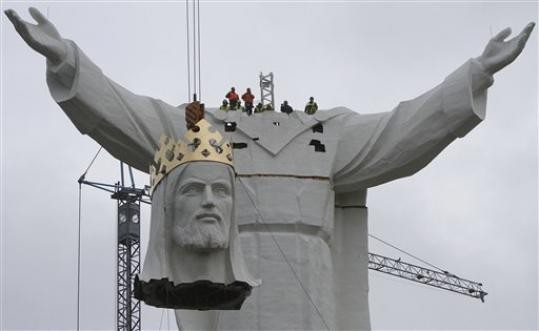
jesus statue

by Michael Maciel

Thou shalt not make unto thee any graven image.
– Exodus 20

In the days before video when no one carried smartphones in their pockets, young athletes would worship photos of their heroes, which they would cut out of sports magazines and tape to their bedroom walls. The photos were freeze-frames of fluid movements, and each captured moment would become an icon, an ideal to strive for. Unfortunately, a still photo is hard to mimic without sacrificing the gracefulness of live action. Today, athletes can see replays of their moves before they even catch their breath. This, more than improvements in equipment, is perhaps the biggest reason for the exponential rise in athletic performance.

pole vault

Too often, our hopes and dreams, our ideals and goals, both for ourselves and our loved ones, are little more than still shots. They are images engraved in our mind, ideas stuck in time that simply do not relate to our current life circumstances. We have ideas about what marriage looks like, what success looks like, what health looks like, ideas that are usually more theoretical than practical. And when we base our knowledge of the present solely on what worked in the past, we violate nature’s prime directive: adapt to changes or die.

Whenever we base our spirituality on the concepts of others, ideas we read in books, or the traditions of our faith, which might be hundreds if not thousands of years old, we run the risk of idolizing images that no longer serve us. Our philosophies become like statues, unable to move, unable to breathe, and unable to have any real effect in our lives. For life more resembles a video with light and color and sound than it does a photograph. Life is a living thing. It moves and breathes, it ebbs and flows, it is born, grows, explores, and then retires, and finally sleeps, only to reawaken and begin again. Is it any wonder that the Ten Commandments, which are truly iconic, would be a living, breathing presence in our spiritual life rather than a set of prohibitions written in stone?

moses

One of religion’s greatest contributions to the spiritual evolution of humanity has been the moral code. This is undeniable. But to say that religion is only about morality is to deny its primary purpose, which is to awaken us to our innate divinity, our creative potential, to empower us to rise above the robotic laws of nature and find our place at the right hand of God as co-creators, in love, in joy, and in harmony. This is our true estate, which the moral code was designed to prepare us for but was in no way intended to be the summit of our aspirations. Such a belief would be the equivalent of going to college for the sole purpose of acquiring knowledge with no intention of ever pursuing a career and putting that knowledge to work. What would be the point?

As the second step in the Law of Mind, “Thou shalt not make unto thee any graven image” cautions us not to get too attached to what we think we want, because as we focus on it, it will, as night follows day, reveal to us aspects of itself we could not have imagined. The closer we come to realizing our ideal, the more it reveals its true nature. What success looks like from the starting blocks looks vastly different from how it looks as we sprint towards the finish. The journey towards our goals is always a growing experience, an unfolding wisdom, and a fine-tuning of our judgment as to what is truly valuable and what is truly vain. The effort itself provides the fires of transformation, and the first thing to get transformed is our understanding of what all the effort was for.

spiral-evolution

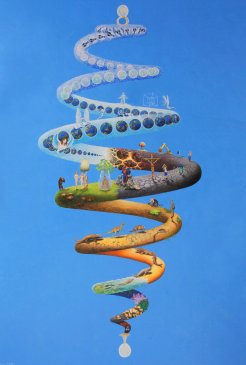
In reality, there is no finish line. Life is continuous and ever-evolving at the point of being. There is no statue carved out of stone waiting for us like some kind of cosmic trophy. What we achieve through prayer becomes the next level as we spiral upwards in our endless journey of spiritual evolution. Every end is a new beginning—forever.

Perhaps it’s because we learned the Ten Commandments in Sunday School as children that we tend to regard them in childish ways, instead of one of the most sophisticated spiritual documents ever written. Just as the First Commandment is the profound principle of focusing on our highest conception of divinity, so the Second Commandment prepares us to blow right through it when we finally get there. When the scholars tried to foist their fossilized ideas of heaven onto Jesus, he said with the wisdom of one truly alive in God, “He is not the God of the dead but the God of the living.” It doesn’t get any more profound than that.

It helps to remember that Moses, the author of the Ten Commandments, was trained in the Egyptian Priesthood, the same mystery school that understood the cosmos and built the Pyramids as its reflection, using knowledge that the best and brightest of today’s scientists can’t figure out. So don’t be blinded by vain imaginings of cultural and scientific superiority. We may be superior in some ways, but when it comes to understanding and using the powers of the soul, we are mere children.

See also:

The First Commandment—it’s not what you think!

____

The Third Commandment—get over yourself!

The Fourth Commandment—do I really have to go to church?

The Fifth Commandment—my mother, drunk or sober

The Sixth Commandment—Thou Shalt Not Kill Bill

Scrambled Eggs—Thou Shalt Not Commit Adultery

Books by Michael Maciel

World Priest—Bringing Heaven to Earth

The Five Vows—Raising Your Spiritual Commitment to the Next Level

Michael Maciel – Author 

Posted in Lessons | 13 Comments