Oneness, Pure Consciousness, and other misleading ideas

spacemountain

by Michael Maciel

When ancient teachers spoke of abstractions such as “pure consciousness,” it was in much the same way that Jesus taught in parables. Jesus told his disciples that he taught the multitude in parables but that he taught them, his disciples, what the parables meant.

Throughout the history of the Ancient Wisdom Teachings, the inner truths were only taught by word of mouth. They were never written. This is called the “Oral Tradition.” It is generally practiced one-on-one or in very small groups. The only way they could be written was in a form that alluded to the truth without spelling it out.

One such teaching is that of “oneness.” Often you will hear it expressed as the “non-dual state” or “pure consciousness.” These words describe concepts that are strictly theoretical; there is no way that the reality they name can be expressed in words. It just can’t be done.

This begs the question: why utter these words at all? It’s pretty much understood that concepts get in the way of “pure consciousness,” so why introduce more of them? Why give the mind one more bone to chew on?

True master teachers (and gurus) are not usually prone to theorize. Nor do they expound philosophy for its own sake. True spiritual teachers know that too much thinking is antithetical to realization, so they emphasize meditation and other spiritual exercises. They know that the truth cannot be written in books, nor can one get to it by reading. The truth only comes as a result of going within to find the God Self.

While realization cannot be expressed in words, the instructions on how to get to realization can. The teaching of “oneness” isn’t meant to be taken as a concept but as an instruction. You can be wowed by the concept for as long as you want to be, but in the end, the teaching of oneness is not much more than hyperbole – a noble and lofty ideal towards which to strive. It’s the “mountaintop experience,” the “pure consciousness of God,” and the “non-dual state.” But these words are all concepts. And they do NOTHING to get you there.

They do nothing, that is, unless you know how to read these teachings as instructions and not as philosophical ideas. For instance, the term “pure consciousness” really means “consciousness without content.” The instruction is implied, not spelled out, and it’s saying, “Empty your mind; stop thinking; be present to what is.”

But even these words are fraught with conceptualizations. Being present to what is can be taken as noticing the flowers in the garden or the wind on your cheek – natural phenomena unburdened by the interpretations of the mind. But consciousness without content excludes these phenomena as well. Consciousness without content means being conscious of consciousness. It means awareness turned inward upon itself, like shining a flashlight into a mirror.

So the term “pure consciousness” means much more than the cessation of thought. It means awareness aware of itself and nothing more – it’s not stopping to notice the sunset. No one can teach you how to do this; you have to work at it on your own. But they CAN tell it to you in just this way: go within, turn your awareness inward upon itself, and continue doing that until you realize the Self.

There are other instances of veiled instructions. When Jesus said “Judge not,” he was describing the method by which we can achieve equanimity or oneness. He was telling us to look upon all things (not just people) and view them all the same; all things have the same value; we are not to ascribe more value to one thing over another, no matter how much we need or want it. “Judge not” is a method, not a moral imperative. It can be taken as one, but its real purpose is to lead you within your own consciousness and to work with it.

The teaching of “oneness” alludes to this same instruction. Who will cause the mountains to be made low and the valleys to be exalted? Will the landscape literally invert itself? Will God come down from heaven and do it? No. It is WE who are to do the leveling. We are the ones who will make the first last and the last first. We will strip these things of the artificial values we have ascribed to them, and in so doing, we will see the world, perhaps for the first time, as it is and not as what we think it is.

There is some utility in creating concepts such as oneness and pure consciousness. Like the parables Jesus told to his casual listeners, they are memorable and will someday remind the more inquisitive among the audience to delve deeper into the mystery behind them. But if you’re reading this article, and you’ve made it this far, it’s unlikely that you will be satisfied with mysteries or, for that matter, concepts.

“Oneness” is not a mantra. Repeating it will not get you any closer to it. You have to do what the concept implies. But in order to do that, you have to hear it as an instruction, not as a concept. You have to take notice when you find yourself valuing one thing over another, and you have to make the effort to correct that. You have to work at it, because the mind – your mind – will fight you tooth and nail.

The principal teachers of the world, people like Jesus, Buddha, Lao Tzu, Hypatia of Alexandria, and Mary Magdalene, never spoke about the teachings directly. They always hid their true meaning from the eyes of the profane. They did this partly because it’s impossible to verbalize the truth and partly because it’s against the rules of the Ancient Wisdom Tradition. Instead, they presented them as concepts, usually pictorialized in stories. Later, they would take their disciples aside and tell them what the stories meant, not to explain them but to put them into their proper context, which was one of instruction, not ideas.

If we can avoid hyperbole for hyperbole’s sake, the Ancient Wisdom Teachings will make a lot more sense. It does no good to say that God is pure consciousness unless we know how to read that. Otherwise, it’s just another philosophical dead-end, unattainable, and entirely useless.

Posted in Lessons | 3 Comments

The Ninth Commandment—Thou Shalt Not Bear False Witness

oathPart of a continuing study of the Ten Commandments by Michael Maciel

When summoned to a court of law, we take an oath to tell the truth when asked about what happened. We are forbidden to lie about it. We are also compelled to divulge whatever information we have that will affect the outcome of the case. If we withhold that information, we can be charged with obstruction of justice.

Obstruction of justice is when we intentionally interfere with the legal process, which includes the process of discovery – the ability of the court to obtain all the evidence. We cannot settle our disagreements unless we know everything that we need to know. So, if we hold back key information, we prevent the legal process from doing what it’s supposed to, which is to reach a just settlement to our dispute.

In terms of the Law of Mind, a “dispute” is the difference between a current condition and a desired condition. The current condition might be that we don’t have enough money to pay our upcoming bills. The desired condition is having enough money to make up the shortfall.

So, we go to work visualizing the money we need – we see see it either as cash in our hands, bigger numbers in our bank account, or the word “Paid” stamped on our bills. We don’t really care where the money comes from, because money is pretty much created out of thin air anyway. We’re not stealing it from anyone else; we’re simply allowing whatever mechanisms are available to put the money where it needs to be.

But here’s the rub. Whenever we use the Law of Mind to affect changes in the constellations of our affairs, something else has to compensate for those changes. This is where the Sufi saying comes in: “Ask for what you want and then pay for it.” When we pray for more money, something has to make room for it. And in order to do that, all of our cards have to be on the table, including the ones we don’t want others (or ourselves) to see.

When the universal mind begins its process of discovery, it’s going to want to examine our “books,” and we might not like what it finds. It might point out things we are unwilling to let go of, things we have inordinate attachments to, or things we simply are unconscious of but nevertheless are unwilling to part with. These are the ways in which we might be obstructing justice.

For example, we might need money for the next three house payments. At the same time, we own a vintage car that’s sitting on blocks in the driveway. Now, we’re VERY invested emotionally in this car – selling it would feel like failure. So we attempt to “hide” it from the universal mind’s process of discovery. This, of course, we cannot do, because the universal mind knows everything. It is the living connection between all things. It knows everything because…well, it IS everything, including the car. But we have the ability to obstruct its process of working the whole thing out by disallowing the car’s value and by our unwillingness to sell it.

If we envision our prayer as a petition in a court of law, the judge is going to want to see all of the evidence. If we withhold part of the evidence, or if we misrepresent it, then the legal process will be thwarted, and we won’t get the results we’re looking for.

Of course, we can’t hide anything from the universal mind, but we can hide it from ourselves. Whenever we use the Law of Mind to manifest something in our lives, our lives are going to change. They have to. If we resist the changes as they present themselves, we are, in effect, blocking our prayer. This is one of the biggest reasons why our prayers seemingly go unanswered.

According to the Law of Mind, if we ask for something in prayer, we will receive it – every time and without exception – as long as it doesn’t violate the universal law of compensation. If we ask for more money without first utilizing resources we already have, our ledger sheets will be even more out of balance. We will receive the extra money, but it will only make our problems worse in the long run.

We all know that lying about other people can ruin their lives, but do we know that lying to ourselves is just as dangerous? We cannot lie to God. That is impossible. But we can (and often do) lie to ourselves. Since the Law of Mind operates according to what we ARE more than to what we say (or think), the thing that most often keeps us from getting what we want is the way we are being (whether consciously or unconsciously) in the world.

Lack is an unnatural state. If we don’t have what we need, we are the ones responsible. Our thoughts are simply at odds with the will of God. It is against God’s nature to deprive anyone of anything. If we are out of touch with the realities of our lives, if we are being inauthentic in our living, if we are putting on a front, or in any way lying to the world about how we feel, then we will be in a continual state of lack. Why? Because we are obstructing the movement of God’s energy, the same energy that is trying to change the conditions in which we find ourselves trapped.

There is another saying: “Always tell the truth; it changes everything.” Someone asks you, “Do you love me?” Your answer could change your world. Your sixteen year-old son asks you to buy him a $75,000 Corvette. What could possibly go wrong? You’re tired of working and you want to take early retirement. How do you really feel about that? Will having less to do actually make you happier? People who lie to themselves are incapable of telling the truth to anyone, including God.

Have you ever wondered why unscrupulous people always seem to get what they want? It’s because they aren’t afraid to be who they are. It doesn’t matter how many people they lie to—they don’t lie to themselves. How are you being dishonest? Under what falsehoods do you labor? What sorts of pretenses are you trying to uphold? Which of your past deeds are sitting in the shadows of your unconscious, passing judgment on you every moment of your life? Wouldn’t you rather expose them to the light of day?

We are, in truth, our own worst enemy, especially when it comes to how we use the Law of Mind. Honesty isn’t just a moral or ethical principle by which we govern our relationships with other people. It should also govern our relationship with ourselves. This is why it is said that confession is good for the soul—it scrubs our inner mirror. And it helps to remember that honesty doesn’t necessarily make you a good person; it just makes you an honest one.

Being honest with yourself about yourself may show you things you do not like. So what? Whatever you find in your self-inquiry, make peace with it, because nothing changes until it becomes what it is. Hiding problems only perpetuates them. Go within, connect with God, and then proclaim, “I stand in the Light of Christ!” But don’t do it until you’re ready to let go—of everything.

See also:

The First Commandment—it’s not what you think!

The Second Commandment—is it really about worshipping idols?

The Third Commandment—get over yourself!

The Fourth Commandment—do I really have to go to church?

The Fifth Commandment—my mother, drunk or sober

The Sixth Commandment—Thou Shalt Not Kill Bill

The Seventh Commandment—Thou Shalt Not Commit Adultery, Scrambled Eggs

The Eighth Commandment—Thou Shalt Not Steal, or else!

The Ninth Commandment—Thou Shalt Not Bear False Witness

Books by Michael Maciel

WP-web

World Priest—Bringing Heaven to Earth

Five Vows front cover copy

The Five Vows—Raising Your Spiritual Commitment to the Next Level

Michael Maciel – Author 

Posted in Lessons | Leave a comment

Bearing False Witness

oathPart of a continuing study of the Ten Commandments by Michael Maciel

When summoned to a court of law, we take an oath to tell the truth when asked about what happened. We are forbidden to lie about it. We are also compelled to divulge whatever information we have that will affect the outcome of the case. If we withhold that information, we can be charged with obstruction of justice.

Obstruction of justice is when we intentionally interfere with the legal process, which includes the process of discovery – the ability of the court to obtain all the evidence. We cannot settle our disagreements unless we know everything that we need to know. So, if we hold back key information, we prevent the legal process from doing what it’s supposed to, which is to reach a just settlement to our dispute.

In terms of the Law of Mind, a “dispute” is the difference between a current condition and a desired condition. The current condition might be that we don’t have enough money to pay our upcoming bills. The desired condition is having enough money to make up the shortfall.

So, we go to work visualizing the money we need – we see see it either as cash in our hands, bigger numbers in our bank account, or the word “Paid” stamped on our bills. We don’t really care where the money comes from, because money is pretty much created out of thin air anyway. We’re not stealing it from anyone else; we’re simply allowing whatever mechanisms are available to put the money where it needs to be.

But here’s the rub. Whenever we use the Law of Mind to affect changes in the constellations of our affairs, something else has to compensate for those changes. This is where the Sufi saying comes in: “Ask for what you want and then pay for it.” When we pray for more money, something has to make room for it. And in order to do that, all of our cards have to be on the table, including the ones we don’t want others (or ourselves) to see.

When the universal mind begins its process of discovery, it’s going to want to examine our “books,” and we might not like what it finds. It might point out things we are unwilling to let go of, things we have inordinate attachments to, or things we simply are unconscious of but nevertheless are unwilling to part with. These are the ways in which we might be obstructing justice.

For example, we might need money for the next three house payments. At the same time, we own a vintage car that’s sitting on blocks in the driveway. Now, we’re VERY invested emotionally in this car – selling it would feel like failure. So we attempt to “hide” it from the universal mind’s process of discovery. This, of course, we cannot do, because the universal mind knows everything. It is the living connection between all things. It knows everything because…well, it IS everything, including the car. But we have the ability to obstruct its process of working the whole thing out by disallowing the car’s value and by our unwillingness to sell it.

If we envision our prayer as a petition in a court of law, the judge is going to want to see all of the evidence. If we withhold part of the evidence, or if we misrepresent it, then the legal process will be thwarted, and we won’t get the results we’re looking for.

Of course, we can’t hide anything from the universal mind, but we can hide it from ourselves. Whenever we use the Law of Mind to manifest something in our lives, our lives are going to change. They have to. If we resist the changes as they present themselves, we are, in effect, blocking our prayer. This is one of the biggest reasons why our prayers seemingly go unanswered.

According to the Law of Mind, if we ask for something in prayer, we will receive it – every time and without exception – as long as it doesn’t violate the universal law of compensation. If we ask for more money without first utilizing resources we already have, our ledger sheets will be even more out of balance. We will receive the extra money, but it will only make our problems worse in the long run.

We all know that lying about other people can ruin their lives, but do we know that lying to ourselves is just as dangerous? We cannot lie to God. That is impossible. But we can (and often do) lie to ourselves. Since the Law of Mind operates according to what we ARE more than to what we say (or think), the thing that most often keeps us from getting what we want is the way we are being (whether consciously or unconsciously) in the world.

Lack is an unnatural state. If we don’t have what we need, we are the ones responsible. Our thoughts are simply at odds with the will of God. It is against God’s nature to deprive anyone of anything. If we are out of touch with the realities of our lives, if we are being inauthentic in our living, if we are putting on a front, or in any way lying to the world about how we feel, then we will be in a continual state of lack. Why? Because we are obstructing the movement of God’s energy, the same energy that is trying to change the conditions in which we find ourselves trapped.

There is another saying: “Always tell the truth; it changes everything.” Someone asks you, “Do you love me?” Your answer could change your world. Your sixteen year-old son asks you to buy him a $75,000 Corvette. What could possibly go wrong? You’re tired of working and you want to take early retirement. How do you really feel about that? Will having less to do actually make you happier? People who lie to themselves are incapable of telling the truth to anyone, including God.

Have you ever wondered why unscrupulous people always seem to get what they want? It’s because they aren’t afraid to be who they are. It doesn’t matter how many people they lie to—they don’t lie to themselves. How are you being dishonest? Under what falsehoods do you labor? What sorts of pretenses are you trying to uphold? Which of your past deeds are sitting in the shadows of your unconscious, passing judgment on you every moment of your life? Wouldn’t you rather expose them to the light of day?

We are, in truth, our own worst enemy, especially when it comes to how we use the Law of Mind. Honesty isn’t just a moral or ethical principle by which we govern our relationships with other people. It should also govern our relationship with ourselves. This is why it is said that confession is good for the soul—it scrubs our inner mirror. And it helps to remember that honesty doesn’t necessarily make you a good person; it just makes you an honest one.

Being honest with yourself about yourself may show you things you do not like. So what? Whatever you find in your self-inquiry, make peace with it, because nothing changes until it becomes what it is. Hiding problems only perpetuates them. Go within, connect with God, and then proclaim, “I stand in the Light of Christ!” But don’t do it until you’re ready to let go—of everything.

See also:

The First Commandment—it’s not what you think!

The Second Commandment—is it really about worshipping idols?

The Third Commandment—get over yourself!

The Fourth Commandment—do I really have to go to church?

The Fifth Commandment—my mother, drunk or sober

The Sixth Commandment—Thou Shalt Not Kill Bill

The Seventh Commandment—Bearing False Witness

Books by Michael Maciel

WP-web

World Priest—Bringing Heaven to Earth

Five Vows front cover copy

The Five Vows—Raising Your Spiritual Commitment to the Next Level

Michael Maciel – Author 

Posted in Lessons | Leave a comment

The Eighth Commandment—Thou Shalt Not Steal…or else!

brass ringby Michael Maciel

Why are there so many “thou shalt nots” in the Ten Commandments? No wonder God comes across as an overbearing father figure ranting at his children. You can almost see him pointing his finger at you as you read these words. “Don’t stay out after midnight. Don’t hit your little sister. Don’t talk back to your mother!” Don’t, don’t, don’t. No wonder so many people rebel.

But if the Ten Commandments seem a bit simplistic, it’s because principles are hard to teach—they’re abstract. It’s the overall pattern of the Decalogue that tells us that there are layers of meaning below the surface—depth, not just breadth. And to plumb the depths, you have to change the context. You have to shift from a morals and ethics point of view to a scientific point of view—the science of the Law of Mind.

The Law of Mind is a principle. It describes the cause-and-effect relationship between thoughts and outer conditions. If you understand how it works, the deeper meaning of the Ten Commandments begins to stand out. Instead of being a doctrine of moral and religious aphorisms, we begin to see discreet, detailed instructions on how to get our prayers answered.

Why is this important? Why does it matter that Moses outlined the Law of Mind in the Decalogue? Don’t we have enough information already in the teachings of New Thought? Surely, everything we’ve discussed so far can be found in Charles Fillmore’s Unity Movement or Ernest Holmes’ Science of Mind. The reason it matters is because within the Ten Commandments lies the whole package. Everything we need to know is laid out in ten easy-to-remember principles. And yes, it’s also important because it gives us a window into the wisdom of the ancients stretching all the way back to the Egyptian Mystery Schools, which is where Moses received his training. What he learned there he summarized on a couple of stone tablets. Hermes couldn’t have done it better.

So now we come to what appears to be little more than a simple rule of ethics—don’t take what doesn’t belong to you. Doesn’t get much simpler than that, does it. But if we shift the context to the Law of Mind, our focus shifts also. Somehow, “thou shalt not steal” has to be internalized. And the more we look at it, the more layers of meaning we begin to see.

At the first layer, we could say that it simply means that we shouldn’t use the Law of Mind to take another person’s property. You might love the house down the street, but you’re not going to pray for that particular house. Why? Because someone’s already living in it, and they may not want to move. But praying for that house will exert a real force, one which the current owners will feel. Circumstances will begin to turn against them. Hidden problems needing repair might suddenly become apparent. Legal problems or money problems could arise, which could make the owners start to consider putting their house on the market. Any number of forces could be brought into play that would start nudging them out so that you could move in. Not good.

The second layer of meaning we might encounter would be subtler still. As a concept, we could call it “over-reaching.” We’ve all experienced this. We like the idea of going to Harvard, but we’re not smart enough. So, we force our way in by using the Law of Mind, but we quickly find out that we don’t belong there. Our current state of consciousness is simply too limited to breathe that kind of air. Or, we’re really attracted to a certain person. He or she fits our preconceived notions of what a perfect mate looks like. But when we visualize getting into a relationship with them and it actually happens, we’re suddenly miserable, and they’re miserable too, because we simply do not belong with that person.

What is yours is only yours by right of consciousness. In a sense, it must already be yours before it will come to you. There has to be a match. Not only must there be a match, there must also be space for it in your life. Whenever we pray for something without doing the necessary preparations for receiving it, we are, in effect, attempting to steal it. The thing we want simply does not belong to us. So, you can see right away that part of praying effectively requires changing yourself. You must first alter your vibration—your internal and external quality of being in the world—so that it harmonically resonates with the thing you want to possess.

The third layer of meaning is really quite powerful. Once you realize that nothing comes to you except what is already yours, you begin to see that your very existence is a reflection of who you are. All the circumstances of your life are there because you drew them to you. And if they didn’t come to you, you went to them. This realization can lead us into a state of mind that eschews desire altogether. You don’t want anything. You become the living embodiment of the 23rd Psalm: “The Lord is my shepherd, I shall not want.” This state of consciousness brings with it a profound sense of peace.

But meanwhile, back here on the ground, the lesson is much simpler: don’t reach out and try to take what hasn’t yet fully manifested. Let go of the process. It’s one thing to set the wheels in motion, to ask God to give you what you want, but it’s quite another to let God give it to you when both you and it are ready. This is one thing you simply cannot control. The Law of Mind isn’t a genie in a bottle. You can’t just snap your fingers and have stuff magically appear. Mind is indeed the cause, but nature must act on that cause and bring it to fruition, and it has to do it according to its own laws. Granted, the answers to some prayers may seem miraculous, but only to the human mind. To God’s mind, most things come very easily, and there is no order of magnitude. As Emerson said, “There is no great and no small to the Mind that maketh all.”

Remember, what you fight to get, you fight to keep. Let God do the logistics. Let go. Don’t let your eagerness muck up the works. Along with preparation, timing is everything.

See also:

The First Commandment—It’s Not What You Think!

The Second Commandment—Is It Really About Worshipping Idols?

The Third Commandment—Get Over Yourself!

The Fourth Commandment—Do I Really Have to Go to Church?

The Fifth Commandment—My Mother, Drunk or Sober

The Sixth Commandment—Thou Shalt Not Kill Bill

The Seventh Commandment—Scrambled Eggs, Thou Shalt Not Commit Adultery

The Ninth Commandment— Bearing False Witness

The Tenth Commandment—Thou Shalt Not Covet, Own It!

Posted in Lessons | Leave a comment

Thou Shalt Not Steal…or else!

brass ringby Michael Maciel

Why are there so many “thou shalt nots” in the Ten Commandments? No wonder God comes across as an overbearing father figure ranting at his children. You can almost see him pointing his finger at you as you read these words. “Don’t stay out after midnight. Don’t hit your little sister. Don’t talk back to your mother!” Don’t, don’t, don’t. No wonder so many people rebel.

But if the Ten Commandments seem a bit simplistic, it’s because principles are hard to teach—they’re abstract. It’s the overall pattern of the Decalogue that tells us that there are layers of meaning below the surface—depth, not just breadth. And to plumb the depths, you have to change the context. You have to shift from a morals and ethics point of view to a scientific point of view—the science of the Law of Mind.

The Law of Mind is a principle. It describes the cause-and-effect relationship between thoughts and outer conditions. If you understand how it works, the deeper meaning of the Ten Commandments begins to stand out. Instead of being a doctrine of moral and religious aphorisms, we begin to see discreet, detailed instructions on how to get our prayers answered.

Why is this important? Why does it matter that Moses outlined the Law of Mind in the Decalogue? Don’t we have enough information already in the teachings of New Thought? Surely, everything we’ve discussed so far can be found in Charles Fillmore’s Unity Movement or Ernest Holmes’ Science of Mind. The reason it matters is because within the Ten Commandments lies the whole package. Everything we need to know is laid out in ten easy-to-remember principles. And yes, it’s also important because it gives us a window into the wisdom of the ancients stretching all the way back to the Egyptian Mystery Schools, which is where Moses received his training. What he learned there he summarized on a couple of stone tablets. Hermes couldn’t have done it better.

So now we come to what appears to be little more than a simple rule of ethics—don’t take what doesn’t belong to you. Doesn’t get much simpler than that, does it. But if we shift the context to the Law of Mind, our focus shifts also. Somehow, “thou shalt not steal” has to be internalized. And the more we look at it, the more layers of meaning we begin to see.

At the first layer, we could say that it simply means that we shouldn’t use the Law of Mind to take another person’s property. You might love the house down the street, but you’re not going to pray for that particular house. Why? Because someone’s already living in it, and they may not want to move. But praying for that house will exert a real force, one which the current owners will feel. Circumstances will begin to turn against them. Hidden problems needing repair might suddenly become apparent. Legal problems or money problems could arise, which could make the owners start to consider putting their house on the market. Any number of forces could be brought into play that would start nudging them out so that you could move in. Not good.

The second layer of meaning we might encounter would be subtler still. As a concept, we could call it “over-reaching.” We’ve all experienced this. We like the idea of going to Harvard, but we’re not smart enough. So, we force our way in by using the Law of Mind, but we quickly find out that we don’t belong there. Our current state of consciousness is simply too limited to breathe that kind of air. Or, we’re really attracted to a certain person. He or she fits our preconceived notions of what a perfect mate looks like. But when we visualize getting into a relationship with them and it actually happens, we’re suddenly miserable, and they’re miserable too, because we simply do not belong with that person.

What is yours is only yours by right of consciousness. In a sense, it must already be yours before it will come to you. There has to be a match. Not only must there be a match, there must also be space for it in your life. Whenever we pray for something without doing the necessary preparations for receiving it, we are, in effect, attempting to steal it. The thing we want simply does not belong to us. So, you can see right away that part of praying effectively requires changing yourself. You must first alter your vibration—your internal and external quality of being in the world—so that it harmonically resonates with the thing you want to possess.

The third layer of meaning is really quite powerful. Once you realize that nothing comes to you except what is already yours, you begin to see that your very existence is a reflection of who you are. All the circumstances of your life are there because you drew them to you. And if they didn’t come to you, you went to them. This realization can lead us into a state of mind that eschews desire altogether. You don’t want anything. You become the living embodiment of the 23rd Psalm: “The Lord is my shepherd, I shall not want.” This state of consciousness brings with it a profound sense of peace.

But meanwhile, back here on the ground, the lesson is much simpler: don’t reach out and try to take what hasn’t yet fully manifested. Let go of the process. It’s one thing to set the wheels in motion, to ask God to give you what you want, but it’s quite another to let God give it to you when both you and it are ready. This is one thing you simply cannot control. The Law of Mind isn’t a genie in a bottle. You can’t just snap your fingers and have stuff magically appear. Mind is indeed the cause, but nature must act on that cause and bring it to fruition, and it has to do it according to its own laws. Granted, the answers to some prayers may seem miraculous, but only to the human mind. To God’s mind, most things come very easily, and there is no order of magnitude. As Emerson said, “There is no great and no small to the Mind that maketh all.”

Remember, what you fight to get, you fight to keep. Let God do the logistics. Let go. Don’t let your eagerness muck up the works. Along with preparation, timing is everything.

Posted in Lessons | Leave a comment

Love Your Enemies—Part 2

face offby Michael Maciel

What is the one thing you hate the most? What more than anything else will cause you to hate someone, possibly forever? In other words, how are enemies created?

Learning how to create something is the first step in gaining power over it. If you learn how to create hatred, you are that much closer to learning how to un-create it.

Wouldn’t it behoove you to learn how to un-create the hatred in yourself? If you could, then you could un-create it in others.

But first, you must first understand how hatred comes into being. So, again, I ask you, what is the one thing you hate the most? What more than anything else will cause you to hate someone, possibly forever? Answer this, and you will have the power of life and death over hatred.

If you know what you hate the most, there is a 99.9 percent chance that it’s the same thing everyone else hates, too. Know yourself, and the chances are good that you will understand your fellow human beings. All of them. We’re just not that different, especially when it comes to core issues like hatred. What you hate the most, everyone else hates as well. Know what it is, and you possess the key to creating peace in the world.

The premise here is an easy one: the word “love” conceals more than it reveals. It simply covers too many meanings for it to be meaningful. Did you know that the Eskimo Indians have fifty words for “snow”? It’s because snow is such a large part of their lives. And yet, we only have one word for love. Is it any wonder why “Love your enemies” as a Christian principle is so universally avoided?

When the meaning of a word obscures the reality behind it, sometimes it’s true meaning can be ascertained by examining its opposite. The opposite of love, however, is not hate. Neither is it indifference, or the verb form of indifference, “to ignore.” While being ignored isn’t pleasant, it doesn’t usually cause us to endlessly hate the person who ignores us.

But what is it that will cause us to hate the other person, and not just in the moment but for the rest of our lives? Whatever that is, it would certainly be at the heart of what Jesus was talking about when he said, “Love your enemies.” He must have understood it. He must have had the deepest insight into the nature of hatred in order to utter the three most paradoxical words in the Gospels: “Love your enemies.”

That one passage, while seemingly unworkable in the extreme, nonetheless cannot be discarded, no matter how hard we try. Intuitively, we know that it is the lynchpin that holds the entire Christian message in place. In fact, without it, Christianity falls apart. Unless it’s there, doctrines become nothing more than statements of tribalism – “us against them.”

And what assurance do we have that if we love our enemies that they will love us back? If we lay down our guns, won’t they take advantage and kill or enslave us? What possible benefit is there in that? “Love your enemies” is, therefore, nothing more than a suicide pact, or, worse yet, the manifesto of a coward. Who could possibly take it seriously?

Or so it seems. And the only way it can seem that way is if you make false assumptions about what it means to “love” your enemies. But what else can you do when you’re using a word that has only one meaning?

What are your false assumptions? One is that you think it means that you have to be nice to those who intend you harm. Kiss them on the cheek. Agree with their ideology. Let them have whatever they want. No wonder “Love your enemies” sounds like the philosophy of a fool. But this is because the word “love” is so misunderstood. And why is it misunderstood? Because it hasn’t been linked to the roots of hatred. If you know how to create hatred, you know how to un-create it.

The other false assumption about “Love your enemies” is that when you do, you will no longer have them—your enemies will suddenly become your friends. Again, this is another sharp departure from reality. We will always have enemies, if not mortal ones, ones with whom we compete, either philosophically, commercially, or socially. In a world of competing interests, enemies are inevitable. It would be stupid to ignore them. And one thing we can pretty much say with certainty is that Jesus was not stupid. Why, then, would he attach unrealistic expectations to the most important part of his message?

So, the question becomes, “How do we deal with our enemies as enemies?” If we’re not trying to magically transform them into friends, what are we trying to transform them into? Are we trying to transform them into anything at all? Besides fertilizer, I mean. How can we possibly “love” our enemies on the battlefield, on the street, or on the floor of Congress? Is this hopelessly paradoxical, or is there something to it that actually works?

If “Love your enemies” doesn’t magically transform them into friends, it must at least help remove the hatred. In other words, it must undermine and eventually remove the cause of hatred, which in turn would help to eliminate the endless cycle of war. Imagine that. Imagine a world in which war was rare. But, that’s not the case, is it. Wars are endless because they’re being fueled by hatred. Not just the hatred that flares up over a disagreement, but the kind of hatred that endures, sometimes for centuries. It’s hatred that’s the problem, and we can’t get rid of it unless we understand it in ourselves.

So again, I ask you (for the last time), what is the one thing you hate the most? What more than anything else will cause you to hate someone, possibly forever?

Humiliation.

Humiliation is the one thing that the human heart cannot forgive. If there is such a things as a “sin against the spirit,” it is humiliation. It makes us more than just angry; it makes us hate. And it makes us hate with a hatred that lasts for generations.

Christianity is a major world religion. It is based on the teachings of one of the most intelligent people who has ever lived. Does it not make sense that the concept of “Love your enemies” would reflect the deepest and most profound truth, and that that truth would be complex enough to cover the full range of human experience? Does it not make sense that the limitations of language would be the chief reason why such a truth would be dismissed out-of-hand by the worldly wise? Does it not make sense that out of such a fundamental, deeply profound truth would come the noblest traditions devised by humanity, such as chivalry, international laws against war crimes, commonly accepted rules of engagement, and the reconstruction of vanquished lands, as in the Marshall Plan in WWII?

Is it possible to have enemies without demonizing them? Is it possible to acknowledge that their cause is as noble in their eyes as yours are to you? Can you fight someone, even to the death, without hating them? By doing so, would it not preserve the most valuable part of you, your SOUL, and not make your physical body the bottom line? Can you live in a world where life and death are so inextricably intertwined without losing your soul?

Are you physical or spiritual? Which is the more important part? If the physical part of you is your highest ideal, then it makes sense to destroy your enemies utterly, not just their bodies but their spirit also. But do you not see that this is what perpetuates wars, that this is what causes unending hatred?

So, let’s recast the mandate in more accessible, albeit negative, terms. We do this because of the limitations of the word “love”:

Do not demonize your enemies.

Do not strip your enemies of their dignity.

Do not call them inhuman.

You can beat them into the ground, but then help them get back on their feet.

You can burn their crops, but not their seeds.

You can beat them in battle, but do not rape them or kill their children.

Do NOT kill civilians.

Do NOT kill the unarmed.

Do NOT destroy their culture or their holy places.

Do NOT, Do NOT, Do NOT humiliate them.

All of these negatives are implied in the one, simple statement, “Love your enemies.” This is not theology; it is the wisdom of the heart. And you don’t have to take my word for it. Just consider the source—it takes a certain amount of faith to accept that Jesus would not have given us a precept that was unworkable.

We will always have enemies, but will we always have hatred?

Time-Out

Posted in Lessons | 2 Comments

Life on the Edge

the-infiltratorby Michael Maciel

Recently, I read a review of The Infiltrator, a movie starring Bryan Cranston about Robert Mazur, an undercover FBI agent whose work led to the arrest of Medellin Cartel boss, Pablo Escobar. One sentence stood out, not for its meaning but for its violent imagery, the way it grabbed my attention against my will and forced me into hyper-awareness of life on the edge:

“Even as Mazur gets closer and closer to the final big bust, there is still the possibility that everything could blow up in an instant — Escobar money manager Javier Ospina, for one, doesn’t trust the newcomer [Mazur] from the first moment he sees him, and his skepticism hangs in the air like the blade of a guillotine.”

Damocles2We all live under the sword of Damocles; no one leaves this world alive. Perhaps this is what makes movies like The Infiltrator so compelling – they play into our awareness of just how temporary life is. And while most of us don’t push the inevitability of our end to such extremes, we secretly long for the intensity of living each day as though it were our last.

This is the essence of the Earth Experience, is it not? Life here is a curious mixture of pleasure and pain, of opportunity and loss, of feast and famine. But we do our best to ignore the danger, treating death and misfortune as though they were a bad uncle who shows up from time to time unannounced, disrupting the normalcy of our lives.

For those on the spiritual path, normalcy is the enemy. We go out of our way to skirt the edges of the known, to push the boundaries of our assumptions, to juggle razor-sharp swords (either literally or metaphorically) as a way to focus ourselves in the sacred but elusive present moment. We seek to shatter the numbness of our complacency by inventing ways to WAKE UP, either by putting our bodies or our sanity at risk. Whether it’s facing our fears on the battlefield or in the shadowy recesses of our own mind, we’re the ones who go looking for the danger. We run towards the gunfire, not away from it.

Jesus said that the birds and foxes have their nests and burrows, but that the Son of Man has nowhere to lay his head. The world, for all of its terrible beauty, is not our home. It’s not dualism to say we don’t belong here, that nature is an obstacle to be overcome. On the contrary, it’s an acknowledgement that the reality of oneness is beyond nature’s capacity to reveal.

seeIt’s not that we can’t find peace in waking up to the immediacy of our environment, it’s that our environment is much larger and deeper than our senses can register. Besides, it’s our mind that has led us to the top of the food chain, not our woefully inferior animal bodies or (compared to the rest of the animal kingdom) their mediocre senses. And it’s within the mind that we find the hidden portals to the greater reality we seek. What our bodies lack in strength and acuity, our mind more than makes up for in its ability to peer behind the veil of matter.
So, we gladly give up our supposed place in nature to find that which lies beyond it. Physical comfort and, indeed, life itself cannot compete with our desire to know the truth. We would reach for that apple even if the bough of the tree stretched out over the deepest abyss. We would risk it all for that knowledge. We must lose what we call “our life” in order to transcend its limitations, to see what the eyes cannot see, to hear what the ears cannot hear, to know what the senses are incapable of perceiving. Nature is but a dark filter that reveals only the slightest hints of the reality that underlies it. To see truth, we must remove that filter and, perhaps for the first time, come face to face with the Real.

Posted in Lessons | 4 Comments

The Question of Evil

15by Michael Maciel

Nature is autonomous and has no regard for our feelings about it. Just as our bodies have automatic functions, so does the greater body of nature. It’s up to us to harmonize ourselves with it, not it with us. When we get out of harmony with natural forces, “all hell breaks loose.” Similarly, when people get out of harmony with the needs of their body and the deeper recesses of their mind, reactions occur, not evil reactions but balancing reactions.

This out-of-balance condition is the result of basing one’s reality on the world of appearances. It’s when we focus on the effects and ignore the underlying causes. In order to see the world of cause, we have to think, and we have to be in touch with our feelings. These are higher functions, not the undeveloped sensibilities of people caught in their animal nature or, shall we say, have voluntarily surrendered to it.

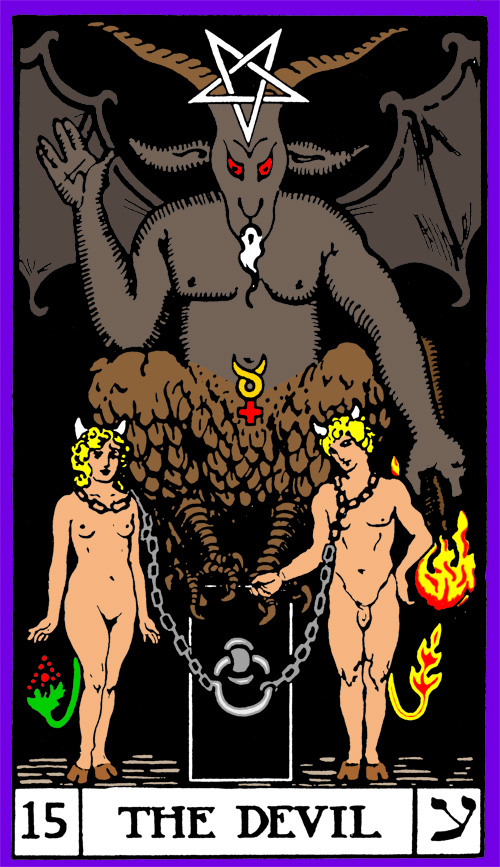
This is the Devil Key. The horned figure holds up his hand to say, “What you see is all there is.” And the beast-like humans could easily remove their chains but don’t want to.

There’s a scene in Pulp Fiction where Vincent Vega complains to his heroin dealer that someone keyed his immaculately restored ’57 Chevy. He says, ” I wish I could have caught him doing it. It would have been WORTH having him do it, just so I could catch him.” This is a person caught up (willingly) in his lower animal nature. It’s where you voluntarily induce an itch just so you can have the pleasure of scratching it.

vega

Posted in Lessons | Leave a comment

Love Your Enemies

respect

by Michael Maciel

There’s a popular saying in New Thought that says, “Where attention goes, energy flows.”

“Love,” more than anything else, means “attention.”

In the movie “Avatar,” the beings of Pandora greeted each other by saying, “I see you.” Each encounter began with both parties fully acknowledging the being-ness of the other.

I felt that it was a better greeting than “Namaste,” which means, “I bow to the god within you,” because it didn’t bypass the person. “I see YOU,” not some abstract notion or my idea of deity.

Similarly, martial artists greet each other on the sparring floor, and for those who practiced true Christian Chivalry, on the battlefield as well.

“I SEE you, my enemy. I’m not going to pretend that you are less than human, that I am intrinsically better than you, or that your cause, in your own eyes, is not just.”

English has no word for this kind of love. “Respect” comes close, but it doesn’t quite encompass divinity.


Join the conversation on our Facebook Group, Mystical Bible Interpretation.

Posted in Lessons | 2 Comments

World Priest, by Michael Maciel

WP-web

Finally, the book I thought would never get published is available on Amazon!

World Priest took over two years to write, which is typical (I imagine) for most non-fiction books. Now that it’s completed, I feel a huge weight lifted off of my shoulders. I can’t tell you how many times I have gone over it, trying to make sure that it says what I want it to say. The Priesthood is not an easy topic, and I know that a lot of people will be surprised by what I have to say about it—what it is, what it isn’t, and what it can be.

I wrote it with one basic premise in mind:

Priests are born, not made.

If you have “priest” written on your soul, you know that you were born to DO something. You know that you have a mission to accomplish. And you won’t feel fulfilled until you know what it is. This book will not only help you discover whether you are a priest, it will show you how to FUNCTION as a priest.

What is a priest? A priest is one who is committed to raising world consciousness. Let me repeat that: A PRIEST IS A PERSON WHO IS COMMITTED TO RAISING WORLD CONSCIOUSNESS.

Is that you?

If so, whatever field you are in, whether it’s public service, business, science, education, medicine, clergy, technology, or whatever, raising world consciousness is your passion.

This book will help you focus your passion. And it will give you TOOLS to get the job done.

Do you feel it? Do you sense that there are people from all over the world gathering in spirit, gathering to make the presence of God a living reality on this planet? Are you one of them? You owe it to yourself and the rest of the world to find out.

Read this book. Find out who and what you really are!


Books by Michael Maciel

WP-web

World Priest—Bringing Heaven to Earth

World Priest—Kindle Edition

Five Vows front cover copy

The Five Vows—Raising Your Spiritual Commitment to the Next Level


Posted in Lessons | Leave a comment